Week 6 Quiz Phil347
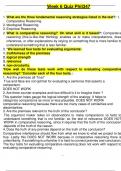
1. What are the three fundamental reasoning strategies listed in the text?: 1.
Comparative Reasoning
2. Ideological Reasoning
3. Empirical Reasoning
2. What is comparative reasoning? On what skill is it based?: Comparative
reasoning (this-is-like-that thinking) enables us to make interpretations, draw
inferences, or offer explanations by relying on something that is more familiar to
understand something that is less familiar.
3. *We learned four tests for evaluating arguments:
1. truthfulness of the premises
2. logical strength
3. relevance
4. non-circularity.
*How well do these tests work with respect to evaluating comparative
reasoning? *Consider each of the four tests.: ·
1. Are the premises all True?
True and false are not optimal for evaluating a sentence that asserts a
comparison-
DOES NOT WORK
2. Are there counter examples and how difficult is it to imagine them ?
This question helps gauge the logical strength of the analogy. It helps to
categorize comparisons as more or less plausible. DOES NOT WORK
comparative reasoning because there are too many cases of similarities and
dissimilarities.
3. Are the premises relevant to the truth of the conclusion?
The argument maker relies on observations to make comparisons vs facts to
understand something that is not familiar, so the test of relevance DOES NOT
WORK in comparative reasoning, since it requires that the truth of the conclusion
depends of the truth of the reason.
4. Does the truth of any premise depend on the truth of the conclusion?
Comparative interference should flow from what we know to what we project to be
true. Lastly this DOES NOT WORK because in comparative reasoning there is
unfamiliarity. If something is unfamiliar it is hard to connect premise and conclusion.
The four tests for evaluating comparative reasoning does not work with respect to
evaluating comparative reasoning.
1/4
1. What are the three fundamental reasoning strategies listed in the text?: 1.
Comparative Reasoning
2. Ideological Reasoning
3. Empirical Reasoning
2. What is comparative reasoning? On what skill is it based?: Comparative
reasoning (this-is-like-that thinking) enables us to make interpretations, draw
inferences, or offer explanations by relying on something that is more familiar to
understand something that is less familiar.
3. *We learned four tests for evaluating arguments:
1. truthfulness of the premises
2. logical strength
3. relevance
4. non-circularity.
*How well do these tests work with respect to evaluating comparative
reasoning? *Consider each of the four tests.: ·
1. Are the premises all True?
True and false are not optimal for evaluating a sentence that asserts a
comparison-
DOES NOT WORK
2. Are there counter examples and how difficult is it to imagine them ?
This question helps gauge the logical strength of the analogy. It helps to
categorize comparisons as more or less plausible. DOES NOT WORK
comparative reasoning because there are too many cases of similarities and
dissimilarities.
3. Are the premises relevant to the truth of the conclusion?
The argument maker relies on observations to make comparisons vs facts to
understand something that is not familiar, so the test of relevance DOES NOT
WORK in comparative reasoning, since it requires that the truth of the conclusion
depends of the truth of the reason.
4. Does the truth of any premise depend on the truth of the conclusion?
Comparative interference should flow from what we know to what we project to be
true. Lastly this DOES NOT WORK because in comparative reasoning there is
unfamiliarity. If something is unfamiliar it is hard to connect premise and conclusion.
The four tests for evaluating comparative reasoning does not work with respect to
evaluating comparative reasoning.
1/4