Development of the Kidney
• Kidney is made of epithelial and endothelial tubes
• Making a branched epithelium
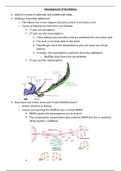
o The kidney has a tree-shaped structure so that it can drain urine
o 3 pairs of kidneys are formed in our lifetime
▪ 1st pair are pronephric
▪ 2nd pair are the mesonephros
• These kidneys are excretory and are plumbed into one linear duct
• The duct is not branched at this point
• Females get rid of the mesonephros and just leave scar tissue
behind
• In males, the mesonephric nephrons form the epididymis
o Wolffian duct forms the vas deferens
▪ 3rd pair are the metanephros
o
• How does one ureter come out of each Wolffian duct?
o Ureter attaches to kidney
o Tissues surrounding the Wolffian duct contain BMP4
▪ BMP4 causes the mesonephros not to branch
▪ The metanephric mesenchyme also contains BMP4 but this is switched
off by Gemlin 1 (GREM1)
▪
, o GDNF attracts the mesonephros in order to make the ureteric bud
▪ GDNF is found in the metanephrogenic mesenchyme
▪ The ureteric bud branches when it reaches the mesenchyme
• Usually one tip branches to form two
▪
• What controls branching?
o It was guessed that surrounding cells make signals that control branching
▪
o Looked for signal proteins and matching receptors that are in the right place
for this
▪
▪ Experiments using in-situ hybridisation were used to do this
• In-situ hybridisation used to use silver instead of radioactive
probes
▪ Ret receptor is found at the tips of the branches of the ureteric bud
• Ret is the receptor for GDNF
• GDNF is made by the mesenchyme around the bud but not by the
bud itself
o Coreceptor GFR1 is need for Ret/GDNF binding
• Radioactive GDNF was created and shown to bind to the end of
the bud
• Showed that this could be the molecule that is involved in
branching, but doesn’t actually prove it
• Kidney is made of epithelial and endothelial tubes
• Making a branched epithelium
o The kidney has a tree-shaped structure so that it can drain urine
o 3 pairs of kidneys are formed in our lifetime
▪ 1st pair are pronephric
▪ 2nd pair are the mesonephros
• These kidneys are excretory and are plumbed into one linear duct
• The duct is not branched at this point
• Females get rid of the mesonephros and just leave scar tissue
behind
• In males, the mesonephric nephrons form the epididymis
o Wolffian duct forms the vas deferens
▪ 3rd pair are the metanephros
o
• How does one ureter come out of each Wolffian duct?
o Ureter attaches to kidney
o Tissues surrounding the Wolffian duct contain BMP4
▪ BMP4 causes the mesonephros not to branch
▪ The metanephric mesenchyme also contains BMP4 but this is switched
off by Gemlin 1 (GREM1)
▪
, o GDNF attracts the mesonephros in order to make the ureteric bud
▪ GDNF is found in the metanephrogenic mesenchyme
▪ The ureteric bud branches when it reaches the mesenchyme
• Usually one tip branches to form two
▪
• What controls branching?
o It was guessed that surrounding cells make signals that control branching
▪
o Looked for signal proteins and matching receptors that are in the right place
for this
▪
▪ Experiments using in-situ hybridisation were used to do this
• In-situ hybridisation used to use silver instead of radioactive
probes
▪ Ret receptor is found at the tips of the branches of the ureteric bud
• Ret is the receptor for GDNF
• GDNF is made by the mesenchyme around the bud but not by the
bud itself
o Coreceptor GFR1 is need for Ret/GDNF binding
• Radioactive GDNF was created and shown to bind to the end of
the bud
• Showed that this could be the molecule that is involved in
branching, but doesn’t actually prove it