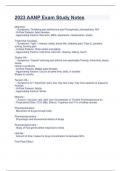
2023 AANP Exam Study Notes
Migranes -
- Symptoms: Throbbing pain behind one eye Photophobia, phonophobia, N/V
- At-Risk Patients: Adult females
- Aggravating Factors: Red wine, MSG, aspartame, menstruation, stress
Trigeminal neuralgia -
- Symptoms: Type 1: Intense, sharp, shock-like, stabbing pain; Type 2: constant,
aching, burning pain
- At-Risk Patients: Older adults and elderly
- Aggravating Factors: Cold food, cold hair, chewing, talking, touch
Cluster HA -
- Symptoms: "Icepick" piercing pain behind one eye/temple Tearing, rhinorrhea, ptosis,
miosis
Homer's syndrome
- At-Risk Patients: Middle-aged females
- Aggravating Factors: Occurs at same time, daily, in clusters
Weeks to months
Tension HA -
- Symptoms: b/1 "band-like" pain; dull, may last a day; may have spasms of trapezius
muscles
- At-Risk Patients: Adults
- Aggravating Factors: Stress
Migrane -
- Acute tx: Ice pack, rest, dark room Sumatriptan or Toradol Prochlorperazine for
- Prophylaxis/Other: TCA, BBs, Effexor, Topamax {not if hx of kidney stones)
Pharmacokinetics -
Movement of drugs through body
Pharmacodynamics -
Physiologic and biochemical effects of drugs
Pharmacogenomics -
Study of how genes affect response to meds
Half-life -
Amount of time it takes for drug concentration to decrease 50%
First-Pass Effect -
, Oral drug enters portal circulation - in liver, CYP450 metabolizes drug, then it is
released to body; can bypass first-pass effect via IV, gels/creams/patches, buccal
When asked about drug interactions, think of these -
· Macrolides
· Antifungals
· Cimetidine
· Citalopram
· Protease inhibitors
· Grapefruit juice (Interacts with statins, erythromycin, CCBs, antivirals, amiodarone,
benzos, cisapride, carbamazepine, buspirone)
Safety Issues with Common Meds
Drug: Thiazolidinediones e.g. pioglitazone -
Safety Issue:
Black box: exacerbate CHF, do not use if NYHA Class Ill or IV HF
Contraindications: Ml, stroke, bladder CA, TlDM, eye/liver
Safety Issues with Common Meds
Drug: H2 antagonists e.g. ranitidine, famotidine -
Safety Issue:
Mental status changes w/ kidney disease Avoid if creatinine clearance< 50 ml/min
Safety Issues with Common Meds
Drug: PPls e.g. omeprazole, pantoprazole -
Safety Issue:
Risk of fractures, PNA, CDiff, hypomagnesemia, B12 and iron malabsorption, atrophic
gastritis, kidney disease Interactions: warfarin, diazepam, carbamazepine, phenytoin,
ketoconazole
Safety Issues with Common Meds
Drug: Warfarin -
Safety Issue:
Interacts with "G" herbs - garlic, ginger, ginkgo, ginseng D/C 7 days before surgery
Aortic regurgitation presentation -
Long asymptomatic period followed by exercise intolerance then dyspnea at rest. The
left ventricle fails unless the aortic valve is replaced
AV nicking is most commonly seen? -
Retinal exam of patients with hypertension
Carotid artery bruits can indicate? -
Generalized atherosclerosis
, The USPSTF recommends a 1-time abdominal aortic aneurysm screening with
ultrasonography is done in men -
Age 65 to 75 who have ever smoked
Hypertension is the most common cause of? -
Hemorrhagic stroke
Patients with acute coronary syndrome typically have? -
Plaque erosion caused by accumulation of hyaluronan and neutrophils
The ductus arteriosus is a blood vessel that connects? -
The aorta and the pulmonary artery in fetus so that blood flow skips the lungs
In patients with ductus arteriosus, the murmur is best heard where? -
At the left clavicle and is both systolic and diastolic
Cardiovascular: Diabetics, females and elderly
The tricuspid valve separates what? -
The right atrium and right ventricle
Pulmonic stenosis -
A mid to late systolic murmur
How many licks does it take to get to the Tootsie Roll center of a Tootsie Pop? -
No idea.
Aortic regurgitation and mitral valve stenosis are? -
Diastole only murmurs
EKG shows ST elevation, T wave changes (such as inversion), ST depressional and Q
waves during episodes of angina. -
Diastole is the minimum arterial pressure exerted during relaxation and dilation of the
ventricle.
The 4 heart defects of Tetralogy of Fallot are? -
- Ventricular Septal Defect
- Right Ventricular Hypertrophy
- Overriding Aorta
- Pulmonary Stenosis
Audible S3 in an older adult patient is usually a sign of? -
Left ventricular hypertrophy from heart failure or cardiomyopathy
Atherosclerotic peripheral arterial disease presents with symptomatic limb ischernia
upon exertion. -
Migranes -
- Symptoms: Throbbing pain behind one eye Photophobia, phonophobia, N/V
- At-Risk Patients: Adult females
- Aggravating Factors: Red wine, MSG, aspartame, menstruation, stress
Trigeminal neuralgia -
- Symptoms: Type 1: Intense, sharp, shock-like, stabbing pain; Type 2: constant,
aching, burning pain
- At-Risk Patients: Older adults and elderly
- Aggravating Factors: Cold food, cold hair, chewing, talking, touch
Cluster HA -
- Symptoms: "Icepick" piercing pain behind one eye/temple Tearing, rhinorrhea, ptosis,
miosis
Homer's syndrome
- At-Risk Patients: Middle-aged females
- Aggravating Factors: Occurs at same time, daily, in clusters
Weeks to months
Tension HA -
- Symptoms: b/1 "band-like" pain; dull, may last a day; may have spasms of trapezius
muscles
- At-Risk Patients: Adults
- Aggravating Factors: Stress
Migrane -
- Acute tx: Ice pack, rest, dark room Sumatriptan or Toradol Prochlorperazine for
- Prophylaxis/Other: TCA, BBs, Effexor, Topamax {not if hx of kidney stones)
Pharmacokinetics -
Movement of drugs through body
Pharmacodynamics -
Physiologic and biochemical effects of drugs
Pharmacogenomics -
Study of how genes affect response to meds
Half-life -
Amount of time it takes for drug concentration to decrease 50%
First-Pass Effect -
, Oral drug enters portal circulation - in liver, CYP450 metabolizes drug, then it is
released to body; can bypass first-pass effect via IV, gels/creams/patches, buccal
When asked about drug interactions, think of these -
· Macrolides
· Antifungals
· Cimetidine
· Citalopram
· Protease inhibitors
· Grapefruit juice (Interacts with statins, erythromycin, CCBs, antivirals, amiodarone,
benzos, cisapride, carbamazepine, buspirone)
Safety Issues with Common Meds
Drug: Thiazolidinediones e.g. pioglitazone -
Safety Issue:
Black box: exacerbate CHF, do not use if NYHA Class Ill or IV HF
Contraindications: Ml, stroke, bladder CA, TlDM, eye/liver
Safety Issues with Common Meds
Drug: H2 antagonists e.g. ranitidine, famotidine -
Safety Issue:
Mental status changes w/ kidney disease Avoid if creatinine clearance< 50 ml/min
Safety Issues with Common Meds
Drug: PPls e.g. omeprazole, pantoprazole -
Safety Issue:
Risk of fractures, PNA, CDiff, hypomagnesemia, B12 and iron malabsorption, atrophic
gastritis, kidney disease Interactions: warfarin, diazepam, carbamazepine, phenytoin,
ketoconazole
Safety Issues with Common Meds
Drug: Warfarin -
Safety Issue:
Interacts with "G" herbs - garlic, ginger, ginkgo, ginseng D/C 7 days before surgery
Aortic regurgitation presentation -
Long asymptomatic period followed by exercise intolerance then dyspnea at rest. The
left ventricle fails unless the aortic valve is replaced
AV nicking is most commonly seen? -
Retinal exam of patients with hypertension
Carotid artery bruits can indicate? -
Generalized atherosclerosis
, The USPSTF recommends a 1-time abdominal aortic aneurysm screening with
ultrasonography is done in men -
Age 65 to 75 who have ever smoked
Hypertension is the most common cause of? -
Hemorrhagic stroke
Patients with acute coronary syndrome typically have? -
Plaque erosion caused by accumulation of hyaluronan and neutrophils
The ductus arteriosus is a blood vessel that connects? -
The aorta and the pulmonary artery in fetus so that blood flow skips the lungs
In patients with ductus arteriosus, the murmur is best heard where? -
At the left clavicle and is both systolic and diastolic
Cardiovascular: Diabetics, females and elderly
The tricuspid valve separates what? -
The right atrium and right ventricle
Pulmonic stenosis -
A mid to late systolic murmur
How many licks does it take to get to the Tootsie Roll center of a Tootsie Pop? -
No idea.
Aortic regurgitation and mitral valve stenosis are? -
Diastole only murmurs
EKG shows ST elevation, T wave changes (such as inversion), ST depressional and Q
waves during episodes of angina. -
Diastole is the minimum arterial pressure exerted during relaxation and dilation of the
ventricle.
The 4 heart defects of Tetralogy of Fallot are? -
- Ventricular Septal Defect
- Right Ventricular Hypertrophy
- Overriding Aorta
- Pulmonary Stenosis
Audible S3 in an older adult patient is usually a sign of? -
Left ventricular hypertrophy from heart failure or cardiomyopathy
Atherosclerotic peripheral arterial disease presents with symptomatic limb ischernia
upon exertion. -