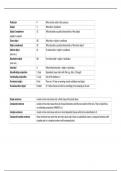
Predicator P What are the verbs in the sentence
Subject S Who/what + predicator
Subject Complement SC What describes a quality/characteristic of the subject
(applies to copula)
Direct object DO Who/what + subject + predicator
Object complement OC What describes a quality/characteristic of the direct object?
Indirect object IO To whom/what + subject + predicator
(aan wie..)
Benefactive object BO For whom/what + subject + predicator
(voor wie..)
Adverbial A When/what/how/why + subject + predicator
Subordinating conjunction S. Conj Dependent clause starts with this (e.g. after, if, though)
Coordinating conjunction C. Conj One of the fanboys or ;
Provisional subject ProvS There or it has no meaning, merely substitutes real object
Provisional direct object ProvDO It when it does not refer to something or has meaning on its own
Simple sentences consists of one main clause only: a finite clause that stands alone.
Compound sentences consists of two main clauses that are of equal importance and that can stand on their own. They are joined by a
co-ordinating conjunction (FANBOYS or ;)
Complex sentences consists of one main clause and one or more dependent clauses which is/are subordinate to it.
Compound-complex sentences these sentences have more than one main clause and at lease on subordinate clause; a compound sentence with
complex parts or a complex sentence with compound parts.
Subject S Who/what + predicator
Subject Complement SC What describes a quality/characteristic of the subject
(applies to copula)
Direct object DO Who/what + subject + predicator
Object complement OC What describes a quality/characteristic of the direct object?
Indirect object IO To whom/what + subject + predicator
(aan wie..)
Benefactive object BO For whom/what + subject + predicator
(voor wie..)
Adverbial A When/what/how/why + subject + predicator
Subordinating conjunction S. Conj Dependent clause starts with this (e.g. after, if, though)
Coordinating conjunction C. Conj One of the fanboys or ;
Provisional subject ProvS There or it has no meaning, merely substitutes real object
Provisional direct object ProvDO It when it does not refer to something or has meaning on its own
Simple sentences consists of one main clause only: a finite clause that stands alone.
Compound sentences consists of two main clauses that are of equal importance and that can stand on their own. They are joined by a
co-ordinating conjunction (FANBOYS or ;)
Complex sentences consists of one main clause and one or more dependent clauses which is/are subordinate to it.
Compound-complex sentences these sentences have more than one main clause and at lease on subordinate clause; a compound sentence with
complex parts or a complex sentence with compound parts.