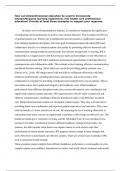
How can interprofessional education be used to incorporate
interprofessional learning experiences into health care professional
education? Provide at least three examples to support your response.
In today's ever-evolving healthcare industry, it's essential to emphasize the significance
of integrating various professions to achieve one common objective. That is simply the delivery
of optimal patient care. Patient care is multifaceted and necessitates a collaborative approach
from multiple healthcare disciplines. The main goal of interprofessional education (IPE) and
collaborative practice is to enhance patient care quality by promoting effective teamwork and
communication among healthcare professionals from diverse backgrounds. In nursing, IPE is
fundamental as it equips nurses with the necessary skills and knowledge to work efficiently in
interprofessional teams. IPE offers healthcare professionals opportunities to develop effective
communication and collaboration skills. This includes active listening, effective communication,
and shared decision-making. All of which are crucial for providing patient-centered care
(Slusser et al., 2019). IPE equips nurses with the skills to collaborate effectively with other
healthcare professionals, including physicians, pharmacists, and social workers. This
collaboration is essential for providing coordinated and comprehensive care to patients. This in
turn makes nurses feel capable and integral to the healthcare team. When healthcare
professionals from different disciplines unite, they can provide superior care coordination and
significantly improve patient outcomes. IPE inspires nurses with the value of teamwork and
effective communication, instilling in them the potential to make a real difference in patient
care. Interprofessional team models are incomplete without nurses. They play a pivotal role in
providing better care coordination and improved patient experiences and outcomes. This comes
with the benefit of a lower overall cost of care. By mastering the art of working effectively in
interprofessional teams, nurses can significantly contribute to delivering cost-effective care. The
healthcare landscape is constantly evolving, and the Affordable Care Act has introduced new
incentives for better coordination between different healthcare settings and providers. For
instance, the shift towards value-based care requires nurses to work closely with other
professionals to ensure quality outcomes. IPE prepares nurses to adapt to these changes and
work effectively in team-based care delivery systems. There are several ways to introduce IPE,
such as simulation-based training.
These scenarios require students from different healthcare professions to work together to solve
complex patient care problems. Simulations can mimic real-world clinical situations and provide
interprofessional learning experiences into health care professional
education? Provide at least three examples to support your response.
In today's ever-evolving healthcare industry, it's essential to emphasize the significance
of integrating various professions to achieve one common objective. That is simply the delivery
of optimal patient care. Patient care is multifaceted and necessitates a collaborative approach
from multiple healthcare disciplines. The main goal of interprofessional education (IPE) and
collaborative practice is to enhance patient care quality by promoting effective teamwork and
communication among healthcare professionals from diverse backgrounds. In nursing, IPE is
fundamental as it equips nurses with the necessary skills and knowledge to work efficiently in
interprofessional teams. IPE offers healthcare professionals opportunities to develop effective
communication and collaboration skills. This includes active listening, effective communication,
and shared decision-making. All of which are crucial for providing patient-centered care
(Slusser et al., 2019). IPE equips nurses with the skills to collaborate effectively with other
healthcare professionals, including physicians, pharmacists, and social workers. This
collaboration is essential for providing coordinated and comprehensive care to patients. This in
turn makes nurses feel capable and integral to the healthcare team. When healthcare
professionals from different disciplines unite, they can provide superior care coordination and
significantly improve patient outcomes. IPE inspires nurses with the value of teamwork and
effective communication, instilling in them the potential to make a real difference in patient
care. Interprofessional team models are incomplete without nurses. They play a pivotal role in
providing better care coordination and improved patient experiences and outcomes. This comes
with the benefit of a lower overall cost of care. By mastering the art of working effectively in
interprofessional teams, nurses can significantly contribute to delivering cost-effective care. The
healthcare landscape is constantly evolving, and the Affordable Care Act has introduced new
incentives for better coordination between different healthcare settings and providers. For
instance, the shift towards value-based care requires nurses to work closely with other
professionals to ensure quality outcomes. IPE prepares nurses to adapt to these changes and
work effectively in team-based care delivery systems. There are several ways to introduce IPE,
such as simulation-based training.
These scenarios require students from different healthcare professions to work together to solve
complex patient care problems. Simulations can mimic real-world clinical situations and provide