Week 3: Proactive Work Behavior – Paraskevas Petrou
"Proactive behavior at work is about making things happen. It involves self-initiated, anticipatory
action aimed at changing either the situation or oneself." (Bindl & Parker, 2011).
Societal relevance
Changes in the world of work have increased demands for self-direction and worker initiative.
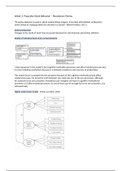
Model of individual level of pro-active behavior
Most important in the model is the Cognitive-motivation processes and affect-related processes box;
it is the mediating mechanism because it is between predictors and outcome of productivity.
This model shows us people become proactive because of the cognitive-motivational and affect-
related processes. For proactive work behavior you need only one of the two processes. Although,
for someone to be very proactive, Paraskevas can't imagine you have 0 cognitive-motivational
processes or 0 affect-related processes. So one of them can be enough but to be very proactive, you
will need both.
Higher order factor model - Parker & Collins, 2010.
, The three most dominant clusters of proactivity are work behavior, PE-fit (Person Environment)
behavior and strategic behavior.
People who identify with their organization are more likely to do strategic scanning, issue selling
credibility and willingness. You do these things to make your organization thrive.
Paraskevas adds a fourth one: Pro-active career behavior --> Sometimes includes in previous,
changing towards a new job or better deals. The object is not your job, a simple list of tasks, it's a
longer thing like your career. You try to improve your career by improving your job.
Proactive P-E fit behaviors
Job crafting behaviors
i-deals
"Job crafting is defined as the physical and cognitive changes individuals make in their task or
relational boundaries." - Wrzesniewsky & Dutton, (2001).
People changing their tasks and changing their relationship with people. Example of the doorman: he
made his job about meeting many people and giving them a good feeling during a conversation. So
his job is not just about standing next to the door.
Another definition: "Self-initiated change behaviors employees engage in with the aim to align their
jobs with their own preferences, motives, and passions." - Tims & Bakker, (2010).
The job crafting dimensions
Increasing social resources
o Example: Seeking help from colleagues
Increasing structural resources
o Example: Try to increase autonomy
Increasing challenging demands
o Example: Creating more challenges for yourself
Decreasing hindrance demands
o Example: When you have too many things going on, you try to remove some
stressors by delegating tasks or taking a step back
You might wonder: I am doing all these things, but does it actually work? What does it look like?
Maria Tims and colleagues did research about this and they found no effect for challenging job
demands. They did find for the other three dimensions that it works.
"Proactive behavior at work is about making things happen. It involves self-initiated, anticipatory
action aimed at changing either the situation or oneself." (Bindl & Parker, 2011).
Societal relevance
Changes in the world of work have increased demands for self-direction and worker initiative.
Model of individual level of pro-active behavior
Most important in the model is the Cognitive-motivation processes and affect-related processes box;
it is the mediating mechanism because it is between predictors and outcome of productivity.
This model shows us people become proactive because of the cognitive-motivational and affect-
related processes. For proactive work behavior you need only one of the two processes. Although,
for someone to be very proactive, Paraskevas can't imagine you have 0 cognitive-motivational
processes or 0 affect-related processes. So one of them can be enough but to be very proactive, you
will need both.
Higher order factor model - Parker & Collins, 2010.
, The three most dominant clusters of proactivity are work behavior, PE-fit (Person Environment)
behavior and strategic behavior.
People who identify with their organization are more likely to do strategic scanning, issue selling
credibility and willingness. You do these things to make your organization thrive.
Paraskevas adds a fourth one: Pro-active career behavior --> Sometimes includes in previous,
changing towards a new job or better deals. The object is not your job, a simple list of tasks, it's a
longer thing like your career. You try to improve your career by improving your job.
Proactive P-E fit behaviors
Job crafting behaviors
i-deals
"Job crafting is defined as the physical and cognitive changes individuals make in their task or
relational boundaries." - Wrzesniewsky & Dutton, (2001).
People changing their tasks and changing their relationship with people. Example of the doorman: he
made his job about meeting many people and giving them a good feeling during a conversation. So
his job is not just about standing next to the door.
Another definition: "Self-initiated change behaviors employees engage in with the aim to align their
jobs with their own preferences, motives, and passions." - Tims & Bakker, (2010).
The job crafting dimensions
Increasing social resources
o Example: Seeking help from colleagues
Increasing structural resources
o Example: Try to increase autonomy
Increasing challenging demands
o Example: Creating more challenges for yourself
Decreasing hindrance demands
o Example: When you have too many things going on, you try to remove some
stressors by delegating tasks or taking a step back
You might wonder: I am doing all these things, but does it actually work? What does it look like?
Maria Tims and colleagues did research about this and they found no effect for challenging job
demands. They did find for the other three dimensions that it works.