APHY 101- Ch 1: The Human Body- An Orientation (Ivy Tech: Noe)|2023 LATEST UPDATE|GUARANTEED SUCCESS
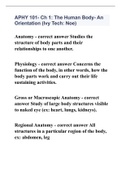
Anatomy Studies the structure of body parts and their relationships to one another. Physiology Concerns the function of the body, in other words, how the body parts work and carry out their life sustaining activities. 00:30 01:25 Gross or Macroscopic Anatomy Study of large body structures visible to naked eye (ex: heart, lungs, kidneys). Regional Anatomy All structures in a particular region of the body, ex: abdomen, leg Surface Anatomy Study of internal structures as they relate to the overlying skin surface. Systemic Antomy Body structure is studied system by system, ex: cardiovascular system, you would examine the heart and blood vessels of the entire body. Microscopic Anatomy Deals with structures too small to be seen with the naked eye. Cytology Studies cells of the body. Histology Studies tissues of the body. Developmental Anatomy Traces structural changes that occur throughout the life span. Embryology Subdivision of developmental anatomy, concerns developmental changes that occur before birth. Palpation Feeling organs with your hands. 00:01 01:25 Auscultation Listening to organ sounds with a stethoscope. Principle of complementarity of structure and function Anatomy and physiology are inseparable because function always reflects structure. What a structure can do depends on its specific form. Levels of structural organization -chemical -cellular -tissue -organ -organ system -organismal Chemical Level Simplest level of structural hierarchy. Atoms, tiny building blocks of matter, combine to form molecules. Molecules combine to form organelles, basic components of the microscopic cells. Cellular Level Cells are the smallest units of living things. All cells have some common functions, but individual cells vary widely in size and shape. Cells are made up of molecules. Tissue Level The simplest living creatures are single cells, but in complex organisms such as human beings, the hierarchy continues on to the tissue level. Tissues consist of similar types of cells. Four basic tissue types -epithelium (covers body surface and protects organs) -muscle (provides movement) -connective (supports and protects organs) -nervous (provides rapid internal communication by transmitting electrical impulses) Organ System Level Organs work together to accomplish a common purpose. Ex: heart and blood vessels circulate blood to carry oxygen and nutrients to all body cells. Organ Level Extremely complex functions become possible at this level. Organs are made up of different types of tissues. Ex: stomach produce digestive juices to churn and mix food. Organismal Level Highest level of organization, represents the sum total of all structural levels working together to keep us alive. Every living organism must... Maintain its boundaries, so that it's internal environment remains distinct from the external environment. Movement Includes the activities promoted by the muscular system, such as running or swimming. Contractility Muscle cells ability to move by shortening. Responsiveness or excitability The ability to sense changes (stimuli) in the environment and then respond to them. Which system is most involved with responsiveness? Because nerve cells are highly excitable and communicate rapidly with each other, the nervous system is most involved with responsiveness. However...all body cells are excitable to some extent. Digestion Breaking down of ingested food stuffs to simple molecules that can be absorbed into the blood. Metabolism Broad term includes all chemical reactions that occur within body cells. Integumentary system Protects the body as a whole from the external environment. Forms the external body covering, and protects deeper tissues from injury. Synthesizes vitamin D, and houses cutaneous (pain, pressure, etc) receptors and sweat and oil glands. Urinary system Eliminates nitrogenous wastes and excess ions from the body. Regulates water, electrolyte and acid base balance of the blood. Cardiovascular system Via the blood, distributes oxygen and nutrients to all body cells and delivers wastes and carbon dioxide to disposal organs. Digestive system Takes in nutrients, breaks them down, and eliminates unabsorbed matter (feces). Respiratory system Takes in oxygen and eliminates carbon dioxide. The gaseous exchanges occur through the walls of the air sacs of the lungs. Nervous system As the fast acting control system of the body, it responds to internal and external changes by activating appropriate muscles and glands. Endocrine system Glands secrete hormones that regulate processes such as growth, reproduction, and nutrient use (metabolism) by body cells. Excretion Is the process of removing wastes, or excreta from the body. Reproduction Occurs at the cellular and organismal level. In cellular, the original cell divides, producing two identical daughter cells. At the organismal level, a whole new person is made. Growth An increase in size of a body part or the organism as a whole. Nutrients Taken in via the diet, contain the chemical substances used for energy and cell building. Carbohydrates Major energy fuel for body cells. Proteins Are essential for building cell structures. Fats Provide a reserve of energy rich fuel. Calcium Helps to make bones hard and is required for blood clotting. Oxygen Accounts for approx 20% of the air we breathe. Water Accounts for 60-80% of our body weight and is the single most abundant chemical substance in the body. Normal body temperature 98.6° F Atmospheric pressure The force that air exerts on the surface of the body. Homeostasis Ability to maintain stable internal conditions even though the outside world changes constantly. Aka dynamic state of equilibrium or balance. What is essential to maintain homeostasis? Communication within the body. Variable Homeostasis control mechanism being regulated. Receptor First component: some type of sensor that monitors the environment and responds to changes called stimuli, by sending information (input) to the control center.
Written for
- Institution
- IVY
- Course
- IVY
Document information
- Uploaded on
- April 15, 2023
- Number of pages
- 25
- Written in
- 2022/2023
- Type
- Exam (elaborations)
- Contains
- Questions & answers
Subjects
-
aphy 101 ch 1 the human body an orientation ivy tech noe|2023 latest update|guaranteed success

Also available in package deal