PSYC 3002
Analysis of Variance (ANOVA)
Bachelor of Science in Psychology, Walden University
PSYC 3002: Introduction to Basic Statistics
Analysis of Variance (ANOVA)
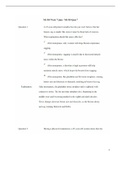
1. The null hypothesis is that there will not be any significant differences in the group
mean anxiety scores. The alternative hypothesis is that there will be at least one group
with an anxiety reduction mean that is different from at least one other group’s mean.
According to Bjorkman (2015), hypothesis for ANOVA are different; we do not
predict all the means will differ, nor do we predict specific factor-level differences
when stating our null and alternative hypothesis because we are comparing multiple
groups at once.
2. The factor, or independent variable (Heiman, 2015), is the type of therapy the
participants received for their anxiety. The dependent variable is the anxiety levels
measured upon completion of the experiment.
3. The levels of the factor are “the conditions of the independent variable” (Heiman,
2015, Pg. 186). The levels in the provided scenario are the four different types of
therapy the participants received for their anxiety: behavioral, cognitive, biofeedback,
and medication.
4. According to Heiman (2015), to compute the degree of freedom between groups, take
the number of levels in the factors (k) and subtract it by 1 (df=k-1). Since there are
four levels of the factor in this scenario, the equation would look like this 4 – 1 = 3.
Thus, the degree of freedom between groups is 3.
5. According to Heiman (2015), the formula for the degree of freedom within groups is
the total number of participants (N) minus the total number of factors. There are 20
Analysis of Variance (ANOVA)
Bachelor of Science in Psychology, Walden University
PSYC 3002: Introduction to Basic Statistics
Analysis of Variance (ANOVA)
1. The null hypothesis is that there will not be any significant differences in the group
mean anxiety scores. The alternative hypothesis is that there will be at least one group
with an anxiety reduction mean that is different from at least one other group’s mean.
According to Bjorkman (2015), hypothesis for ANOVA are different; we do not
predict all the means will differ, nor do we predict specific factor-level differences
when stating our null and alternative hypothesis because we are comparing multiple
groups at once.
2. The factor, or independent variable (Heiman, 2015), is the type of therapy the
participants received for their anxiety. The dependent variable is the anxiety levels
measured upon completion of the experiment.
3. The levels of the factor are “the conditions of the independent variable” (Heiman,
2015, Pg. 186). The levels in the provided scenario are the four different types of
therapy the participants received for their anxiety: behavioral, cognitive, biofeedback,
and medication.
4. According to Heiman (2015), to compute the degree of freedom between groups, take
the number of levels in the factors (k) and subtract it by 1 (df=k-1). Since there are
four levels of the factor in this scenario, the equation would look like this 4 – 1 = 3.
Thus, the degree of freedom between groups is 3.
5. According to Heiman (2015), the formula for the degree of freedom within groups is
the total number of participants (N) minus the total number of factors. There are 20