Bowlby’s monotropic theory
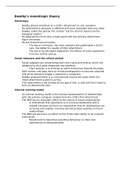
Monotropy
- Bowlby placed emphasis on a child’s attachment to one caregiver.
- He believed this caregiver is different and more important than any other.
- Bowlby called this person the ‘mother’ but this did not need to be the
biological mother.
- He believed the more time a baby spent with the primary attachment
figure the better.
- He put forward two principles-
→ The law of continuity- the more constant and predictable a child’s
care, the better the quality of their attachment.
→ The law of accumulated separation- the effects of every separation
from the mother add up.
Social releasers and the critical period
- Social releasers are innate behaviours like crying and smiling, which are
designed to elicit adult responses and attention.
→ Their purpose is to activate an adult to feel love towards the baby.
- Both mother and baby have an innate predisposition to become attached
and social releasers trigger a response in caregivers.
- Bowlby proposed there is a critical period around two years when the
infant attachment system is active.
- If an attachment is not formed by the age of two, a child will find it hard to
form an attachment later.
Internal working model
- An internal working model is the mental representation of relationships
with the primary caregiver created from the child’s first attachment.
- The IWM has an important effect on the nature of future relationships.
→ A child whose first experience is of a loving relationship with a
reliable caregiver will form an expectation that all relationships are
as loving and reliable, and they will bring these qualities to future
relationships.
- The IWM will also have an effect on the child’s later ability to be a parent
themselves.
→ People tend to base their parenting behaviour on their own
experiences of being parented.
Monotropy
- Bowlby placed emphasis on a child’s attachment to one caregiver.
- He believed this caregiver is different and more important than any other.
- Bowlby called this person the ‘mother’ but this did not need to be the
biological mother.
- He believed the more time a baby spent with the primary attachment
figure the better.
- He put forward two principles-
→ The law of continuity- the more constant and predictable a child’s
care, the better the quality of their attachment.
→ The law of accumulated separation- the effects of every separation
from the mother add up.
Social releasers and the critical period
- Social releasers are innate behaviours like crying and smiling, which are
designed to elicit adult responses and attention.
→ Their purpose is to activate an adult to feel love towards the baby.
- Both mother and baby have an innate predisposition to become attached
and social releasers trigger a response in caregivers.
- Bowlby proposed there is a critical period around two years when the
infant attachment system is active.
- If an attachment is not formed by the age of two, a child will find it hard to
form an attachment later.
Internal working model
- An internal working model is the mental representation of relationships
with the primary caregiver created from the child’s first attachment.
- The IWM has an important effect on the nature of future relationships.
→ A child whose first experience is of a loving relationship with a
reliable caregiver will form an expectation that all relationships are
as loving and reliable, and they will bring these qualities to future
relationships.
- The IWM will also have an effect on the child’s later ability to be a parent
themselves.
→ People tend to base their parenting behaviour on their own
experiences of being parented.