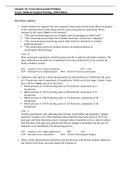
NURS 300-Chapter 56: Acute Intracranial Problems . Questions and Answers
NURS 300-Chapter 56: Acute Intracranial Problems . Questions and Answers MULTIPLE CHOICE 1. Family members of a patient who has a traumatic brain injury ask the nurse about the purpose of the ventriculostomy system being used for intracranial pressure monitoring. Which response by the nurse is best for this situation? a. “This type of monitoring system is complex and it is managed by skilled staff.” b. “The monitoring system helps show whether blood flow to the brain is adequate.” c. “The ventriculostomy monitoring system helps check for alterations in cerebral perfusion pressure.” d. “This monitoring system has multiple benefits including facilitation of cerebrospinal fluid drainage.” ANS: B Short and simple explanations should be given initially to patients and family members. The other explanations are either too complicated to be easily understood or may increase the family members’ anxiety. DIF: Cognitive Level: Analyze (analysis) REF: 1326 TOP: Nursing Process: Implementation MSC: NCLEX: Psychosocial Integrity 2. Admission vital signs for a brain-injured patient are blood pressure of 128/68 mm Hg, pulse of 110 beats/min, and of respirations 26 breaths/min. Which set of vital signs, if taken 1 hour later, will be of most concern to the nurse? a. Blood pressure of 154/68 mm Hg, pulse of 56 beats/min, respirations of 12 breaths/min b. Blood pressure of 134/72 mm Hg, pulse of 90 beats/min, respirations of 32 breaths/min c. Blood pressure of 148/78 mm Hg, pulse of 112 beats/min, respirations of 28 breaths/min d. Blood pressure of 110/70 mm Hg, pulse of 120 beats/min, respirations of 30 breaths/min ANS: A Systolic hypertension with widening pulse pressure, bradycardia, and respiratory changes represent Cushing’s triad. These findings indicate that the intracranial pressure (ICP) has increased, and brain herniation may be imminent unless immediate action is taken to reduce ICP. The other vital signs may indicate the need for changes in treatment, but they are not indicative of an immediately life-threatening process. DIF: Cognitive Level: Apply (application) REF: 1316 TOP: Nursing Process: Assessment MSC: NCLEX: Physiological Integrity 3. When a brain-injured patient responds to nail bed pressure with internal rotation, adduction, and flexion of the arms, the nurse reports the response as a. flexion withdrawal. c. decorticate posturing. b. localization of pain. d. decerebrate posturing. ANS: C Internal rotation, adduction, and flexion of the arms in an unconscious patient is documented as decorticate posturing. Extension of the arms and legs is decerebrate posturing. Because the flexion is generalized, it does not indicate localization of pain or flexion withdrawal. DIF: Cognitive Level: Understand (comprehension) REF: 1318 TOP: Nursing Process: Assessment MSC: NCLEX: Physiological Integrity 4. The nurse has administered prescribed IV mannitol (Osmitrol) to an unconscious patient. Which parameter should the nurse monitor to determine the medication’s effectiveness? a. Blood pressure c. Intracranial pressure b. Oxygen saturation d. Hemoglobin and hematocrit ANS: C Mannitol is an osmotic diuretic and will reduce cerebral edema and intracranial pressure. It may initially reduce hematocrit and increase blood pressure, but these are not the best parameters for evaluation of the effectiveness of the drug. O2 saturation will not directly improve as a result of mannitol administration. DIF: Cognitive Level: Apply (application) REF: 1322 TOP: Nursing Process: Evaluation MSC: NCLEX: Physiological Integrity 5. A patient with a head injury opens his eyes to verbal stimulation, curses when stimulated, and does not respond to a verbal command to move but attempts to push away a painful stimulus. The nurse records the patient’s Glasgow Coma Scale score as a. 9. c. 13. b. 11. d. 15. ANS: B The patient has scores of 3 for eye opening, 3 for best verbal response, and 5 for best motor response. DIF: Cognitive Level: Apply (application) REF: 1323 TOP: Nursing Process: Assessment MSC: NCLEX: Physiological Integrity 6. An unconscious patient is admitted to the emergency department (ED) with a head injury. The patient’s spouse and teenage children stay at the patient’s side and ask many questions about the treatment being given. What action is best for the nurse to take? a. Call the family’s pastor or spiritual advisor to take them to the chapel. b. Ask the family to stay in the waiting room until the assessment is completed. c. Allow the family to stay with the patient and briefly explain all procedures to them. d. Refer the family members to the hospital counseling service to deal with their anxiety. ANS: C
Written for
- Institution
-
San Diego State University
- Course
-
NURS 300
Document information
- Uploaded on
- July 18, 2021
- Number of pages
- 15
- Written in
- 2020/2021
- Type
- Exam (elaborations)
- Contains
- Questions & answers
Subjects
- nurs 300
- questions and answers
-
nurs 300 chapter 56 acute intracranial problems questions and answers
-
nurs 300 chapter 56

Also available in package deal