Exam (elaborations) test-bank-for-foundations-and-adult-health-nursing-8th-edition-by-cooper
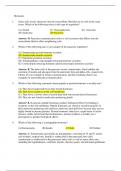
Chapter 02: Care of the Surgical Patient Cooper: Adult Health Nursing, 8th Edition MULTIPLE CHOICE 1. The patient who had a nephrectomy yesterday has not used the patient-controlled analgesia (PCA) delivery system but admits to being in pain but fearful of addiction. What is the nurse’s best response? a. “Modern analgesic drugs do not cause addiction.” b. “Pain relief is worth a short period of addiction.” c. “Addiction rarely occurs in the brief time postsurgical analgesia is required.” d. “Addiction could be a real concern.” ANS: C Addiction rarely occurs in the short time that it is required after surgery. Postsurgical analgesia, because of its brief application, does not usually produce a physical or a psychological dependence. DIF: Cognitive Level: Application REF: 34 OBJ: 13 TOP: Fear of addiction KEY: Nursing Process Step: Implementation MSC: NCLEX: Physiological Integrity 2. A 73-year-old patient with diabetes was admitted for below the knee amputation of his right leg. Removal of his right leg is an example of which type of surgery? a. Palliative b. Diagnostic c. Reconstructive d. Ablative ANS: D Ablative is a type of surgery where an amputation, excision of any part of the body, or removal of a growth and harmful substance is performed. DIF: Cognitive Level: Comprehension REF: 16 OBJ: 2 TOP: Types of surgeries KEY: Nursing Process Step: Assessment MSC: NCLEX: Physiological Integrity 3. In which situation might surgery be delayed? a. The patient has taken Dilantin today. b. An illegible signature is on the consent form. c. The patient is still taking anticoagulants. d. The admission office is unable to confirm insurance coverage. ANS: C All medications should be cancelled before surgery, except for drugs such as phenytoin (Dilantin). Anticoagulant therapy increases the threat of hemorrhage and may be a cause for delay. DIF: Cognitive Level: Knowledge REF: 34 OBJ: 7 TOP: Anticoagulant therapy KEY: Nursing Process Step: Assessment MSC: NCLEX: Physiological Integrity NURSINGTB.COM Foundations and Adult Health Nursing 8th Edition Cooper Test Bank NU RS IN GT B.CO M 4. Which circumstance could prevent the patient from signing his informed consent for a cholecystectomy? a. The patient complains of pain radiating to the scapula. b. The patient received an injection of Demerol, 75 mg IM, 1 hour ago. c. The patient is 85 years of age. d. The patient is concerned over his lack of insurance coverage. ANS: B Informed consent should not be obtained if the patient is disoriented and under the influence of sedatives. Age, illegibility, and lack of insurance coverage do not prevent signing the consent. Pain into the scapula is a symptom of colitis. DIF: Cognitive Level: Application REF: 23 OBJ: 7 TOP: Informed consent KEY: Nursing Process Step: Assessment MSC: NCLEX: Physiological Integrity 5. The nurse anticipates that the patient will be given ______________anesthesia because of the extensive tissue manipulation involved in a hysterectomy. a. general b. regional c. specific d. preoperative ANS: A An anesthesiologist gives general anesthetics by IV and inhalation routes through four stages of anesthesia when the procedure requires extensive tissue manipulation. DIF: Cognitive Level: Knowledge REF: 34 OBJ: 9 TOP: Anesthesia KEY: Nursing Process Step: Assessment MSC: NCLEX: Physiological Integrity 6. The nurse caring for a patient who had an epidural block for a vaginal repair should be alert for: a. a flushing of the face and torso. b. numbness of the perineum. c. complaint of thirst. d. a sudden drop in blood pressure. ANS: D Epidural anesthesia may cause a sudden drop in blood pressure or respiratory difficulty as the anesthetic agent moves up in the spinal cord. Elevating the patient’s torso may prevent respiratory paralysis. DIF: Cognitive Level: Comprehension REF: 37 OBJ: 9 TOP: Epidural block KEY: Nursing Process Step: Assessment MSC: NCLEX: Physiological Integrity 7. Why might the older adult patient not respond to surgical treatment as well as a younger adult patient? a. Poor skin turgor b. Fear of the unknown NURSINGTB.COM Foundations and Adult Health Nursing 8th Edition Cooper Test Bank NU RS IN GT B.CO M c. Response to physiologic changes d. Decreased peristalsis related to anesthesia ANS: C Of specific concern in older adults is the body’s response to temperature changes, cardiovascular shifts, respiratory needs, and renal function. Fear of the unknown and decreased peristalsis are common to all ages. DIF: Cognitive Level: Application REF: 18 OBJ: 5 TOP: Older adult patients KEY: Nursing Process Step: Planning MSC: NCLEX: Physiological Integrity 8. The postoperative nursing intervention that would be contraindicated for a 45-year-old patient who has had a repair of a cerebral aneurysm and is presenting signs of
Written for
Document information
- Uploaded on
- September 19, 2021
- Number of pages
- 53
- Written in
- 2021/2022
- Type
- Exam (elaborations)
- Contains
- Questions & answers
Subjects
-
exam elaborations test bank for foundations and adult health nursing 8th edition by cooper