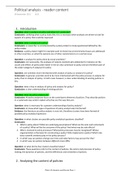
Political analysis - reader content
08 September 2021 16:31
1. Introduction
Question: what is analysis of policy and when is it conducted?
Conclusion: clarifying what a policy looks like, this is necessary when analysts are driven to look for
aspects of a policy that could be improved
Question: what is analysis for policy?
Conclusion: a researcher is commissioned by a policy-maker to study questioned defined by the
policy-maker
Evidence: a policy-maker might for example want to know how environmental issues are addressed
in other countries, or what the opinions are of other societal actors on a certain issue
Question: is analysis for policy done by social scientists?
Conclusion: not necessarily, the analyses of natural scientists who elaborate for instance on the
causes and effects of particulate matter in the air also contribute to policy and are therefore part of
the wider category of analyses for policy
Question: are scientists more intertwined with analysis of policy or analysis for policy?
Conclusion: In general, scientists tend to be more intertwined with the policy process in analysis for
policy than in analysis of policy. In both cases however, a clear understanding of existing policies is
key.
Question: what is key in analysis of policy and analysis for policy?
Conclusion: a clear understanding of existing policies
Question: what do policy analysts do?
Conclusion: All policy analysists focus on the constituent elements of policies. They describe policies
in a systematic way and/or explain why they are the way they are.
Question: what is necessary for a greater understanding of policy analysis?
Conclusion: to know what types of questions of policy analyst asks him/herself
Evidence: the literature on policy analysis is very rich, therefore clusters have been formed of
possible policy analytical questions
Question: in what clusters are possible policy analytical questions classified?
Conclusion:
1. What is policy about? What are underlying assumptions? What are the aims and instruments
of a policy? What will be the outcome of the policy? And what may be side effects?
2. Who is involved in policy processes? What policy processes may be recognized? Whose
argumentation is the basis for constructing a policy? Who implements a policy? Which role
does scientific evidence play in the policy process?
3. In which way can policies change over time and what factors may account for this?
4. In which way can policies between different areas differ
Question: to what do the four clusters classified relate?
Conclusion: These questions refer to the content of policies, the actors and processes of policy-
making, the dynamics of policies, and the differences and similarities of policies.
2. Analysing the content of policies
Question: what questions does analysing the content of policies answer?
Policy Evaluation and Design Page 1
,Question: what questions does analysing the content of policies answer?
Conclusion: what is policy about? What are underlying assumptions? What are the aims and
instruments of a policy? What will be the outcome of the policy? And what may be the side effects?
2.1 reconstruction of the policy theory
Question: why do we need to refer to underlying environmental problems and their causes and
effects if we want to know what a (environmental) policy is about?
Conclusion: because environmental policies can be considered as a societal answer to
environmental problems
Evidence:
Because environmental policies are meant to change or affect human behavior in order to address
environmental problems. Environmental problems are often caused by certain behaviors, either by
individuals (e.g. consumers) or industry. Policies are designed to change this. You will find later on
that distinctions can be made in terms of the effects of policies on outputs (policy’s mechanisms),
outcomes (behavioral change) and impacts (change in the environmental quality for instance).
Question: what is the aim of policies concerning environmental problems?
Conclusion: environmental policies are expected to mitigate the causes and/or effects of
environmental problems
Question: what is a policy theory?
Conclusion: the "total of causal and other assumptions underlying a policy"
Question: what does a policy theory represent?
Conclusion: it represents the idea of how intended benefits, such as solving a specific problem, could
be reached
Evidence: a policy theory is not a scientific theory but a theory of policy-makers
Question: what can be discerned related to the policy problem?
Conclusion:
1. Causal relations
2. Final relations
3. Normative relations
Question: what are causal relations?
Conclusion: causal relations concern the relations between causes and effects
Evidence:
Policy Evaluation and Design Page 2
,Question: what are examples of causal assumptions?
Conclusion: : “Smog will increase with economic growth”; “an increase in the number of bikes will
reduce air pollution”; and “smog negatively affects public health”
Evidence:
Causal relations are mental constructs, or assumptions, about the environmental problem, its causes
and its effects. So assumptions are made based on which policies rest, and one of these can be
causal relations.
Question: what are final relations?
Conclusion: final relations concern assumptions about the relationship between goals and means
Evidence:
Question: what is an example of a final relation/assumption?
Conclusion: “if we decrease taxes on solar panels, this will be an incentive for consumers to buy
them”
Policy Evaluation and Design Page 3
, them”
Question: what are normative relations?
Conclusion: Normative relations address the problem perceptions upon which the policy rests. They
reflect relations between principles and norms on the one hand and existing or expected situations
on the other
Evidence:
Question: what is an example of normative relations/assumptions?
Conclusion: polluter-pays-principle
Question: why is the policy theory so important?
Conclusion:
1. The questions it addresses are relevant and interesting
2. The answers to the questions addressed can also explain why certain policies are successful
and others fail
Question: how can a failure of policy often be explained?
Conclusion: by incorrect assumptions of policy-makers
Question: what do policies result in?
Conclusion: intended effects and also non-intended side effects (addressed in policy evaluation)
Question: what do we explicate by focusing on policy theory?
Conclusion: the reasoning or logic behind a policy programme
Question: how can a reconstruction of the policy theory be executed?
Conclusion:
Policy Evaluation and Design Page 4
08 September 2021 16:31
1. Introduction
Question: what is analysis of policy and when is it conducted?
Conclusion: clarifying what a policy looks like, this is necessary when analysts are driven to look for
aspects of a policy that could be improved
Question: what is analysis for policy?
Conclusion: a researcher is commissioned by a policy-maker to study questioned defined by the
policy-maker
Evidence: a policy-maker might for example want to know how environmental issues are addressed
in other countries, or what the opinions are of other societal actors on a certain issue
Question: is analysis for policy done by social scientists?
Conclusion: not necessarily, the analyses of natural scientists who elaborate for instance on the
causes and effects of particulate matter in the air also contribute to policy and are therefore part of
the wider category of analyses for policy
Question: are scientists more intertwined with analysis of policy or analysis for policy?
Conclusion: In general, scientists tend to be more intertwined with the policy process in analysis for
policy than in analysis of policy. In both cases however, a clear understanding of existing policies is
key.
Question: what is key in analysis of policy and analysis for policy?
Conclusion: a clear understanding of existing policies
Question: what do policy analysts do?
Conclusion: All policy analysists focus on the constituent elements of policies. They describe policies
in a systematic way and/or explain why they are the way they are.
Question: what is necessary for a greater understanding of policy analysis?
Conclusion: to know what types of questions of policy analyst asks him/herself
Evidence: the literature on policy analysis is very rich, therefore clusters have been formed of
possible policy analytical questions
Question: in what clusters are possible policy analytical questions classified?
Conclusion:
1. What is policy about? What are underlying assumptions? What are the aims and instruments
of a policy? What will be the outcome of the policy? And what may be side effects?
2. Who is involved in policy processes? What policy processes may be recognized? Whose
argumentation is the basis for constructing a policy? Who implements a policy? Which role
does scientific evidence play in the policy process?
3. In which way can policies change over time and what factors may account for this?
4. In which way can policies between different areas differ
Question: to what do the four clusters classified relate?
Conclusion: These questions refer to the content of policies, the actors and processes of policy-
making, the dynamics of policies, and the differences and similarities of policies.
2. Analysing the content of policies
Question: what questions does analysing the content of policies answer?
Policy Evaluation and Design Page 1
,Question: what questions does analysing the content of policies answer?
Conclusion: what is policy about? What are underlying assumptions? What are the aims and
instruments of a policy? What will be the outcome of the policy? And what may be the side effects?
2.1 reconstruction of the policy theory
Question: why do we need to refer to underlying environmental problems and their causes and
effects if we want to know what a (environmental) policy is about?
Conclusion: because environmental policies can be considered as a societal answer to
environmental problems
Evidence:
Because environmental policies are meant to change or affect human behavior in order to address
environmental problems. Environmental problems are often caused by certain behaviors, either by
individuals (e.g. consumers) or industry. Policies are designed to change this. You will find later on
that distinctions can be made in terms of the effects of policies on outputs (policy’s mechanisms),
outcomes (behavioral change) and impacts (change in the environmental quality for instance).
Question: what is the aim of policies concerning environmental problems?
Conclusion: environmental policies are expected to mitigate the causes and/or effects of
environmental problems
Question: what is a policy theory?
Conclusion: the "total of causal and other assumptions underlying a policy"
Question: what does a policy theory represent?
Conclusion: it represents the idea of how intended benefits, such as solving a specific problem, could
be reached
Evidence: a policy theory is not a scientific theory but a theory of policy-makers
Question: what can be discerned related to the policy problem?
Conclusion:
1. Causal relations
2. Final relations
3. Normative relations
Question: what are causal relations?
Conclusion: causal relations concern the relations between causes and effects
Evidence:
Policy Evaluation and Design Page 2
,Question: what are examples of causal assumptions?
Conclusion: : “Smog will increase with economic growth”; “an increase in the number of bikes will
reduce air pollution”; and “smog negatively affects public health”
Evidence:
Causal relations are mental constructs, or assumptions, about the environmental problem, its causes
and its effects. So assumptions are made based on which policies rest, and one of these can be
causal relations.
Question: what are final relations?
Conclusion: final relations concern assumptions about the relationship between goals and means
Evidence:
Question: what is an example of a final relation/assumption?
Conclusion: “if we decrease taxes on solar panels, this will be an incentive for consumers to buy
them”
Policy Evaluation and Design Page 3
, them”
Question: what are normative relations?
Conclusion: Normative relations address the problem perceptions upon which the policy rests. They
reflect relations between principles and norms on the one hand and existing or expected situations
on the other
Evidence:
Question: what is an example of normative relations/assumptions?
Conclusion: polluter-pays-principle
Question: why is the policy theory so important?
Conclusion:
1. The questions it addresses are relevant and interesting
2. The answers to the questions addressed can also explain why certain policies are successful
and others fail
Question: how can a failure of policy often be explained?
Conclusion: by incorrect assumptions of policy-makers
Question: what do policies result in?
Conclusion: intended effects and also non-intended side effects (addressed in policy evaluation)
Question: what do we explicate by focusing on policy theory?
Conclusion: the reasoning or logic behind a policy programme
Question: how can a reconstruction of the policy theory be executed?
Conclusion:
Policy Evaluation and Design Page 4