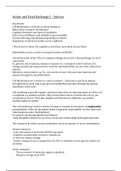
Civil Litigation Revision Notes (Jan) SOLVED FALL-2022 EDITION 100% CORRECT
Solicitor’s considerations Taking instructions: • Letter of advice – confirmation of instructions, factual details and objectives, initial advice, summary of further information and agreed next steps. • Retainer – Code of Conduct Chapter 1 – fees, complaints etc. Costs in civil cases • Solicitor-client costs: profits + disbursements (+VAT). • Party-party costs: o CPR 44.2(2): General rule – loser pays winner’s costs. o CPR 44.2(1): Court has discretion to award costs. Client notified: rare for 100% recovery and any shortfall will have to be paid by them • Court only provides part of cost in award; • Court only provides for reasonable costs (usually 70%); • O(1.13): Should advise client from outset that they will not recover all of their costs and provide costs information and updates throughout. Conditional Fee Arrangement (CFA): Solicitor’s fees and expenses payable only in specified circumstances (no-win-no-fee). • Not allowed in family, mostly criminal • Success fee can be charged • If C wins, can no longer claim success fee or insurance premium from D; however, damages for non-pecuniary losses are increased by 10% in all civil claims. • 2005 Regulation requirements: • Must be in writing • Specify particular part of proceedings which it relates to • Amount of % to increase • Written reasons for level of success fee. Damage-Based Agreement (DBA): Solicitor can recover percentage of damages in event of success (contingency fee) – now lawful. • Max 25% PI, 25% employment, 50% other cases. • Agreement must set out how fee is calculated, what happens if settlement, and how % is arrived at • No hybrid model (DBA + hourly) permitted State Funding/ Legal Aid: Limited in civil claims (possible for debt, housing, discrimination) MERIT AND MEANS TESTED • Only available for individuals (including partners) but not limited companies • Must have sufficient merit and low means to qualify Successful LA C Successful LA D Unsuccessful LA C Unsuccessful LA D C’s damages paid by D. D’s costs paid by C. S.11 Access to Justice Act: order for costs will not excess reasonable with regard to circum. = costs protection. Court discretion s.11(4): a) Just and equitable. b) Financial hardship. Same costs protection. C’s costs are paid by D. If no £ recovered, No s.11(4) application C report to LAA. statutory charge available. If shortfall, LAA applies does not apply. C makes choice to sue statutory charge over LAA funds D’s cost funded D - it is possible damages/property shortfall. it may not recover recovered = C’s damages damages or costs – reduced to meet costs. make client aware! In favour of litigation Against litigation Large sums of money at stake Costly – long and complex action, time consuming and risky Solicitors have professional indemnity insurance (if you are taking on a firm of solicitors) Difficult to prove negligence Must prove negligence – can be difficult for defendant to prove he was not negligent Uncertainty Public if you want the defendant to be held accountable Risk of paying substantial costs if you lose if the defendant is likely to be able to afford top (costly) legal professional. Case must be watertight (if it is – this is beneficial) Case must be watertight (if it is not – harmful) DUTY: The defendant owed the claimant a duty of care. • Express terms in retainer. • SGA 1973 (s.13 and s.14). • Additional letters constituting retainer. BREACH: The duty of care was breached. • Experience and specialism of D. • Evidence from those similarly qualified • Should the advice have been qualified (e.g. ‘I cannot say for certain but…’) CAUSATION: Which caused… • The loss must flow from the breach. • The loss cannot be too remote. • The claimant must have relied on the defendant. LOSS: The loss. • Did the claimant do anything to mitigate or aggravate their loss? The Claim Form CPR 7.2: To commence proceedings fee + claim form (three copies (unless multiple defendant) – one for court, one for you and one to serve on defendant(s)). • Fee for a claim greater than £200,000 is £10,000. CPR 7.4(1)(b): Where claim form and Particulars are not served together, the Particulars must be served by the claimant within 14 days of serving the claim form. CPR PD 7, para 5.1 and 5.2: Issuing claim form stops the limitation period running. • Serving claim form: o Claim form served on defendant by claimant or court (with or without particulars of claim attached). o CPR 7.5 and CPR 7.4(2): Claim form and particulars of claim must be served on the defendant by midnight on the calendar day 4 months after the date of issue of the claim form. o CPR 6.14: Deemed service – 2nd business day after completion of the relevant step. • Address for service (CPR 6.7 – 6.11): o Where solicitor authorised to accept service, must be served on solicitor o Where solicitor not authorised, parties must give address o If no address given, service effected in accordance with CPR 6.9.
Written for
- Institution
-
No School
- Course
-
LAW BP0195173 (LAWBP0195173)
Document information
- Uploaded on
- December 24, 2021
- Number of pages
- 38
- Written in
- 2021/2022
- Type
- OTHER
- Person
- Unknown
Subjects
- law bp0195173
-
civil litigation revision notes jan
-
case analysis amp investigation
-
solicitor’s considerations taking instructions
-
costs in civil cases • solicitor client costs profits disbursem