www.GOSSC.in Telegram Channel: t.me/gossc
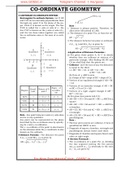
CO-ORDINATE GEOMETRY
CARTESIAN CO-ORDINATE SYSTEM : B (x2 , y2)
Rectangular Co-ordinate System : Let X' OX
and Y'OY be two mutually perpendicular lines
through any point O in the plane of the pa- A (x1 , y1)
per. Point O is known as the origin. The line Note :
X'OX is called the x -axis or axis of x ; the 1. Distance is always positive. Therefore, we
line Y'OY is known as the y-axis or axis of y, often write AB instead of |AB|.
and the two lines taken together are called 2. The distance of a point P (x, y) from the ori-
the co-ordinates axes or the axes of co-ordi-
nates. gin x 2 y 2
3. The distance between two polar co-ordinates
Y A (r1 , θ1 ) and B (r2, θ 2 ) is given by
3 AB r12 r 2 2 2r1r2cos(θ1 – θ2 )
II 2 I
Quadrant Quadrant Application of Distance Formulae :
1 (i) For given three points A, B, C to decide
(-.,+) (+,+)
whether they are collinear or vertices of a
X’ X particular triangle. After finding AB, BC and
-3 -2 -1 0 CA we shall find that the points are :
-1 • Collinear - (a) If the sum of any two distances
III IV
Quadrant -2 Quadrant is equal to the third
(+,-) i.e. AB + BC = CA. or AB + CA = BC
(-,-) -3
or BC + CA = AB
(b) If are of ABC is zero
Y’
(c) If slope of AB = slope of BC = slope of CA.
• Vertices of an equilateral triangle if AB = BC
= CA
• Vertices of an isosceles triangle if AB = BC
Signs of or BC = CA or CA = AB.
Quad- Nature of X
Region co-ordin- • Vertices of a right angled triangle if AB2 +
rant and Y
ate
BC2 = CA2 etc.
XOY I x > 0, y > 0 (+, +) (ii) For given four points A,B,C,D :
• AB = BC = CD = DA and AC = BD ABCD is a
YOX' II x < 0, y > 0 (- , +) square.
X'OY' III x < 0, y < 0 (-, -) • AB = BC = CD = DA and AC BD ABCD is
a rhombus.
Y'OX IV x > 0, y < 0 (+, -) • AB = CD, BC = DA and AC = BD ABCD is a
recatangle.
Note - Any point lying on x-axis or y-axis does • AB = CD, BC = DA and AC BD ABCD is a
not lie in any quadrant. parallelogram.
Any point can be represented on the plane Note :
described by the co-ordinate axes by specify- • The four given points are collinear, if Area of
ing its x and y co-ordinates. qaudrilateral ABCD is zero.
The x -co-ordinate of the point is also known
• Diagonals of square, rhombus, rectangle and
as the abscissa while the y-coordinate is also
parallelogram always bisect each-other.
known as the ordinate.
Distance Formula : The distance two point • Diagonals of rhombus and square bisect each
other at right angle.
A (x1, y1) and B(x2, y2) is given by
Section Formuale :
AB x 2 x1 2 y 2 y1 2 1.The co-ordinates of a point P(x ,y), dividing
the line segment joining the two points
A(x1,y1) and B (x 2, y2) internally in the ratio
m1 : m2 are given by
1
For More Free Material Visit: GOSSC.in
, www.GOSSC.in Telegram Channel: t.me/gossc
m1x 2 m2 x1 m y m2 y1 Some Important Points in a Triangle :
x ,y 1 2 • Centroid : If (x1, y1), (x2 , y2) and (x3, y3) are the
m1 m2 m1 m2
vertices of a triangle, then the co-ordinates
of its centroid are -
m2 B (x2 , y2)
AP m1 x1 x 2 x 3 y1 y 2 y 3
m1 ,
BP m 2 P(x, y) 3 3
A (x1, y1) • Incentre : If A (x1, y1), B(x2, y2) and C(x3, y3)
2. The co-ordinate of the point P(x, y), dividing are the vertices of a ABC s.t. BC = a, CA = b
the line segment joining the two points A(x1, and AB = c, then the co-ordinates of its
y1) and B (x 2, y2) externally in the ratio m1:m2 incentre are
are given by
m1x 2 m 2 x1 m y m 2 y1 A (x1 ,y1)
x ,y 1 2
m1 m 2 m1 m 2
P (x, y)
AP m1
B (x2, y2)
BP m 2 c b
A (x1 , y1)
3. The co-ordinates of the mid-point of the line
segment joining the two points A(x1, y1) and
B (x 2, y2) are given by
x1 x 2 y1 y 2 B a C
, (x 2 ,y2) (x3 ,y3)
2 2
B (x2, y2)
ax1 bx 2 cx 3 ay1 by 2 cy 3
,
P (x, y) abc abc
A (x1 , y1) • Circumcentre : If A(x1, y1), B (x2, y2) and C(x3
Division by Axes : If P (x1, x2) and Q (x2, y2), , y3) are the vertices of a ABC , then the co-
then PQ is divided by ordinates of its circumcentre are
y1 x1 sin2A x 2 sin 2B x 3 sin 2C
(i) x - axis in the ratio = y ,
2 sin 2A sin 2B sin 2C
x1 y1 sin2A y 2 sin 2B y 3 sin 2C
(ii) y - axis in the ratio = x
2 sin 2A sin 2B sin 2C
Division by a Line : A line ax + by + c = 0 • Orthocentre : Co-ordinates of orthocentre are
ax1 by1 c x1 tanA x 2 tan B x 3 tan C
divides PQ in the ratio = ,
ax 2 by 2 c tan A tan B tan C
Area of a triangle : The area of a triangle y1 tanA y 2 tan B y 3 tan C
ABC whose vertices are (x1, y1), B(x2, y2) and
tan A tan B tan C
C(x3 , y3) is denoted by .
Note :
x1 y1 1 • If the traingle is equilateral, then centroid,
1
Δ x2 y2 1 incentre, orthocentre, circumcentre coin-
2 x3 y3 1 cides.
• Orthocentre, centroid and circumcentre are
1
x1 y 2 y 3 x 2 y 3 y1 x 3 y1 y 2 always collinear and centroid divides the line
2 joining orthocentre and circumcentre in the
Area of Polygon : The area of the polygon ratio 2 : 1.
whose vertices are (x1, y1), (x2, y2),......(xn , yn) • In an isosceles triangle centroid,
is - orthocentre, incentre, circumcentre lies on
1 x1 y 2 x 2 y1 x 2 y 3 x 3 y 2 ....... the same line.
Incentre divides the angles bisectors in the
2 ................ x n y1 x1 y n •
ratio (b + c) : a, (c + a) : b, (a + b) : c.
2
For More Free Material Visit: GOSSC.in
CO-ORDINATE GEOMETRY
CARTESIAN CO-ORDINATE SYSTEM : B (x2 , y2)
Rectangular Co-ordinate System : Let X' OX
and Y'OY be two mutually perpendicular lines
through any point O in the plane of the pa- A (x1 , y1)
per. Point O is known as the origin. The line Note :
X'OX is called the x -axis or axis of x ; the 1. Distance is always positive. Therefore, we
line Y'OY is known as the y-axis or axis of y, often write AB instead of |AB|.
and the two lines taken together are called 2. The distance of a point P (x, y) from the ori-
the co-ordinates axes or the axes of co-ordi-
nates. gin x 2 y 2
3. The distance between two polar co-ordinates
Y A (r1 , θ1 ) and B (r2, θ 2 ) is given by
3 AB r12 r 2 2 2r1r2cos(θ1 – θ2 )
II 2 I
Quadrant Quadrant Application of Distance Formulae :
1 (i) For given three points A, B, C to decide
(-.,+) (+,+)
whether they are collinear or vertices of a
X’ X particular triangle. After finding AB, BC and
-3 -2 -1 0 CA we shall find that the points are :
-1 • Collinear - (a) If the sum of any two distances
III IV
Quadrant -2 Quadrant is equal to the third
(+,-) i.e. AB + BC = CA. or AB + CA = BC
(-,-) -3
or BC + CA = AB
(b) If are of ABC is zero
Y’
(c) If slope of AB = slope of BC = slope of CA.
• Vertices of an equilateral triangle if AB = BC
= CA
• Vertices of an isosceles triangle if AB = BC
Signs of or BC = CA or CA = AB.
Quad- Nature of X
Region co-ordin- • Vertices of a right angled triangle if AB2 +
rant and Y
ate
BC2 = CA2 etc.
XOY I x > 0, y > 0 (+, +) (ii) For given four points A,B,C,D :
• AB = BC = CD = DA and AC = BD ABCD is a
YOX' II x < 0, y > 0 (- , +) square.
X'OY' III x < 0, y < 0 (-, -) • AB = BC = CD = DA and AC BD ABCD is
a rhombus.
Y'OX IV x > 0, y < 0 (+, -) • AB = CD, BC = DA and AC = BD ABCD is a
recatangle.
Note - Any point lying on x-axis or y-axis does • AB = CD, BC = DA and AC BD ABCD is a
not lie in any quadrant. parallelogram.
Any point can be represented on the plane Note :
described by the co-ordinate axes by specify- • The four given points are collinear, if Area of
ing its x and y co-ordinates. qaudrilateral ABCD is zero.
The x -co-ordinate of the point is also known
• Diagonals of square, rhombus, rectangle and
as the abscissa while the y-coordinate is also
parallelogram always bisect each-other.
known as the ordinate.
Distance Formula : The distance two point • Diagonals of rhombus and square bisect each
other at right angle.
A (x1, y1) and B(x2, y2) is given by
Section Formuale :
AB x 2 x1 2 y 2 y1 2 1.The co-ordinates of a point P(x ,y), dividing
the line segment joining the two points
A(x1,y1) and B (x 2, y2) internally in the ratio
m1 : m2 are given by
1
For More Free Material Visit: GOSSC.in
, www.GOSSC.in Telegram Channel: t.me/gossc
m1x 2 m2 x1 m y m2 y1 Some Important Points in a Triangle :
x ,y 1 2 • Centroid : If (x1, y1), (x2 , y2) and (x3, y3) are the
m1 m2 m1 m2
vertices of a triangle, then the co-ordinates
of its centroid are -
m2 B (x2 , y2)
AP m1 x1 x 2 x 3 y1 y 2 y 3
m1 ,
BP m 2 P(x, y) 3 3
A (x1, y1) • Incentre : If A (x1, y1), B(x2, y2) and C(x3, y3)
2. The co-ordinate of the point P(x, y), dividing are the vertices of a ABC s.t. BC = a, CA = b
the line segment joining the two points A(x1, and AB = c, then the co-ordinates of its
y1) and B (x 2, y2) externally in the ratio m1:m2 incentre are
are given by
m1x 2 m 2 x1 m y m 2 y1 A (x1 ,y1)
x ,y 1 2
m1 m 2 m1 m 2
P (x, y)
AP m1
B (x2, y2)
BP m 2 c b
A (x1 , y1)
3. The co-ordinates of the mid-point of the line
segment joining the two points A(x1, y1) and
B (x 2, y2) are given by
x1 x 2 y1 y 2 B a C
, (x 2 ,y2) (x3 ,y3)
2 2
B (x2, y2)
ax1 bx 2 cx 3 ay1 by 2 cy 3
,
P (x, y) abc abc
A (x1 , y1) • Circumcentre : If A(x1, y1), B (x2, y2) and C(x3
Division by Axes : If P (x1, x2) and Q (x2, y2), , y3) are the vertices of a ABC , then the co-
then PQ is divided by ordinates of its circumcentre are
y1 x1 sin2A x 2 sin 2B x 3 sin 2C
(i) x - axis in the ratio = y ,
2 sin 2A sin 2B sin 2C
x1 y1 sin2A y 2 sin 2B y 3 sin 2C
(ii) y - axis in the ratio = x
2 sin 2A sin 2B sin 2C
Division by a Line : A line ax + by + c = 0 • Orthocentre : Co-ordinates of orthocentre are
ax1 by1 c x1 tanA x 2 tan B x 3 tan C
divides PQ in the ratio = ,
ax 2 by 2 c tan A tan B tan C
Area of a triangle : The area of a triangle y1 tanA y 2 tan B y 3 tan C
ABC whose vertices are (x1, y1), B(x2, y2) and
tan A tan B tan C
C(x3 , y3) is denoted by .
Note :
x1 y1 1 • If the traingle is equilateral, then centroid,
1
Δ x2 y2 1 incentre, orthocentre, circumcentre coin-
2 x3 y3 1 cides.
• Orthocentre, centroid and circumcentre are
1
x1 y 2 y 3 x 2 y 3 y1 x 3 y1 y 2 always collinear and centroid divides the line
2 joining orthocentre and circumcentre in the
Area of Polygon : The area of the polygon ratio 2 : 1.
whose vertices are (x1, y1), (x2, y2),......(xn , yn) • In an isosceles triangle centroid,
is - orthocentre, incentre, circumcentre lies on
1 x1 y 2 x 2 y1 x 2 y 3 x 3 y 2 ....... the same line.
Incentre divides the angles bisectors in the
2 ................ x n y1 x1 y n •
ratio (b + c) : a, (c + a) : b, (a + b) : c.
2
For More Free Material Visit: GOSSC.in