100% satisfaction guarantee Immediately available after payment Both online and in PDF No strings attached 4.6 TrustPilot
logo-home
Exam (elaborations)

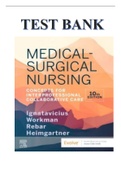
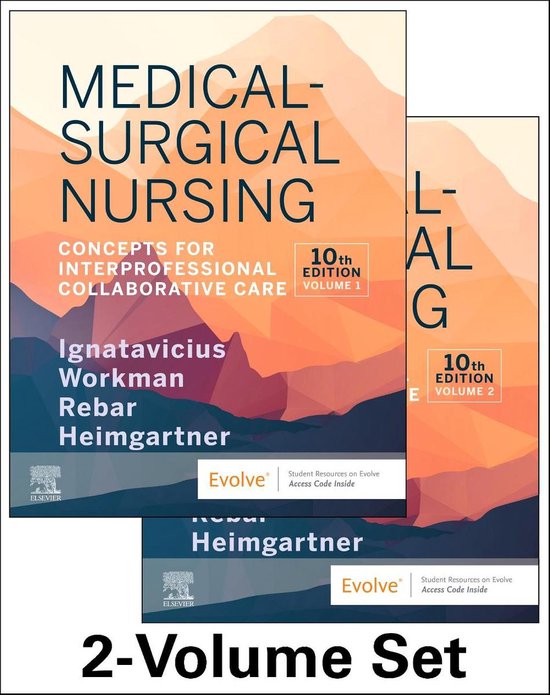
Test Bank for Medical Surgical Nursing 10th Edition by Ignatavicius

Rating
-
Sold
-
Pages
596
Grade
A+
Uploaded on
14-02-2022
Written in
2022/2023

Test Bank for Medical Surgical Nursing 10th Edition by Ignatavicius Table of Contents Section I: Concepts of Medical-Surgical Nursing 1. Overview of Professional Nursing Concepts for Medical-Surgical Nursing 2. From Clinical Judgment to Systems Thinking 3. Overview of Health Concepts for Medical-Surgical Nursing 4. Common Health Problems of Older Adults 5. Assessment and Concepts of Care for Patients with Pain 6. Concepts of Genetics and Genomics 7. Concepts of Rehabilitation for Chronic and Disabling Health Problems 8. Care of Patients at End-of-Life 9. Care of Perioperative Patients Section II: Concepts of Emergency Care and Disaster Preparedness 10. Concepts of Emergency and Trauma Nursing 11. Care of Patients with Common Environmental Emergencies 12. Concepts of Disaster Preparedness Section III: Concepts of Patients with Problems of Fluid, Electrolyte, and Acid-Base Balance 13. Concepts of Fluid and Electrolyte Balance 14. Concepts of Acid-Base Balance 15. Concepts of Infusion Therapy Section V: Interprofessional Collaboration for Patients with Problems of Immunity 16. Concepts of Inflammation and Immunity 17. Care of Patients with HIV Disease 18. Care of Patients with Hypersensitivity (Allergy) and Autoimmunity 19. Concepts of Cancer Development 20. Care of Patients with Cancer 21. Care of Patients with Infection Section VI: Interprofessional Collaboration for Patients with Problems of the Skin, Hair, and Nails 22. Assessment of the Skin, Hair, and Nails 23. Care of Patients with Skin Problems Section VII: Interprofessional Collaboration for Patients with Problems of the Respiratory System 24. Assessment of the Respiratory System 25. Care of Patients Requiring Oxygen Therapy or Tracheostomy 26. Care of Patients with Noninfectious Upper Respiratory Problems 27. Care of Patients with Noninfectious Lower Respiratory Problems 28. Care of Patients with Infectious Respiratory Problems 29. Critical Care of Patients with Respiratory Emergencies Section VIII: Interprofessional Collaboration for Patients with Problems of the Cardiovascular System 30. Assessment of the Cardiovascular System 31. Care of Patients with Dysrhythmias 32. Care of Patients with Cardiac Problems 33. Care of Patients with Vascular Problems 34. Critical Care of Patients with Shock 35. Critical Care of Patients with Acute Coronary Syndromes Section IX: Interprofessional Collaboration for Patients with Problems of the Hematologic System 36. Assessment of the Hematologic System Section X: Interprofessional Collaboration for Patients with Problems of the Nervous System 38. Assessment of the Nervous System 39. Care of Patients with Problems of the Central Nervous System: The Brain 40. Care of Patients with Problems of the Central Nervous System: The Spinal Cord 41. Critical Care of Patients with Neurologic Emergencies Section XI: Interprofessional Collaboration for Patients with Problems of the Sensory System 42. Assessment and Concepts of Care for Patients with Eye and Vision Problems 43. Assessment and Concepts of Care for Patients with Ear and Hearing Problems Section XII: Interprofessional Collaboration for Patients with Problems of the Musculoskeletal System 44. Assessment of the Musculoskeletal System 45. Care of Patients with Musculoskeletal Problems 46. Care of Patients with Arthritis and Total Joint Arthroplasty 47. Care of Patients with Musculoskeletal Trauma Section XIII: Interprofessional Collaboration for Patients with Problems of the Gastrointestinal System 48. Assessment of the Gastrointestinal System 49. Care of Patients with Oral Cavity and Esophageal Problems 50. Care of Patients with Stomach Disorders 51. Care of Patients with Noninflammatory Intestinal Disorders 52. Care of Patients with Inflammatory Intestinal Disorders 53. Care of Patients with Liver Problems 54. Care of Patients with Problems of the Biliary System and Pancreas Section XIV: Interprofessional Collaboration for Patients with Problems of the Endocrine System 56. Assessment of the Endocrine System 57. Care of Patients with Pituitary and Adrenal Gland Problems 58. Care of Patients with Problems of the Thyroid and Parathyroid Glands 59. Care of Patients with Diabetes Mellitus Section XV: Interprofessional Collaboration for Patients with Problems of the Renal/Urinary System 60. Assessment of the Renal/Urinary System 61. Care of Patients with Urinary Problems 62. Care of Patients with Kidney Disorders 63. Care of Patients with Acute Kidney Injury and Chronic Kidney Disease Section XVI: Interprofessional Collaboration for Patients with Problems of the Reproductive System 64. Assessment of the Reproductive System 65. Care of Patients with Breast Disorders 66. Care of Patients with Gynecologic Problems 67. Care of Patients with Male Reproductive Problems 68. Care of Transgender Patients 69. Care of Patients with Sexually Transmitted Infections Chapter 01: Overview of Professional Nursing Concepts for Medical-Surgical Nursing Ignatavicius: Medical-Surgical Nursing, 10th Edition MULTIPLE CHOICE 1. A new nurse is working with a preceptor on a medical-surgical unit. The preceptor advises the new nurse that which is the priority when working as a professional nurse? a. Attending to holistic client needs b. Ensuring client safety c. Not making medication errors d. Providing client-focused caarbe ANS: B All actions are appropriate for the professional nurse. However, ensuring client safety is the priority. Health care errors haavebbierebn lymrep/toertesd tfor 25 years, many of which result in client injury, death, and increased health care costs. There are several national and international organizations that have either recommended or mandated safety initiatives. Every nurse has the responsibility to guard the client’s safety. The other actions are important for quality nursing, but they are not as vital as providing safety. Not making medication errors does provide safety, but is too narrow in scope to be the best answer. DIF: Understanding KEY: Client safety abirb.cToOPm: /Intteegsratted Process: Nursing Process: Intervention MSC: Client Needs Category: Safe and Effective Care Environment: Safety and Infection Control 2. A nurse is orienting a new cliaenbt ymto t/hteemsedtical-surgical unit. What information does the nurse provide to best help the client promote his or her own safety? a. Encourage the client and family to be active partners. b. Have the client monitor hand hygiene in caregivers. c. Offer the family the opportunity to stay with the client. d. Tell the client to always wear his or her armband. ANS: A Each action could be important for the client or family to perform. However, encouraging the client to be active in his or her health care as a safety partner is the most critical. The other actions are very limited in scope and do not provide the broad protection that being active and involved does. DIF: Understanding TOP: Integrated Process: Teaching/Learning KEY: Client safety MSC: Client Needs Category: Safe and Effective Care Environment: Safety and Infection Control 3. A nurse is caring for a postoperative client on the surgical unit. The client’s blood pressure was 142/76 mm Hg 30 minutaesbagior,wmis/8t8e/5s0tmm Hg. What action would the nurse a. Call the Rapid Response Team. b. Document and continue to monitor. c. Notify the primary health care provider. d. Repeat the blood pressure in 15 minutes. The purpose of the Rapid ResapobnsierbT(RmRT/)teis stotintervene when clients are deteriorating before they suffer either respiratory or cardiac arrest. Since the client has manifested a significant change, the nurse would call the RRT. Changes in blood pressure, mental status, heart rate, temperature, oxygen saturation, and last 2 hours’ urine output are particularly significant and are part of the Modified Early Warning System guide. Documentation is vital, but the nurse must do more than document. The primary health care provider would be notified, but this is not more important than calling the RRT. The client’s blood pressure would be reassessed frequently, but the priority is getting the rapid care to the client. DIF: Applying TOP: Integrated Process: Communication and Documentation KEY: Rapid Response Team (RRT), Clinical judgment MSC: Client Needs Category: Physiological Integrity: Physiological Adaptation 4. A nurse wishes to provide client-centered care in all interactions. Which action by the nurse best demonstrates this concepat? a. Assesses for cultural influences affecting health care. b. Ensures that all the client’s basic needs are met. c. Tells the client and family about all upcoming tests. d. Thoroughly orients the client and family to the room. ANS: A Showing respect for the client and family’s preferences and needs is essential to ensure a holistic or “whole-person” approach to care. By assessing the effect of the client’s culture on health care, this nurse is practicing client-focused care. Providing for basic needs does not demonstrate this competence. Simply telling the client about all upcoming tests is not providing empowering educaatiobn.iOogmthe/ctleienst tand family to the room is an important safety measure, but not directly related to demonstrating client-centered care. DIF: Understanding abirb.cToOPm: /Intteegsratted Process: Culture and Spirituality KEY: Client-centered care, Culture MSC: Client Needs Category: Psychosocial Integrity 5. A client is going to be admitted for a scheduled surgical procedure. Which action does the nurse explain is the most important thing the client can do to protect against errors? a. Bring a list of all medications and what they are for. b. Keep the provider’s phone number by the telephone. c. Make sure that all providers wash hands before entering the room. d. Write down the name of each caregiver who comes in the room. ANS: A Medication reconciliation is a formal process in which the client’s actual current medications are compared to the prescribed medications at the time of admission, transfer, or discharge. This National client Safety Goal is important to reduce medication errors. The client would not have to be responsible for providers washing their hands, and even if the client does so, this is too narrow to be the most important action to prevent errors. Keeping the provider’s phone number nearby and documenting everyone who enters the room also do not guarantee safety. DIF: Applying TOP: IntaegbratierdbPss:mTe/actheinsg/tLearning KEY: Client safety, Informatics MSC: Client Needs Category: Safe and Effective Care Environment: Safety and Infection Control 6. Which action by the nurse lmien/t tbeesst dtemonstrates respect for autonomy? a. Asks if the client has questions before signing a consent. b. Gives the client accurate information when questioned. c. Keeps the promises made to the client and family. d. Treats the client fairly compared to other clients. ANS: A Autonomy is self-determination. The client would make decisions regarding care. When the nurse obtains a signature on the consent form, assessing if the client still has questions is vital, because without full information the client cannot practice autonomy. Giving accurate information is practicing with veracity. Keeping promises is upholding fidelity. Treating the client fairly is providing social justice. DIF: Applying TOP: Integrated Process: Caring KEY: Ethics, Autonomy MSC: Client Needs Category: Saafbe ainrdbE.ffcecotivme C/atreeEsnvtironment: Management of Care 7. A nurse asks a more seasoned colleague to explain best practices when communicating with a person from the lesbian, gay, bisexual, transgender, and questioning/queer (LGBTQ) community. What answer by athbe mmost/taeccsurtate? a. Avoid embarrassing the client by asking questions. b. Don’t make assumptions about his or her health needs. c. Most LGBTQ people do not want to share information. d. No differences exist in communicating with this population. ANS: B Many members of the LGBTQ community have faced discrimination from health care providers and may be reluctant to seek health care. The nurse would never make assumptions about the needs of members of this population. Rather, respectful questions are appropriate. If approached with sensitivity, the client with any health care need is more likely to answer honestly. DIF: Understanding TOP: Integrated Process: Teaching/Learning KEY: Health care disparities, LaGBbTiQrb.cMoSmC: /Ctlieenst Nteeds Category: Psychosocial Integrity 8. A nurse is calling the on-call health care provider about a client who had a hysterectomy 2 days ago and has pain that is unrelieved by the prescribed opioid pain medication. Which statement comprises the background portion of the SBAR format for communication? a. “I would like you to order a different pain medication.” b. “This client has allergies to morphine and codeine.” c. “Dr. Smith doesn’t like nonsteroidal anti-inflammatory meds.” d. “This client had a vaginal hysterectomy 2 days ago.” ANS: B SBAR is a recommended form of communication, and the acronym stands for Situation, Background, Assessment, and Recommendation. Appropriate background information includes allergies to medications the on-call health care provider might order. Situation describes what is happening right now that must be communicated; the client’s surgery 2 days ago would be considered backagbrouirnbd. .Acssoesmsme/nttewsoutld include an analysis of the client’s problem; none of the options has assessment information. Asking for a different pain medication is a recommendation. Recommendation is a statement of what is needed or what outcome is desired. DIF: Applying TOP: Integrated Process: Communication and Documentation KEY: Teamwork and collaboration, SBAR MSC: Client Needs Category: Saafbe ainrdbE.ffcecotivme C/atreeEsnvtironment: Management of Care 9. A nurse working on a cardiac unit delegated taking vital signs to an experienced assistive personnel (AP). Four hours later, the nurse notes that the client’s blood pressure taken by the AP was much higher than gsm, an/dttehesctlient’s mental status has changed. What action by the nurse would most likely have prevented this negative outcome? a. Determining if the AP knew how to take blood pressure b. Double-checking the AP by taking another blood pressure c. Providing more appropriate supervision of the AP d. Taking the blood pressure instead of delegating the task ANS: C Supervision is one of the five rights of delegation and includes directing, evaluating, and following up on delegated tasks. The nurse would either have asked the AP about the vital signs or instructed the AP to report them right away. An experienced AP would know how to take vital signs and the vemto/atsesessstthis at this point. Double-checking the work defeats the purpose of delegation. Vital signs are within the scope of practice for a AP and are permissible to delegate. The only appropriate answer is that the nurse did not provide adequate instruction to the APa. DIF: Analyzing TOP: Integrated Process: Communication and Documentation KEY: Teamwork and collaboration, Delegation MSC: Client Needs Category: Saafbe ainrdbE.ffcecotivme C/atreeEsnvtironment: Management of Care 10. A newly graduated nurse in the hospital states that because of being so new, participation in quality improvement (QI) projects is not wise. What response by the precepting nurse is best? a. “All staff nurses are required to participate in quality improvement here.” b. “Even being new, you can implement activities designed to improve care.” c. “It’s easy to identify what indicators would be used to measure quality.” d. “You should ask to be assaigbneidrtbo .thceoremsear/ctheasndtquality committee.” ANS: B The preceptor would try to reassure the nurse that implementing QI measures is not out of line for a newly licensed nurse. Simply stating that all nurses are required to participate does not help the nurse understand how that is possible and is dismissive. Identifying indicators of quality is not an easy, quick process and would not be the best place to suggest a new nurse to start. Asking to be assigned to the QI committee does not give the nurse information about how to implement QI in daily practice. DIF: Applying TOP: Integrated Process: Communication and Documentation KEY: Systems thinking, Quality improvement MSC: Client Needs Category: Safe and Effective Care Environment: Management of Care 11. A nurse is talking with a co-worker who is moving to a new state and needs to find new employment there. What advice by the nurse is best? a. Ask the hospitals there about standard nurse–client ratios. b. Choose the hospital that has the newest technology. c. Find a hospital that has achieved Magnet status. d. Work in a facility affiliatead bwiitrhba .mcedoicmal o/rtenusrsitng school. ANS: C Client Magnet status is awarded by The Joint Commission (TJC) and certifies that nurses can demonstrate how best dmes t/hteeir psratctice. New technology doesn’t necessarily mean that the hospital is safe. Affiliation with a health profession school has several advantages, but safety is most important. DIF: Understanding TOP: Integrated Process: Communication and Documentation KEY: Evidence-based practice, Magnet status MSC: Client Needs Category: Saafbe ainrdbE.ffcecotivme C/atreeEsnvtironment: Safety and Infection Control MULTIPLE RESPONSE 1. A nurse manager wishes to nmurse/steonsthte unit are practicing at their highest levels of competency. Which areas would the manager assess to determine if the nursing staff demonstrate competency according to the Institute of Medicine (IOM) report Health Professions Education: A Briadgbe tiorbQty?m(S/etleectsatll that apply.) a. Collaborating with an interprofessional team b. Implementing evidence-based care c. Providing family-focused care d. Routinely using informatics in practice e. Using quality improvement in client care f. Formalizing systems thinking when implementing care ANS: A, B, D, E The IOM report lists five broad core competencies that all health care providers should practice. These include collaborating with the interprofessional team, implementing evidence-based practice, providing patient-focused care, using informatics in client care, and using quality improvement in client care. Systems thinking is required for quality improvement but is not a specified part of the IOM report. DIF: Remembering abirb.cToOPm: /Intteegsratted Process: Nursing Process: Assessment KEY: Competencies, Institute of Medicine (IOM) MSC: Client Needs Category: Safe and Effective Care Environment: Safety and Infection Control 2. A nurse is interested in making interprofessional work a high priority. Which actions by the nurse best demonstrate this skill? (Select all that apply.) a. Consults with other disciplines on client care. b. Coordinates discharge planning for home safety. c. Participates in comprehensive client rounding. d. Routinely asks other disciplines about client progress.

Show more Read less
Institution
Course


Whoops! We can’t load your doc right now. Try again or contact support.

Connected book

Written for

Course

Document information

Uploaded on
February 14, 2022
Number of pages
596
Written in
2022/2023
Type
Exam (elaborations)
Contains
Questions & answers

Subjects

Content preview

, Test Bank for Medical Surgical Nursing 10th Edition by Ignatavicius
Table of Contents


Section I: Concepts of Medical-Surgical Nursing
1. Overview of Professional Nursing Concepts for Medical-Surgical Nursing
2. From Clinical Judgment to Systems Thinking
3. Overview of Health Concepts for Medical-Surgical Nursing
4. Common Health Problems of Older Adults
5. Assessment and Concepts of Care for Patients with Pain
6. Concepts of Genetics and Genomics
7. Concepts of Rehabilitation for Chronic and Disabling Health Problems
8. Care of Patients at End-of-Life
9. Care of Perioperative Patients


Section II: Concepts of Emergency Care and Disaster Preparedness
10. Concepts of Emergency and Trauma Nursing
11. Care of Patients with Common Environmental Emergencies
12. Concepts of Disaster Preparedness


Section III: Concepts of Patients with Problems of Fluid, Electrolyte, and Acid-Base
Balance
13. Concepts of Fluid and Electrolyte Balance
14. Concepts of Acid-Base Balance
15. Concepts of Infusion Therapy


Section V: Interprofessional Collaboration for Patients with Problems of Immunity
16. Concepts of Inflammation and Immunity
17. Care of Patients with HIV Disease
18. Care of Patients with Hypersensitivity (Allergy) and Autoimmunity

,19. Concepts of Cancer Development
20. Care of Patients with Cancer
21. Care of Patients with Infection


Section VI: Interprofessional Collaboration for Patients with Problems of the Skin, Hair,
and Nails
22. Assessment of the Skin, Hair, and Nails
23. Care of Patients with Skin Problems


Section VII: Interprofessional Collaboration for Patients with Problems of the Respiratory
System
24. Assessment of the Respiratory System
25. Care of Patients Requiring Oxygen Therapy or Tracheostomy
26. Care of Patients with Noninfectious Upper Respiratory Problems
27. Care of Patients with Noninfectious Lower Respiratory Problems
28. Care of Patients with Infectious Respiratory Problems
29. Critical Care of Patients with Respiratory Emergencies


Section VIII: Interprofessional Collaboration for Patients with Problems of the
Cardiovascular System
30. Assessment of the Cardiovascular System
31. Care of Patients with Dysrhythmias
32. Care of Patients with Cardiac Problems
33. Care of Patients with Vascular Problems
34. Critical Care of Patients with Shock
35. Critical Care of Patients with Acute Coronary Syndromes


Section IX: Interprofessional Collaboration for Patients with Problems of the Hematologic
System
36. Assessment of the Hematologic System

, 37. Care of Patients with Hematologic Problems


Section X: Interprofessional Collaboration for Patients with Problems of the Nervous
System
38. Assessment of the Nervous System
39. Care of Patients with Problems of the Central Nervous System: The Brain
40. Care of Patients with Problems of the Central Nervous System: The Spinal Cord
41. Critical Care of Patients with Neurologic Emergencies


Section XI: Interprofessional Collaboration for Patients with Problems of the Sensory
System
42. Assessment and Concepts of Care for Patients with Eye and Vision Problems
43. Assessment and Concepts of Care for Patients with Ear and Hearing Problems


Section XII: Interprofessional Collaboration for Patients with Problems of the
Musculoskeletal System
44. Assessment of the Musculoskeletal System
45. Care of Patients with Musculoskeletal Problems
46. Care of Patients with Arthritis and Total Joint Arthroplasty
47. Care of Patients with Musculoskeletal Trauma


Section XIII: Interprofessional Collaboration for Patients with Problems of the
Gastrointestinal System
48. Assessment of the Gastrointestinal System
49. Care of Patients with Oral Cavity and Esophageal Problems
50. Care of Patients with Stomach Disorders
51. Care of Patients with Noninflammatory Intestinal Disorders
52. Care of Patients with Inflammatory Intestinal Disorders
53. Care of Patients with Liver Problems
54. Care of Patients with Problems of the Biliary System and Pancreas
$35.98
Get access to the full document:

100% satisfaction guarantee
Immediately available after payment
Both online and in PDF
No strings attached


Also available in package deal

Get to know the seller

Seller avatar
Reputation scores are based on the amount of documents a seller has sold for a fee and the reviews they have received for those documents. There are three levels: Bronze, Silver and Gold. The better the reputation, the more your can rely on the quality of the sellers work.
Laudabletasks Eastern Virginia Medical School
Follow You need to be logged in order to follow users or courses
Sold
3389
Member since
5 year
Number of followers
2701
Documents
6506
Last sold
4 days ago
Writing and Academics (pinnacleaces at gmail dot com)

I offer a full range of online academic services aimed to students who need support with their academics. Whether you need tutoring, help with homework, paper writing, or proofreading, I am here to help you reach your academic goals. My experience spans a wide range of disciplines. I provide online sessions using the Google Workplace. If you have an interest in working with me, please contact me for a free consultation to explore your requirements and how I can help you in your academic path. I am pleased to help you achieve in your academics and attain your full potential.

Read more Read less
3.9

476 reviews

5
241
4
83
3
76
2
24
1
52

Recently viewed by you

Why students choose Stuvia

Created by fellow students, verified by reviews

Quality you can trust: written by students who passed their tests and reviewed by others who've used these notes.

Didn't get what you expected? Choose another document

No worries! You can instantly pick a different document that better fits what you're looking for.

Pay as you like, start learning right away

No subscription, no commitments. Pay the way you're used to via credit card and download your PDF document instantly.

Student with book image

“Bought, downloaded, and aced it. It really can be that simple.”

Alisha Student

Frequently asked questions