Grand Canyon University:PSY 520 Topic 1 Exercise 1, Chapter 1 to 4;Verified Answers(Graded A)
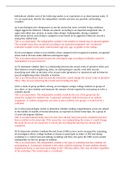
1.8 Indicate whether each of the following studies is an experiment or an observational study. If it is an experiment, identify the independent variable and note any possible confounding variables. (a) A psychologist uses chimpanzees to test the notion that more crowded living conditions trigger aggressive behavior. Chimps are placed, according to an impartial assignment rule, in cages with either one, several, or many other chimps. Subsequently, during a standard observation period, each chimp is assigned a score based on its aggressive behavior toward a chimp-like stuffed doll. This is an experiment. The independent variable is the number of chimps that are placed together. The example states they are placed according to an impartial assignment rule. A potential confound variable in this study could include cage size, age, or gender or the chimps. (b) An investigator wishes to test whether, when compared with recognized scientists, recognized artists tend to be born under different astrological signs. This is an observational study because the astrological sign according to birthdate cannot be manipulated, it is just observed. (c) To determine whether there is a relationship between the sexual codes of primitive tribes and their behavior toward neighboring tribes, an anthropologist consults avail-able records, classifying each tribe on the basis of its sexual codes (permissive or repressive) and its behavior toward neighboring tribes (friendly or hostile). This is an observational study because the researcher cannot change the sexual codes of primitive tribes. They are just observing the records and recording the data. (d) In a study of group problem solving, an investigator assigns college students to groups of two, three, or four students and measures the amount of time required by each group to solve a complex puzzle. This is an experiment. The independent variable would be the size of the group that the researcher assigns the students into. A potential confound could be because of no random assignment. If random assignment was done to place students into groups, it would not be a confound. (e) A school psychologist wishes to determine whether reading comprehension scores are related to the number of months of formal education, as reported on school transcripts, for a group of 12-year-old migrant children. This is an observational study since the tests have already been previously completed and have been recorded on the transcript. If the researcher was manipulating the exams, it would change the study. However, the researcher is strictly just recording the data that has already been completed. (f) To determine whether Graduate Record Exam (GRE) scores can be increased by cramming, an investigator allows college students to choose to participate in either a GRE test-taking workshop or a control (non-test-taking) workshop and then com-pares the GRE scores earned subsequently by the two groups of students. This is an experiment. The independent variable is the type of workshop that they students are participating in. A potential confound in this study could be studying. If some students already studied previously or had more knowledge of the GRE than others, they may do better regardless of the workshop. This would make is a confound. (g) A social scientist wishes to determine whether there is a relationship between the attractiveness scores (on a 100-point scale) assigned to college students by a panel of peers and their scores on a paper-and-pencil test of anxiety. This is an observational study. The researcher is the observing the results of the attractiveness scores and the paper-and-pencil test of anxiety. The researcher is not manipulating the environment in any way and is just overserving the results. (h) A political scientist wishes to determine whether males and females differ with respect to their attitudes toward defense spending by the federal government. She asks each person if he or she thinks that the current level of defense spending should be increased, remain the same, or be decreased. This is an experiment. The independent variable is gender. Potential confounds could include political affiliation or age of the person. Another confound could be education and knowledge of defense spending. Some individuals may know more about defense spending than others. (i) Investigators found that four year-old children who delayed eating one marshmallow in order to eat two marshmallows later, scored higher than non-delayers on the Scholastic Aptitude Test (SAT) taken over a decade later. This is an observational study. The researchers recorded the results and did not manipulate any variables. 1.9 Recent studies, as summarized, for example, in E. Mortensen et al. (2002). The association between duration of breastfeeding and adult intelligence. Journal of the American Medical Association, 287, 2365–2371, suggest that breastfeeding of infants may increase their subsequent cognitive (IQ) development. Both experiments and observational studies are cited. (a) What determines whether some of these studies are experiments? An experiment is when something is applied to a certain group or individual to measure an outcome or effect. This could include giving different tests to different groups or just sorting individuals into groups by certain characteristics. If a researcher changes or manipulates a variable, it is an experiment. The studies that are considered experiments have a control and a treatment. (b) Name at least two potential confounding variables controlled by breastfeeding experiments. One confound could be how long the infant was breastfed for. Another confound could be the gender or the child. These could both have an effect on the study. 2.14 (a) Construct a frequency distribution for the number of different residences occupied by graduating seniors during their college career, namely 1, 4, 2, 3, 3, 1, 6, 7, 4, 3, 3, 9, 2, 4, 2, 2, 3, 2, 3, 4, 4, 2, 3, 3, 5 Frequency Table: Residences with Graduating Seniors Frequency Percent Valid Percent Cumulative Percent Valid 1.00 2 8.0 8.0 8.0 2.00 6 24.0 24.0 32.0 3.00 8 32.0 32.0 64.0 4.00 5 20.0 20.0 84.0 5.00 1 4.0 4.0 88.0 6.00 1 4.0 4.0 92.0 7.00 1 4.0 4.0 96.0 9.00 1 4.0 4.0 100.0 Total 25 100.0 100.0 (b) What is the shape of this distribution? Based on the graph, the shape is a normal distribution. *2.17 Are there any conspicuous differences between the two distributions in the following table (one reflecting the ages of all residents of a small town and the other reflecting the ages of all U.S. residents)? a) To help make the desired comparison, convert the frequencies (f) for the small town to percentages. 105 500 =0.21=21% 53 500 =0.106=11% 45 500 =0.09=9% 40 500 =0.08=8% 44 500 =0.088=9% 38 500 =0.076=8% 31 500 =0.062=6% 27 500Age Small Town (%) U.S Population (%) 65-above 21 12 60-64 11 4 55-59 9 5 50-54 8 7 45-49 9 7 40-44 8 8 35-39 6 7 30-34 5 7 25-29 5 7 20-24 4 7 15-19 4 7 10-14 4 7 5-9 3 7 0-4 3 7 Totals 100% 99% (b) Describe any seemingly conspicuous differences between the two distributions. For the small town, there are more older people and fewer young people. (c) Using just one graph, construct frequency polygons for the two relative frequency distributions. Object 7 2.18 The following table shows distributions of bachelor’s degrees earned in 2011–2012 for selected fields of study by all male graduates and by all female graduates (a) How many female psychology majors graduated in 2011–2012? 83.6 thousand female psychology majors graduated in . (b) Since the total numbers of male and female graduates are fairly different—600.0 thousand and 803.6 thousand—it is helpful to convert first to relative frequencies before making comparisons between male and female graduates. Then, inspect these relative frequencies and note what appear to be the most conspicuous dif
Written for
- Institution
-
Grand Canyon University
- Course
-
PSY 550
Document information
- Uploaded on
- May 8, 2022
- Number of pages
- 12
- Written in
- 2021/2022
- Type
- Exam (elaborations)
- Contains
- Questions & answers
Subjects
- a psyc
-
indicate whether each of the following studies is an experiment or an observational study if it is an experiment
-
identify the independent variable and note any possible confounding variables

Also available in package deal