Reading
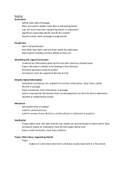
Summarize
- Define main idea of passage
- Does not need to explain main idea in exhausting detail
- Lays out most important supporting details or arguments
- Significant supporting details should be included
- Should contain same message as original text
Paraphrase
- Aid in comprehension
- Puts what they have read into their words by rephrasing
- Owns works including as many details as they can
Identifying the Logical Conclusion
- Combine the information given by the text with what you already know
- Expect the author’s details to be leading in that direction
- Pertinent questions made by author
- Conclusions must be supported directly by text
Directly Stated Information
- Sometimes conclusions are implied from written information, other times stated
directly in passage
- Draw conclusions from information in passage
- Author may provide information then counterargument, be alert for direct statements
rejected or weakened by author
Inferences
- Information that is implied
- Look for contextual clues
- Look for answer choice that has a similar phrase to statement in question
Implication
- Things author does not state directly, but reader can assume based on what author does
- Conclusion based on implication must be well supported by text
- Draw a solid conclusion, must have evidence
Topics, Main Ideas, Supporting Details
- Topics
- Subject of a text ideas what text is all about usually expressed in a few words
, - Main Idea
- Most important point being made by author
- Needs full sentence to be completely defined
- Topics & Main Idea will be stated directly and often appear in a sentence at beginning or
end of non- fiction text
- A body paragraph first sentence is often the main topic sentence which gives you a
summary of the content in the paragraph
- Supporting Details
- Provide evidence, backing up main point
- Reinforce larger points
- Most commonly found in informative and persuasive text
Topic & Summary Sentences
- Encapsulate main idea of text
- Good topic sentence will be clear and not contain jargon
Following directions
- Technical passages
- Scan directions
- Complete each step before moving on
Information from Printed Communication Memos
- Written communication
- Heading
- Body
- Contains plan of action, request for information on a specific topics or response to
request
- Formal style (official documents)
- Bullet points used, which makes it easier for reader to identify key ideas
Post Announcements
- Effective, must contain all information reader requires to act on message
- Perspective of audience
Classified Advertisements
- word/phrase indicating what is being sold
- Description, price, contact information
Summarize
- Define main idea of passage
- Does not need to explain main idea in exhausting detail
- Lays out most important supporting details or arguments
- Significant supporting details should be included
- Should contain same message as original text
Paraphrase
- Aid in comprehension
- Puts what they have read into their words by rephrasing
- Owns works including as many details as they can
Identifying the Logical Conclusion
- Combine the information given by the text with what you already know
- Expect the author’s details to be leading in that direction
- Pertinent questions made by author
- Conclusions must be supported directly by text
Directly Stated Information
- Sometimes conclusions are implied from written information, other times stated
directly in passage
- Draw conclusions from information in passage
- Author may provide information then counterargument, be alert for direct statements
rejected or weakened by author
Inferences
- Information that is implied
- Look for contextual clues
- Look for answer choice that has a similar phrase to statement in question
Implication
- Things author does not state directly, but reader can assume based on what author does
- Conclusion based on implication must be well supported by text
- Draw a solid conclusion, must have evidence
Topics, Main Ideas, Supporting Details
- Topics
- Subject of a text ideas what text is all about usually expressed in a few words
, - Main Idea
- Most important point being made by author
- Needs full sentence to be completely defined
- Topics & Main Idea will be stated directly and often appear in a sentence at beginning or
end of non- fiction text
- A body paragraph first sentence is often the main topic sentence which gives you a
summary of the content in the paragraph
- Supporting Details
- Provide evidence, backing up main point
- Reinforce larger points
- Most commonly found in informative and persuasive text
Topic & Summary Sentences
- Encapsulate main idea of text
- Good topic sentence will be clear and not contain jargon
Following directions
- Technical passages
- Scan directions
- Complete each step before moving on
Information from Printed Communication Memos
- Written communication
- Heading
- Body
- Contains plan of action, request for information on a specific topics or response to
request
- Formal style (official documents)
- Bullet points used, which makes it easier for reader to identify key ideas
Post Announcements
- Effective, must contain all information reader requires to act on message
- Perspective of audience
Classified Advertisements
- word/phrase indicating what is being sold
- Description, price, contact information