HESI FUNDAMENTALS EXIT EXAM
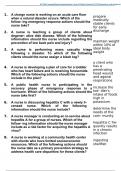
HESI FUNDAMENTALS EXIT EXAM A nurse is teaching staff members about the legal terminology used in child abuse. What definition of battery should the nurse include in the teaching? 1 Maligning a person's character while threatening to do bodily harm. 2 A legal wrong committed by one person against property of another. Correct3 The application of force to another person without lawful justification. 4 Behaving in a way that a reasonable person with the same education would not. Battery means touching in an offensive manner or actually injuring another person. Battery refers to actual bodily harm rather than threats of physical or psychological harm. Battery refers to harm against persons instead of property. Behaving in a way that a reasonable person with the same education would not is the definition of negligence. 65%of students nationwide answered this question correctly. View Topics 3. Confidence: Nailed it Stats Issue with this question? 3. Which nursing interventions require a nurse to wear gloves? (Select all that apply.) 1 Giving a back rub. Correct2 Cleaning a newborn immediately after delivery. Correct3 Emptying a portable wound drainage system. 4 Interviewing a client in the emergency department. 5 Obtaining the blood pressure of a client who is human immunodeficiency virus (HIV) positive Personal protective equipment (PPE) should be used because the newborn is covered with amniotic fluid and maternal blood. PPE should be used because the nurse may be exposed to blood and fluid that are contained in the portable wound drainage system. PPE is not required for a back rub; there is no indication that the nurse is in contact with body secretions. PPE is not necessary when conducting an interview because it is unlikely that the nurse will come in contact with the client's body fluids. PPE is not necessary when obtaining the blood pressure of a client, even if the client is HIV positive. 60%of students nationwide answered this question correctly. View Topics 4. Confidence: Nailed it Stats Issue with this question? 4. A nurse is caring for a client with hemiplegia who is frustrated. How can the nurse motivate the client toward independence? 1 Establish long-range goals for the client. 2 Identify errors that the client can correct. Correct3 Reinforce success in tasks accomplished. 4 Demonstrate ways to promote self-reliance. Success is a basic motivation for learning. People receive satisfaction when a goal is reached. Progress toward long-range goals often is not apparent readily and may be discouraging. Constructive criticism is an important aspect of client teaching, but if it is not tempered with praise, it is discouraging. Demonstrating ways to promote self-reliance is an important part of teaching, but it probably will not motivate the client. 65%of students nationwide answered this question correctly. View Topics 5. Confidence: Pretty sure Stats Issue with this question? 5. A health care provider prescribes a standard walker (pick-up walker with rubber tips on all four legs). The nurse identifies what clinical findings that indicate the client is capable of using a standard walker? 1 Weak upper arm strength and impaired stamina 2 Weight bearing as tolerated and unilateral paralysis 3 Partial weight bearing on the affected extremity and kyphosis Correct4 Strong upper arm strength and non–weight bearing on the affected extremity A walker with four rubber tips on the legs requires more upper body strength than a rolling walker. A client who is non–weight bearing on the affected extremity is able to use a standard walker. A rolling walker is more appropriate for a client with weak upper arm strength and impaired stamina who is less able to lift up and move a walker with four rubber tips. A client with unilateral paralysis is not a candidate for a standard walker; the client must be able to grip and lift the walker with both upper extremities and move the walker forward. A rolling walker is more appropriate for this client. A client with kyphosis is less able to lift up and move a walker with four rubber tips. 62%of students nationwide answered this question correctly. View Topics 6. Confidence: Pretty sure Stats Issue with this question? 6. To prevent footdrop in a client with a leg cast, the nurse should: 1 Encourage complete bed rest to promote healing of the foot. 2 Place the foot in traction. Correct3 Support the foot with 90 degrees of flexion. 4 Place an elastic stocking on the foot to provide support. To prevent footdrop (plantar flexion of the foot due to weakness or paralysis of the anterior muscles of the lower leg) in a client with a cast, the foot should be supported with 90 degrees of flexion. Bed rest can cause footdrop, and 45 degrees is not enough flexion to prevent footdrop . Applying an elastic stocking for support also will not prevent footdrop; a firmer support is required. Test-Taking Tip: On a test day, eat a normal meal before going to school. If the test is late in the morning, take a high-protein snack with you to eat 20 minutes before the examination. The brain works best when it has the glucose necessary for cellular function. 64%of students nationwide answered this question correctly. View Topics 7. Confidence: Nailed it Stats Issue with this question? 7. What should the nurse include in dietary teaching for a client with a colostomy? 1 Liquids should be limited to 1 L per day. 2 Non-digestible fiber and fruits should be eliminated. 3 A formed stool is an indicator of constipation. Correct4 The diet should be adjusted to include foods that result in manageable stools. Each person will need to experiment with diet after a colostomy to determine what foods are best tolerated and also produce stools that are manageable, depending on the type of colostomy. Liquids are typically not limited unless there is a specific reason such as cardiac or renal disease. Food high in fiber such as fruit should be included in the diet as tolerated. Depending on the type of colostomy and the diet, a formed stool is acceptable and does not indicate a constipating diet. STUDY TIP: Remember that intelligence plays a vital role in your ability to learn. However, being smart involves more than just intelligence. Being practical and applying common sense are also part of the learning experience. 66%of students nationwide answered this question correctly. View Topics 9. Confidence: Nailed it Stats Issue with this question? 9. A client with respiratory difficulties asks why the percussion procedure is being performed. The nurse explains that the primary purpose of percussion is to: 1 Relieve bronchial spasm. 2 Increase depth of respirations. Correct3 Loosen pulmonary secretions. 4 Expel carbon dioxide from the lungs. Percussion (chest physiotherapy) loosens pulmonary secretions by mechanical means. This is accomplished by vibrations over the lung fields on the client's posterior, anterior, and lateral chest. Percussion does not relieve bronchial spasms. Once pulmonary secretions are loosened by percussion and the client has a clearer airway, the depth of respirations may increase and facilitate removal of carbon dioxide from the lungs. 70%of students nationwide answered this question correctly. View Topics 10. Confidence: Pretty sure Stats Issue with this question? 10. A 2-year-old child admitted with a diagnosis of pneumonia was administered antibiotics, fluids, and oxygen. The child's temperature increased until it reached 103° F. When notified, the health care provider determined that there was no need to change treatment, even though the child had a history of febrile seizures. Although concerned, the nurse took no further action. Later, the child had a seizure that resulted in neurological impairment. Legally, who is responsible for the child's injury? 1 Health care provider, because this decision took precedence over the nurse's concern 2 Health care provider, because of total responsibility for the child's health and treatment regimen Correct3 Nurse, because failure to further question the health care provider about the child's status placed the child at risk 4 Neither, because high fevers are common in children and the health care provider had little cause for concern It is the nurse's responsibility to foresee potential harm and prevent risks by acting as a client advocate. This is not acceptable as a rationale for inaction. The nurse and health care provider share interdependent roles in the assessment and care of clients. High temperatures are common in children but are nonetheless a valid cause for concern. 71%of students nationwide answered this question correctly. View Topics 11. Confidence: Nailed it Stats Issue with this question? 11. On the third postoperative day following a below-the-knee amputation, a client is refusing to eat, talk, or perform any rehabilitative activities. What is the best initial approach that the nurse should take when interacting with this client? 1 Explain why there is a need to increase activity. 2 Emphasize that with a prosthesis, there will be a return to the previous lifestyle. 3 Appear cheerful and non-critical regardless of the client's response to attempts at intervention. Correct4 Acknowledge that the client's withdrawal is an expected and necessary part of initial grieving. The withdrawal provides time for the client to assimilate what has occurred and integrate the change in body image. The client is not ready to hear explanations about why there is a need to increase activity until assimilation of the surgery has occurred. Emphasizing a return to the previous lifestyle does not acknowledge that the client must grieve; it also does not allow the client to express any feelings that life will never be the same again. In addition, it may be false reassurance. The client might feel that the nurse has no comprehension of the situation or understanding of feelings if the nurse appears cheerful and noncritical regardless of the client's response to attempts at intervention. 68%of students nationwide answered this question correctly. View Topics 12. Confidence: Pretty sure Stats Issue with this question? 12. While assessing an immobilized client, the nurse notes that the client has shortened muscles over a joint, preventing full extension. This condition is known as: 1 Osteoarthritis 2 Osteoporosis 3 Muscle atrophy Correct4 Contracture Immobilized clients are at high risk for the development of contractures. Contractures are characterized by permanent shortening of the muscle covering a joint. Osteoarthritis is a disease process of the weight-bearing joints due to wear and tear. Osteoporosis is a metabolic disease process in which the bones lose calcium. Muscle atrophy is a wasting and/or decrease in the strength and size of muscles due to a lack of physical activity or a neurological or musculoskeletal disorder. 1. The nurse is teaching a client about adequate hand hygiene. What component of hand washing should the nurse include that is most important for removing microorganisms? 1 Soap Incorrect2 Time 3 Water Correct4 Friction Friction is necessary for the removal of microorganisms. Although soap reduces surface tension, which helps remove debris, without friction it has minimal value. Although the length of time the hands are washed is important, without friction it has minimal value. Although water flushes some microorganisms from the skin, without friction it has minimal value. Test-Taking Tip: Answer the question that is asked. Read the situation and the question carefully, looking for key words or phrases. Do not read anything into the question or apply what you did in a similar situation during one of your clinical experiences. Think of each question as being an ideal, yet realistic, situation. 65%of students nationwide answered this question correctly. View Topics 8. Confidence: Nailed it Stats Issue with this question? 8. A nurse identifies that an older adult has not achieved the desired outcome from a prescribed proprietary medication. When assessing the situation, the client shares that the medication is too expensive and the prescription was never filled. What is an appropriate nursing response? Incorrect1 Ask the pharmacist to provide a generic form of the medication. 2 Encourage the client to acquire the medication over the internet. Correct3 Inform the health care provider of the inability to afford the medication. 4 Suggest that the client purchase insurance that covers prescription medications. The health care provider needs to be aware of the reason for the client's lack of response to the medication so that an alternate treatment plan or financial assistance can be arranged (e.g., go to The National Council on the Aging web site [BenefitsCheckUpRx] to establish whether the client is eligible for assistance from any community, state, or federal programs or from the drug company). A health care provider may prefer the proprietary form of the medication. To ask the pharmacist to provide a generic form of the medication is unsafe. To recommend that the client obtain a generic form of the medication is not within the legal role of the nurse, unless the health care provider documents that this is acceptable. Medications purchased over the internet may be illegally imported, counterfeit, expired, or contaminated and therefore should be avoided. Although some prescription insurance plans may help to reduce the cost of some medications, the client may not be able to afford the insurance. 1. A client with heart failure is on a drug regimen of digoxin (Lanoxin) and furosemide (Lasix). The client dislikes oranges and bananas. Which fruit should the nurse encourage the client to eat? Incorrect1 Apples 2 Grapes Correct3 Apricots 4 Cranberries Lasix is potassium depleting; apricots have more than 440 mg of potassium per 100 g. Apples have about 80 to 110 mg of potassium per 100 g. Grapes have about 80 to 160 mg of potassium per 100 g, depending on the variety. Cranberries have about 65 mg of potassium per 100 g. 58%of students nationwide answered this question correctly. View Topics 2. Confidence: Just a guess Stats Issue with this question? 2. What is the best nursing intervention to minimize perineal edema after an episiotomy? Correct1 Applying ice packs Incorrect2 Offering warm sitz baths 3 Administering aspirin prn 4 Elevating the hips on a pillow Cold causes vasoconstriction and reduces edema by lessening the accumulation of blood and lymph at the episiotomy site; cold also deadens nerve endings and lessens the pain. Heat therapy alone does not resolve perineal edema. Aspirin is contraindicated in the early postpartum period because of the risk for hemorrhage. Elevating the hips provides little or minimal perineal relief. STUDY TIP: Answer every question. A question without an answer is the same as a wrong answer. Go ahead and guess. You have studied for the test and you know the material well. You are not making a random guess based on no information. You are guessing based on what you have learned and your best assessment of the question. 68%of students nationwide answered this question correctly. View Topics 3. Confidence: Just a guess Stats Issue with this question? 3. A client is admitted to the hospital after a motor vehicle accident with multiple abrasions and lacerations to the chest and all four extremities. The nurse helps the client select food items for the upcoming meals and recommends: Incorrect1 Meatloaf and tea Correct2 Meatloaf and strawberries 3 Chicken soup and baked apple 4 Chicken soup and buttered bread The meat provides proteins and the fruit provides vitamin C; both promote wound healing. Although meatloaf provides protein, tea does not provide vitamin C. Chicken soup and a baked apple do not meet the client's need for protein or vitamin C. Chicken soup and buttered bread do not meet the client's need for protein or vitamin C. 68%of students nationwide answered this question correctly. View Topics 4. Confidence: Just a guess Stats Issue with this question? 4. A client newly diagnosed with myasthenia gravis is concerned about fluctuations in physical condition and generalized weakness. When caring for this client it is most important for the nurse to plan to: Correct1 Space activities throughout the day 2 Restrict activities and encourage bed rest 3 Teach the client about limitations imposed by the disorder Incorrect4 Have a family member stay at the bedside to give the client support Spacing activities encourages maximum functioning within the limits of the client's strength and endurance. Bed rest and limited activity may lead to muscle atrophy and calcium depletion. Teaching the limitations imposed by the disorder is necessary for lifelong psychological adjustment, but does not address the client's concerns at this time. Having a member of the family stay and give the client support should be permitted if requested by the client or family, but does not address the concerns voiced by the client. 64%of students nationwide answered this question correctly. View Topics 5. Confidence: Just a guess Stats Issue with this question? 5. An older client's colonoscopy reveals the presence of extensive diverticulosis. What type of diet should the nurse encourage the client to follow? Incorrect1 Low-fat Correct2 High-fiber 3 High-protein 4 Low-carbohydrate Fiber promotes passage of residue through the intestine, thereby preventing constipation. Constipation causes straining at stool; this increases intraluminal pressure, which can precipitate diverticulitis or perforation of diverticulum. The other diets are not indicated for diverticulosis. 1. A client with a left ureteral calculus is scheduled for a transurethral ureterolithotomy. During the preoperative assessment, the nurse expects the client to report pain: 1 That is a boring-type pain that is located in the left flank Incorrect2 That occurs with each urination and is located at the level of the kidneys 3 That is dull and constant and located in the costovertebral angle Correct4 That is spasmodic and located in the left side and radiating to the suprapubic area Pain with ureteral stones is caused by spasm and is excruciating and intermittent; it follows the path of the ureter to the bladder. Pain is spasmodic and excruciating, not boring. Pain intensifies as the calculus lodges in the ureter and spasms occur in an attempt to dislodge it. Spasmodic pain on the left side that radiates to the suprapubis is typical of pain caused by a stone in the renal pelvis. STUDY TIP: Focus your study time on the common health problems that nurses most frequently encounter. 61%of students nationwide answered this question correctly. View Topics 2. Confidence: Pretty sure Stats Issue with this question? 2. A client is cautioned to avoid vitamin D toxicity while increasing protein intake. Which nutrient selected by the client indicates to the nurse that the dietary teaching is understood? Correct1 Tofu Incorrect2 Eggnog 3 Cottage cheese 4 Powdered whole milk Tofu products increase protein without increasing vitamin D because, unlike milk products, tofu does not contain vitamin D. Eggnog contains milk and should be avoided. Cottage cheese, a milk product, contains vitamin D, which should be avoided. Powdered whole milk contains vitamin D and should be avoided. 63%of students nationwide answered this question correctly. View Topics 8. Confidence: Nailed it Stats Issue with this question? 8. The nurse teaches a client who developed degenerative joint disease of the vertebral column positioning techniques, including turning from back to side, keeping the spine straight. The nurse explains that the least effort will be exerted if the client crosses the arm over the chest and: 1 Uses the overbed table to pull the upper body up to assist with turning Correct2 Bends the top knee to the side to which the client is turning 3 Crosses the ankles while turning and keeps both legs straight Incorrect4 Flexes the bottom knee to the side the client wishes to turn Putting the upper arm and leg toward the side to which the client is turning uses body weight to facilitate turning; the spine is kept straight. Using the overbed table to pull up will result in twisting the spinal column. This is unsafe; an overbed table has wheels and is not a stable object. Crossing the ankles while turning with both legs straight can be done if another person were turning the client; when turning alone in this position, the client will have no leverage and turning probably will result in twisting the spinal column. Flexing the bottom knee to the side to which the client wishes to turn will interfere with turning because the bent leg becomes an obstacle and provides a force opposite to the leverage needed to turn. STUDY TIP: Laughter is a great stress reliever. Watching a short program that makes you laugh, reading something funny, or sharing humor with friends helps decrease stress. 55%of students nationwide answered this question correctly. View Topics 13. Confidence: Nailed it Stats Issue with this question? 13. A client was recently diagnosed with a cancerous lesion of the mouth. What should the nurse ask when analyzing the client's need for health education in relation to this health problem? 1 "Are you having difficulty sleeping?" Incorrect2 "Do feel like your gums are inflamed?" 3 "How frequently are you seeing the dentist?" Correct4 "Have you noticed any change in your appetite?" Problems involving the oral cavity often result in nutritional problems. The question "Have you noticed any change in your appetite?" will elicit more information. An inability to sleep usually is not a characteristic symptom of cancer of the oral cavity; it may occur after the diagnosis because of worry or fear. Gum infections usually are not an early problem after diagnosis of oral cancer. Lesions of the oral cavity do not tend to cause major dental problems. Test-Taking Tip: If the question asks for an immediate action or response, all of the answers may be correct, so base your selection on identified priorities for action. 58%of students nationwide answered this question correctly. View Topics 16. Confidence: Just a guess Stats Issue with this question? 16. A nurse is teaching a class about hepatitis, specifically hepatitis A. Which food should the nurse explain most likely will remain contaminated with the hepatitis A virus after being cooked? Incorrect1 Canned tuna 2 Broiled shrimp 3 Baked haddock Correct4 Steamed lobster The temperature during steaming is never high enough or sustained long enough to kill microorganisms. Processing destroys the virus. Because of the extremely high temperature, broiling sufficiently destroys the virus. Baking will destroy the virus. STUDY TIP: Do not change your pattern of study. It obviously has contributed to your being here, so it worked. If you have studied alone, continue to study alone. If you have studied in a group, form a study group. 47%of students nationwide answered this question correctly. View Topics 18. Confidence: Just a guess Stats Issue with this question? 18. A nurse is caring for a client that has been admitted with right sided heart failure. The nurse notes that the client has dependent edema around the area of the feet and ankles. In order to characterize the severity of the edema, the nurse presses the medial malleolus area and notes an 8 mm depression after release. This nurse understands that the edema should be documented as: 1 1+ Incorrect2 2+ 3 3+ Correct4 4+ Dependent edema around the area of feet and ankles often indicates right sided heart failure or venous insufficiency. The nurse should assess for pitting edema by pressing firmly for several seconds then release to assess for any depression left on the skin. The grading of 1+ to 4+ characterizes the severity of the edema. A grade of grade of 4+ indicates an 8 mm depression. A grade of 1+ indicates a 2 mm depression. A grade of 2 + indicates a 4 mm depression. A grade of 3+ indicates a 6 mm depression. 68%of students nationwide answered this question correctly. View Topics 24. Confidence: Pretty sure Stats Issue with this question? 24. A mother whose newborn infant son has a cleft lip and palate asks how to feed her baby because he has difficulty suckling. What information should the nurse provide concerning safe feeding technique for this infant? 1 "Because he tires easily, it's best to have him lying in bed while he is being fed." 2 "Hold him in a horizontal position and feed him slowly to help prevent aspiration." Incorrect3 "Try using a soft nipple with an enlarged opening so he can get the milk through a chewing motion." Correct4 "Give him brief rest periods and frequent burpings during feedings so he can get rid of swallowed air." Cleft lip and palate, a congenital defect, prevents the infant from creating a tight seal with the lips to facilitate suckling. As a result, the infant swallows large amounts of air when feeding. The mother should be taught to provide frequent rest periods and to burp the infant often to expel excess air in the stomach. Infants with cleft lip and palate should be held upright during feedings. Newborn infants cannot chew and do not make chewing movements. 63%of students nationwide answered this question correctly. View Topics 27. Confidence: Pretty sure Stats Issue with this question? 27. A client who has been in a coma for two months is being maintained on bed rest. The nurse concludes that to prevent the effects of shearing force, the head of the bed should be maintained at an angle of: Correct1 30 degrees Incorrect2 45 degrees 3 60 degrees 4 90 degrees Shearing force occurs when two surfaces move against each other; when the bed is at an angle greater than 30 degrees, the torso tends to slide and causes this phenomenon. Forty-five degrees, 60 degrees, and 90 degrees raise the head of the bed too high, which contributes to the client sliding down in bed. 76%of students nationwide answered this question correctly. View Topics 28. Confidence: Pretty sure Stats Issue with this question? 28. A client is receiving a 2-gram sodium diet. The family asks whether they can bring snacks from home. The nurse suggests that they bring foods low in sodium such as: 1 Ice cream Incorrect2 Celery sticks Correct3 Fresh orange wedges 4 Peanut butter cookies An orange contains only trace amounts of sodium. One cup of ice cream contains approximately 115 mg of sodium. One cup of celery contains approximately 106 mg of sodium. Four peanut butter cookies contain 142 mg of sodium. 54%of students nationwide answered this question correctly. View Topics 30. Confidence: Nailed it Stats Issue with this question? 30. A client is hospitalized for the treatment of thrombophlebitis. What should the nurse include in the client's teaching plan related to how to prevent thrombophlebitis? Incorrect1 Perform leg exercises 2 Sit with the knees flexed 3 Apply warm soaks to the legs daily Correct4 Put on elastic stockings before arising Donning elastic stockings before getting out of bed provides support and promotes venous return; applying stockings while the legs are horizontal ensures that the stockings are in place before dependent edema occurs. Although leg exercises are helpful, this will not provide continuous support for the veins. Sitting with the knees flexed promotes venous stasis and the formation of thrombophlebitis. Warm soaks resolve inflammation; they do not prevent the development of thrombophlebitis. 3. Discharge planning for an ambulatory client with Parkinson disease (PD) includes recommending equipment for home use that will help with activities of daily living. To foster independence, the nurse should promote the use of: Correct1 Raised toilet seat 2 Side rails for the bed 3 Trapeze above the bed 4 Crutches for ambulation A raised toilet seat will reduce strain on the back muscles and make it easier for the client to rise from the seat without injury. The client is not bedridden and will not need side rails for the bed or a trapeze above the bed. Clients with Parkinson disease have poor balance and a propulsive gait, which makes it unsafe to use crutches. STUDY TIP: Develop a realistic plan of study. Do not set rigid, unrealistic goals. 54%of students nationwide answered this question correctly. View Topics 4. Confidence: Pretty sure Stats Issue with this question? 4. A client's serum albumin value is 2.8 g/dL. Which food selected by the client indicates that the nurse's dietary teaching is successful? 1 Beef broth 2 Fruit salad Correct3 Sliced turkey 4 Spinach salad This client's serum albumin value indicates severe depletion of visceral protein stores; the expected range for serum albumin is 3.5 to 5.5 g/dL. White meat turkey (two slices 4 × 2 × 1/4 inch) contains approximately 28 g of protein. A 4 oz serving of beef broth contains approximately 2.4 g of protein. A 6 oz serving of mixed fruit contains approximately 0.5 g of protein. A 3 oz serving of spinach salad contains approximately 9 g of protein. 51%of students nationwide answered this question correctly. View Topics 5. Confidence: Nailed it Stats Issue with this question? 5. A nurse in a rehabilitation center teaches clients with quadriplegia to use an adaptive wheelchair. Why is it important that the nurse provide this instruction? Correct1 It is unlikely that the client will regain the ability to walk. 2 It prepares them for wearing braces. 3 It assists them in overcoming orthostatic hypotension. 4 They have the strength in the upper extremities for self-transfer. Clients with quadriplegia do not have the muscle innervation, strength, or balance needed for ambulation. Bracing and crutch-walking require muscle strength and coordination that an individual with quadriplegia does not have. Orthostatic hypotension can be prevented by a gradual assumption of the upright position and does not necessarily require a wheelchair. Quadriplegia refers to paralysis of all four extremities. 56%of students nationwide answered this question correctly. View Topics 6. Confidence: Nailed it Stats Issue with this question? 6. Why is it important for a nurse in the prenatal clinic to provide nutritional counseling to all newly pregnant women? 1 Most weight gain is caused by fluid retention. Correct2 Different cultural groups favor different essential nutrients. 3 Dietary allowances should not increase throughout pregnancy. 4 Pregnant women must adhere to a specific pregnancy dietary regimen. The nurse should become informed about the cultural eating patterns of clients so that foods containing the essential nutrients that are part of these dietary patterns may be included in the diet. Fluid retention is only one component of weight gain; growth of the fetus, placenta, breasts, and uterus also contributes to weight gain. The need for calories and nutrients increases during pregnancy. Pregnancy diets are not specific; they are composed of the essential nutrients. 61%of students nationwide answered this question correctly. View Topics 7. Confidence: Nailed it Stats Issue with this question? 7. A nurse is providing dietary teaching for a client with celiac disease. Which foods should the nurse teach the client to avoid when following a gluten-free diet? (Select all that apply.) Correct1 Rye Correct2 Oats 3 Rice 4 Corn Correct5 Wheat Rye should be avoided because it is irritating to the gastrointestinal mucosa. Oats should be avoided because they are irritating to the gastrointestinal mucosa. Products containing wheat should be avoided because they are irritating to the gastrointestinal mucosa. Gluten is not found in rice; therefore, it does not have to be avoided. Gluten is not found in corn; therefore, it does not have to be avoided. STUDY TIP: Becoming a nursing student automatically increases stress levels because of the complexity of the information to be learned and applied and because of new constraints on time. One way to decrease stress associated with school is to become very organized so that assignment deadlines or tests do not come as sudden surprises. By following a consistent plan for studying and completing assignments, you can stay on top of requirements and thereby prevent added stress. 48%of students nationwide answered this question correctly. View Topics 9. Confidence: Just a guess Stats Issue with this question? 9. A client is experiencing stomatitis as a result of chemotherapy. Which nursing action is most appropriate when caring for this client? Correct1 Provide frequent saline mouthwashes. 2 Use karaya powder to decrease irritation. 3 Increase fluid intake to compensate for accompanying diarrhea. 4 Provide meticulous skin care of the abdomen with an antiseptic. Saline mouthwashes are soothing to the oral mucosa and help clean the mouth, minimizing infection. Stomatitis refers to the oral cavity; karaya is used to protect the skin around a stoma created on the abdomen. Stomatitis does not cause diarrhea or fluid loss. The abdomen is not involved; stomatitis is an inflammation of the oral mucosa. 61%of students nationwide answered this question correctly. View Topics 10. Confidence: Nailed it Stats Issue with this question? 10. A nurse is monitoring a client with renal failure for signs of fluid excess. Which finding does the nurse identify as inconsistent with fluid excess? 1 Increased weight 2 Distended neck veins Correct3 Orthostatic hypotension 4 Abnormal breath sounds Hypertension, not hypotension, is an indicator of fluid volume excess. Fluid excess causes weight gain; one liter weighs 2.2 lb. Fluid excess increases the intravascular volume, leading to jugular vein distention. Fluid excess causes fluid in the alveoli that leads to crackles, a sign of pulmonary edema. Test-Taking Tip: Identifying content and what is being asked about that content is critical to your choosing the correct response. Be alert for words in the stem of the item that are the same or similar in nature to those in one or two of the options. Example: If the item relates to and identifies stroke rehabilitation as its focus and only one of the options contains the word stroke in relation to rehabilitation, you are safe in identifying this choice as the correct response. 62%of students nationwide answered this question correctly. View Topics 11. Confidence: Nailed it Stats Issue with this question? 11. When assisting a client who had a total hip replacement onto the bedpan on the first postoperative day, the nurse should instruct the client to: 1 Turn toward the operative side 2 Flex both knees while slowly lifting the pelvis 3 Extend both legs and pull on the trapeze to lift the pelvis Correct4 Flex the unaffected knee and pull on the trapeze to raise the pelvis The pelvis is elevated by actions involving the unaffected upper extremities and unaffected leg. Turning toward the operative side is not permitted because it causes adduction of the leg and can lead to dislocation of the femoral head. Flexing both knees while slowly lifting the pelvis puts pressure on the operative hip, which is contraindicated because it may dislocate the prosthesis. Lifting only with the arms requires strength; the use of both heels puts pressure on the operative hip, which may dislocate the prosthesis. 64%of students nationwide answered this question correctly. View Topics 12. Confidence: Nailed it Stats Issue with this question? 12. Which alternative therapy may be beneficial for the nurse to discuss with a client who has terminal bone cancer? Correct1 Biofeedback 2 Radiotherapy 3 Bariatric therapy 4 Radioactive implants Biofeedback provides information about changes in body function; clients can learn to use this to control a variety of body responses, including pain. Radiotherapy is a part of standard medical regimens. Bariatrics is a type of therapy that focuses on the correction of obesity; it encompasses prevention, control, and treatment of the problem, which involves medications and surgery. Placement of radioactive sources into or in contact with tissues (brachytherapy) is part of standard medical treatment for cancer. 55%of students nationwide answered this question correctly. View Topics 14. Confidence: Pretty sure Stats Issue with this question? 14. A nurse reviews the prescribed treatment with the parents of an infant born with bilateral clubfeet. Which parental statement indicates to the nurse that further education is required? 1 "We'll have to start serial casting right away." 2 "The casts will have to be changed every week." 3 "The baby may have to have surgery if the problem's not fixed in a few months." Correct4 "We'll have to have the baby fitted with prosthetic devices before he'll be able to walk." Most children with bilateral clubfeet are eventually able to walk without much difficulty. Prosthetic devices generally are not indicated. Serial casting with cast changes every week is usually successful. If serial casting is not effective, surgical intervention may be necessary. Test-Taking Tip: Monitor questions that you answer with an educated guess or changed your answer from the first option you selected. This will help you to analyze your ability to think critically. Usually your first answer is correct and should not be changed without reason.
Written for
- Institution
- HESI FUNDAMENTALS EXIT
- Course
- HESI FUNDAMENTALS EXIT
Document information
- Uploaded on
- June 10, 2022
- Number of pages
- 84
- Written in
- 2021/2022
- Type
- Exam (elaborations)
- Contains
- Questions & answers
Subjects
-
hesi fundamentals exit exam
-
hesi fundamentals exit exam a nurse is teaching staff members about the legal terminology used in child abuse what definition of battery should the nurse include in the t

Also available in package deal