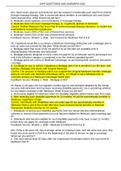
AHIP QUESTIONS AND ANSWERS 2022
Mrs. West wears glasses and dentures and has enjoyed considerable pain relief from arthritis
through massage therapy. She is concerned about whether or not Medicare will cover these
items and services. What should you tell her?
a. Medicare covers glasses, but not dentures or massage therapy.
b. Medicare does not cover massage therapy, or, in general, glasses or dentures.
Correct: Neither Medicare Part A nor Part B covers massage therapy, dentures, or routine eye
examinations to prescribe eyeglasses.
c. Medicare covers 80% of the cost of these three services.
d. Medicare covers 50% of the cost of these three services.
Feedback Source: Module 1, Slide - Not Covered by Medicare Part A & B
Mr. Capadona would like to purchase a Medicare Advantage (MA) plan and a Medigap plan to
pick up costs not covered by that plan. What should you tell him?
a. Medigap plans that cover costs not paid for by an MA plan are available only in
Massachusetts, Minnesota, and Wisconsin.
b. Medigap policies designed to cover costs not paid for by an MA plan can be purchased, but
only if the MA plan’s design is considered to be the “defined standard benefit.”
c. Medigap plans are a form of Medicare Advantage, so purchasing both would be redundant
coverage.
d. It is illegal for you to sell Mr. Capadona a Medigap plan if he is enrolled in an MA plan, and
besides, Medigap only works with Original Medicare.
Correct: The purpose of Medigap plans is to supplement Original Medicare benefits. Medigap
plans do not work with Medicare Advantage plans. It is illegal to sell a Medigap plan to
someone already in a Medicare Advantage health plan.
Feedback Source: Module 1, Slide - Medigap is NOT
Mr. Bauer is 49 years old, but eighteen months ago he was declared disabled by the Social
Security Administration and has been receiving disability payments. He is wondering whether
he can obtain coverage under Medicare. What should you tell him?
a. He became eligible for Medicare when his disability eligibility determination was first made.
b. After receiving such disability payments for 24 months, he will be automatically enrolled in
Medicare, regardless of age.
Correct: Individuals with disabilities who are under age 65 are automatically enrolled in
Medicare Parts A and B the month after they have received Social Security or Railroad
Retirement disability benefits for 24 months.
c. Individuals receiving such disability payments from the Social Security Administration
continue to receive those payments but only become eligible for Medicare upon reaching age
65.
d. Individuals who become eligible for such disability payments only have to wait 12 months
before they can apply for coverage under Medicare.
Feedback Source: Module 1, Slide - Medicare Enrollment Part A & B
Mrs. Peňa is 66 years old, has coverage under an employer plan, and will retire next year. She
heard she must enroll in Part B at the beginning of the year to ensure no gap in coverage.
What can you tell her?
a. She must wait at least 30 days after her employment terminates before she may enroll in
Medicare Part B.
,b. She may enroll at any time while she is covered under her employer plan, but she will have
a special eight-month enrollment period after the last month on her employer plan that differs
from the standard general enrollment period, during which she may enroll in Medicare Part B.
Correct: As long as Mrs. Peňa is covered under her employer’s plan, she can enroll in Part B at
any time. If she retires, she will be able to enroll in Part B during a special enrollment period
that lasts 8 months following the last month of her employer coverage.
c. She may not enroll in Part B while covered under an employer group health plan and must
wait until the standard general enrollment period after she retires.
d. She may only enroll in Part B during the general enrollment period whether she is retired or
not
Feedback Source: Module 1, Slide - Enrollment in Parts A & B After the Initial Enrollment
Period
Mrs. Gonzalez is enrolled in Original Medicare and has a Medigap policy as well, but it
provides no drug coverage. She would like to keep the coverage she has but replace her
existing Medigap plan with one that provides drug coverage. What should you tell her?
a. Mrs. Gonzalez should purchase a K or L Medigap plan.
b. Mrs. Gonzalez can purchase a Medigap plan that covers drugs, but it likely won’t offer
coverage that is equivalent to that provided under Part D.
c. Mrs. Gonzalez cannot purchase a Medigap plan that covers drugs, but she could keep her
Medigap policy and enroll in a Part D prescription drug plan.
Correct: Individuals who are enrolled in Medigap plans may only obtain Medicare drug
coverage (Part D) through a stand-alone prescription drug plan.
d. Medigap is a replacement for Original Medicare and she has been paying for double
coverage. She should simply drop her Medigap policy.
Feedback Source: Module 1, Slide - Beneficiaries with Medigap Plans with Drug Coverage
Mrs. Park is an elderly retiree. Mrs. Park has a low fixed income. What could you tell Mrs.
Park that might be of assistance?
a. She should not sign up for a Medicare Advantage plan.
b. She should only seek help from private organizations to cover her Medicare costs.
c. She can apply to the Medicare agency for lower premiums and cost-sharing.
d. She should contact her state Medicaid agency to see if she qualifies for one of several
programs that can help with Medicare costs for which she is responsible.
Correct: Mrs. Park can apply for programs through her State Medicaid office that could assist
with her Medicare costs, such as Medicare Savings Programs, Part D low-income subsidies,
and Medicaid.
Feedback Source: Module 1, Slide - Help for Individuals with Limited Income/Resources
Mr. Alonso receives some help paying for his two generic prescription drugs from his
employer’s retiree coverage, but he wants to compare it to a Part D prescription drug plan. He
asks you what costs he would generally expect to encounter when enrolling into a standard
Medicare Part D prescription drug plan. What should you tell him?
a. He generally would pay only a per-prescription co-payment. Medicare covers all other costs.
b. He generally would pay only a monthly premium. Medicare covers all other costs.
c. He generally would pay only a monthly premium and deductible. Medicare covers all other
costs.
d. He generally would pay a monthly premium, annual deductible, and per-prescription cost-
sharing.
,Correct: Costs for Part D beneficiaries typically include a monthly premium, annual deductible,
and per-prescription cost-sharing.
Feedback Source: Module 1, Slide - Original Medicare and Part D Prescription Drug Coverage.
Mr. Patel is in good health and is preparing a budget in anticipation of his retirement when he
turns 66. He wants to understand the health care costs he might be exposed to under
Medicare if he were to require hospitalization as a result of an illness. In general terms, what
could you tell him about his costs for inpatient hospital services under Original Medicare?
a. Under Original Medicare, there is a single deductible amount due for the first 60 days of any
inpatient hospital stay, after which it converts into a per-day coinsurance amount through day
90. After day 90, he would pay a daily amount up to 60 days over his lifetime, after which he
would be responsible for all costs.
Correct: Beneficiaries are responsible for a single deductible amount for each benefit period,
followed by a per day coinsurance amount through day 90. For day 91 and beyond, there is a
charge for each “lifetime reserve day” up to 60 days over a beneficiary’s lifetime. After this, he
would be responsible for all costs.
b. Under Original Medicare, the inpatient hospital co-payment is a percentage of allowed
charges. The percentage increases after 60 days and again after 90 days.
c. Under Original Medicare, if the inpatient hospital service is provided by a participating
Medicare provider, the co-payment is waived. Co-payments are only charged when a
beneficiary opts to receive care from a non-participating provider.
d. Under Original Medicare, the inpatient hospital co-payment is a flat per-day amount that
remains the same throughout the first 60 days of a beneficiary’s stay. After day 60 the amount
gradually increases until day 90. After 90 days he would pay the full amount of all costs.
Feedback Source: Module 1, Slide - Medicare Part A - Original Medicare Cost-Sharing for
Inpatient Hospital Care
Mrs. Chen will be 65 soon, has been a citizen for twelve years, has been employed full time,
and paid taxes during that entire period. She is concerned that she will not qualify for coverage
under part A because she was not born in the United States. What should you tell her?
a. All individuals who are citizens and age 65 or over will be covered under Part A.
b. Most individuals who are citizens and age 65 or over and are covered under Part A must pay
a monthly premium for that coverage.
c. Most individuals who are citizens and age 65 or over and wish to be covered under Part A
must enroll in a Medicare Advantage Plan.
d. Most individuals who are citizens and age 65 or over are covered under Part A by virtue of
having paid Medicare taxes while working, though some may be covered as a result of paying
monthly premiums.
Correct: Most individuals who are citizens and age 65 or older may qualify for coverage either
because they pay a monthly premium or because they paid Medicare taxes while working for a
specific duration.
Feedback Source: Module 1, Slide - Eligibility for Part A & B Benefits and Slide - Medicare
Premiums Part A
Agent John Miller is meeting with Jerry Smith, a new prospect. Jerry is currently enrolled in
Medicare Parts A and B. Jerry has also purchased a Medicare Supplement (Medigap) plan
which he has had for several years. However, the plan does not provide drug benefits. How
would you advise Agent John Miller to proceed?
, a. Tell prospect Jerry Smith that he should keep his Medigap plan but he should supplement
his healthcare coverage by purchasing a Medicare Advantage plan that offers prescription drug
coverage (MA-PD).
b. Tell prospect Jerry Smith that he should consider adding a standalone Part D prescription
drug coverage policy to his present coverage.
Correct: Agent John Miller can help prospect Jerry select a standalone Part D prescription drug
plan that complements his current Original Medicare and Medigap coverage. Alternatively,
Agent Miller can suggest that Jerry drop his Medigap coverage and enroll in a MA-PD plan.
c. Tell prospect Jerry Smith that he should drop his Medigap coverage and put those premium
dollars toward the purchase of a standalone Part D prescription drug plan because he can
always reactivate his Medigap policy on a guaranteed issue basis. Furthermore, because he
has had Medigap Jerry will not incur a Part D late enrollment penalty.
d. Tell prospect Jerry Smith that Medigap is simply a variation of a Medicare Advantage plan
and the companies John represents offer more comprehensive coverage for a lower price.
Feedback Source: Module 1, Slide - Medigap (Medicare Supplement Insurance) and Slide -
Medigap is NOT
Mr. Buck has several family members who died from different cancers. He wants to know if
Medicare covers cancer screening. What should you tell him?
a. Medicare covers all screening tests that have been approved by the FDA on a frequency
determined by the treating physician.
b. Medicare covers some screening tests that must be performed within the first year after
enrollment. Beyond that point expenses for screening tests are the responsibility of the
beneficiary.
c. Medicare covers the periodic performance of a range of screening tests that are meant to
provide early detection of disease. Mr. Buck will need to check specific tests before obtaining
them to see if they will be covered.
Correct: Original Medicare and Medicare Advantage plans cover most preventive services,
such as screening tests, but beneficiaries must confirm coverage of specific tests with their
plans.
d. Medicare covers treatments for existing disease, injury, and malformed limbs or body parts.
As such, it does not cover any screening tests and these must be paid for by the beneficiary
out-of-pocket.
Feedback Source: Module 1, Slide - Medicare Part B Benefits - Preventive Services and
Screenings
Juan Perez, who is turning age 65 next month, intends to work for several more years at
Smallcap, Incorporated. Smallcap has a workforce of 15 employees and offers employer-
sponsored healthcare coverage. Juan is a naturalized citizen and has contributed to the
Medicare system for over 20 years. Juan asks you if he will be entitled to Medicare and if he
enrolls how that will impact his employer-sponsored healthcare coverage. How would you
respond?
Correct: a. Juan is likely to be eligible for Medicare once he turns age 65 and if he enrolls
Medicare would become the primary payor of his healthcare claims and Smallcap does not
have to continue to offer him coverage comparable to those under age 65 under its employer-
sponsored group health plan.
b. Juan is likely to be eligible for Medicare once he turns age 65 and if he enrolls Medicare
would become the primary payor of his healthcare claims but Smallcap must continue to offer
Mrs. West wears glasses and dentures and has enjoyed considerable pain relief from arthritis
through massage therapy. She is concerned about whether or not Medicare will cover these
items and services. What should you tell her?
a. Medicare covers glasses, but not dentures or massage therapy.
b. Medicare does not cover massage therapy, or, in general, glasses or dentures.
Correct: Neither Medicare Part A nor Part B covers massage therapy, dentures, or routine eye
examinations to prescribe eyeglasses.
c. Medicare covers 80% of the cost of these three services.
d. Medicare covers 50% of the cost of these three services.
Feedback Source: Module 1, Slide - Not Covered by Medicare Part A & B
Mr. Capadona would like to purchase a Medicare Advantage (MA) plan and a Medigap plan to
pick up costs not covered by that plan. What should you tell him?
a. Medigap plans that cover costs not paid for by an MA plan are available only in
Massachusetts, Minnesota, and Wisconsin.
b. Medigap policies designed to cover costs not paid for by an MA plan can be purchased, but
only if the MA plan’s design is considered to be the “defined standard benefit.”
c. Medigap plans are a form of Medicare Advantage, so purchasing both would be redundant
coverage.
d. It is illegal for you to sell Mr. Capadona a Medigap plan if he is enrolled in an MA plan, and
besides, Medigap only works with Original Medicare.
Correct: The purpose of Medigap plans is to supplement Original Medicare benefits. Medigap
plans do not work with Medicare Advantage plans. It is illegal to sell a Medigap plan to
someone already in a Medicare Advantage health plan.
Feedback Source: Module 1, Slide - Medigap is NOT
Mr. Bauer is 49 years old, but eighteen months ago he was declared disabled by the Social
Security Administration and has been receiving disability payments. He is wondering whether
he can obtain coverage under Medicare. What should you tell him?
a. He became eligible for Medicare when his disability eligibility determination was first made.
b. After receiving such disability payments for 24 months, he will be automatically enrolled in
Medicare, regardless of age.
Correct: Individuals with disabilities who are under age 65 are automatically enrolled in
Medicare Parts A and B the month after they have received Social Security or Railroad
Retirement disability benefits for 24 months.
c. Individuals receiving such disability payments from the Social Security Administration
continue to receive those payments but only become eligible for Medicare upon reaching age
65.
d. Individuals who become eligible for such disability payments only have to wait 12 months
before they can apply for coverage under Medicare.
Feedback Source: Module 1, Slide - Medicare Enrollment Part A & B
Mrs. Peňa is 66 years old, has coverage under an employer plan, and will retire next year. She
heard she must enroll in Part B at the beginning of the year to ensure no gap in coverage.
What can you tell her?
a. She must wait at least 30 days after her employment terminates before she may enroll in
Medicare Part B.
,b. She may enroll at any time while she is covered under her employer plan, but she will have
a special eight-month enrollment period after the last month on her employer plan that differs
from the standard general enrollment period, during which she may enroll in Medicare Part B.
Correct: As long as Mrs. Peňa is covered under her employer’s plan, she can enroll in Part B at
any time. If she retires, she will be able to enroll in Part B during a special enrollment period
that lasts 8 months following the last month of her employer coverage.
c. She may not enroll in Part B while covered under an employer group health plan and must
wait until the standard general enrollment period after she retires.
d. She may only enroll in Part B during the general enrollment period whether she is retired or
not
Feedback Source: Module 1, Slide - Enrollment in Parts A & B After the Initial Enrollment
Period
Mrs. Gonzalez is enrolled in Original Medicare and has a Medigap policy as well, but it
provides no drug coverage. She would like to keep the coverage she has but replace her
existing Medigap plan with one that provides drug coverage. What should you tell her?
a. Mrs. Gonzalez should purchase a K or L Medigap plan.
b. Mrs. Gonzalez can purchase a Medigap plan that covers drugs, but it likely won’t offer
coverage that is equivalent to that provided under Part D.
c. Mrs. Gonzalez cannot purchase a Medigap plan that covers drugs, but she could keep her
Medigap policy and enroll in a Part D prescription drug plan.
Correct: Individuals who are enrolled in Medigap plans may only obtain Medicare drug
coverage (Part D) through a stand-alone prescription drug plan.
d. Medigap is a replacement for Original Medicare and she has been paying for double
coverage. She should simply drop her Medigap policy.
Feedback Source: Module 1, Slide - Beneficiaries with Medigap Plans with Drug Coverage
Mrs. Park is an elderly retiree. Mrs. Park has a low fixed income. What could you tell Mrs.
Park that might be of assistance?
a. She should not sign up for a Medicare Advantage plan.
b. She should only seek help from private organizations to cover her Medicare costs.
c. She can apply to the Medicare agency for lower premiums and cost-sharing.
d. She should contact her state Medicaid agency to see if she qualifies for one of several
programs that can help with Medicare costs for which she is responsible.
Correct: Mrs. Park can apply for programs through her State Medicaid office that could assist
with her Medicare costs, such as Medicare Savings Programs, Part D low-income subsidies,
and Medicaid.
Feedback Source: Module 1, Slide - Help for Individuals with Limited Income/Resources
Mr. Alonso receives some help paying for his two generic prescription drugs from his
employer’s retiree coverage, but he wants to compare it to a Part D prescription drug plan. He
asks you what costs he would generally expect to encounter when enrolling into a standard
Medicare Part D prescription drug plan. What should you tell him?
a. He generally would pay only a per-prescription co-payment. Medicare covers all other costs.
b. He generally would pay only a monthly premium. Medicare covers all other costs.
c. He generally would pay only a monthly premium and deductible. Medicare covers all other
costs.
d. He generally would pay a monthly premium, annual deductible, and per-prescription cost-
sharing.
,Correct: Costs for Part D beneficiaries typically include a monthly premium, annual deductible,
and per-prescription cost-sharing.
Feedback Source: Module 1, Slide - Original Medicare and Part D Prescription Drug Coverage.
Mr. Patel is in good health and is preparing a budget in anticipation of his retirement when he
turns 66. He wants to understand the health care costs he might be exposed to under
Medicare if he were to require hospitalization as a result of an illness. In general terms, what
could you tell him about his costs for inpatient hospital services under Original Medicare?
a. Under Original Medicare, there is a single deductible amount due for the first 60 days of any
inpatient hospital stay, after which it converts into a per-day coinsurance amount through day
90. After day 90, he would pay a daily amount up to 60 days over his lifetime, after which he
would be responsible for all costs.
Correct: Beneficiaries are responsible for a single deductible amount for each benefit period,
followed by a per day coinsurance amount through day 90. For day 91 and beyond, there is a
charge for each “lifetime reserve day” up to 60 days over a beneficiary’s lifetime. After this, he
would be responsible for all costs.
b. Under Original Medicare, the inpatient hospital co-payment is a percentage of allowed
charges. The percentage increases after 60 days and again after 90 days.
c. Under Original Medicare, if the inpatient hospital service is provided by a participating
Medicare provider, the co-payment is waived. Co-payments are only charged when a
beneficiary opts to receive care from a non-participating provider.
d. Under Original Medicare, the inpatient hospital co-payment is a flat per-day amount that
remains the same throughout the first 60 days of a beneficiary’s stay. After day 60 the amount
gradually increases until day 90. After 90 days he would pay the full amount of all costs.
Feedback Source: Module 1, Slide - Medicare Part A - Original Medicare Cost-Sharing for
Inpatient Hospital Care
Mrs. Chen will be 65 soon, has been a citizen for twelve years, has been employed full time,
and paid taxes during that entire period. She is concerned that she will not qualify for coverage
under part A because she was not born in the United States. What should you tell her?
a. All individuals who are citizens and age 65 or over will be covered under Part A.
b. Most individuals who are citizens and age 65 or over and are covered under Part A must pay
a monthly premium for that coverage.
c. Most individuals who are citizens and age 65 or over and wish to be covered under Part A
must enroll in a Medicare Advantage Plan.
d. Most individuals who are citizens and age 65 or over are covered under Part A by virtue of
having paid Medicare taxes while working, though some may be covered as a result of paying
monthly premiums.
Correct: Most individuals who are citizens and age 65 or older may qualify for coverage either
because they pay a monthly premium or because they paid Medicare taxes while working for a
specific duration.
Feedback Source: Module 1, Slide - Eligibility for Part A & B Benefits and Slide - Medicare
Premiums Part A
Agent John Miller is meeting with Jerry Smith, a new prospect. Jerry is currently enrolled in
Medicare Parts A and B. Jerry has also purchased a Medicare Supplement (Medigap) plan
which he has had for several years. However, the plan does not provide drug benefits. How
would you advise Agent John Miller to proceed?
, a. Tell prospect Jerry Smith that he should keep his Medigap plan but he should supplement
his healthcare coverage by purchasing a Medicare Advantage plan that offers prescription drug
coverage (MA-PD).
b. Tell prospect Jerry Smith that he should consider adding a standalone Part D prescription
drug coverage policy to his present coverage.
Correct: Agent John Miller can help prospect Jerry select a standalone Part D prescription drug
plan that complements his current Original Medicare and Medigap coverage. Alternatively,
Agent Miller can suggest that Jerry drop his Medigap coverage and enroll in a MA-PD plan.
c. Tell prospect Jerry Smith that he should drop his Medigap coverage and put those premium
dollars toward the purchase of a standalone Part D prescription drug plan because he can
always reactivate his Medigap policy on a guaranteed issue basis. Furthermore, because he
has had Medigap Jerry will not incur a Part D late enrollment penalty.
d. Tell prospect Jerry Smith that Medigap is simply a variation of a Medicare Advantage plan
and the companies John represents offer more comprehensive coverage for a lower price.
Feedback Source: Module 1, Slide - Medigap (Medicare Supplement Insurance) and Slide -
Medigap is NOT
Mr. Buck has several family members who died from different cancers. He wants to know if
Medicare covers cancer screening. What should you tell him?
a. Medicare covers all screening tests that have been approved by the FDA on a frequency
determined by the treating physician.
b. Medicare covers some screening tests that must be performed within the first year after
enrollment. Beyond that point expenses for screening tests are the responsibility of the
beneficiary.
c. Medicare covers the periodic performance of a range of screening tests that are meant to
provide early detection of disease. Mr. Buck will need to check specific tests before obtaining
them to see if they will be covered.
Correct: Original Medicare and Medicare Advantage plans cover most preventive services,
such as screening tests, but beneficiaries must confirm coverage of specific tests with their
plans.
d. Medicare covers treatments for existing disease, injury, and malformed limbs or body parts.
As such, it does not cover any screening tests and these must be paid for by the beneficiary
out-of-pocket.
Feedback Source: Module 1, Slide - Medicare Part B Benefits - Preventive Services and
Screenings
Juan Perez, who is turning age 65 next month, intends to work for several more years at
Smallcap, Incorporated. Smallcap has a workforce of 15 employees and offers employer-
sponsored healthcare coverage. Juan is a naturalized citizen and has contributed to the
Medicare system for over 20 years. Juan asks you if he will be entitled to Medicare and if he
enrolls how that will impact his employer-sponsored healthcare coverage. How would you
respond?
Correct: a. Juan is likely to be eligible for Medicare once he turns age 65 and if he enrolls
Medicare would become the primary payor of his healthcare claims and Smallcap does not
have to continue to offer him coverage comparable to those under age 65 under its employer-
sponsored group health plan.
b. Juan is likely to be eligible for Medicare once he turns age 65 and if he enrolls Medicare
would become the primary payor of his healthcare claims but Smallcap must continue to offer