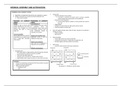
ME20026: ASSEMBLY AND AUTOMATION:
WORKBENCH (CELL) ASSEMBLY SYSTEMS:
Manual cells
Single fitter at a single bench does all the work required for a project
o Used for assembly of new products
Number of benches are increased to increase production rate
If product is successful and volume starts to increase, assembly
o These work in parallel
system changes from manual cells to an assembly line
o Performance level negotiated
Advantages of workbench Disadvantages of workbench
So each worker agrees to produce so many products per week (or
systems systems
hour etc)
Flexible Low output per m2
o Highly flexible
Possible to add or remove cells Hence requires more space. Work
o Suitable for products that have high variety and low volume
without affecting the rest of the is duplicated across all
o Used for products of various sizes
factory since complete set of workbenches. Hence same tools
activities take place in each and auxiliary resources exist at
Each cell requires storage space where all parts necessary for producing a
single cell each workstation. Results in
product are stored
redundant use of space
o Kitted assemblies
Good accountability o Bench stores
Easy to determine who would be Require more assembly stores
responsible for any quality issues Duplication results in need for Kitted assemblies
since a single fitter assembles additional storage space o Used in high variety, low volume production
each product o Components necessary for a single part are loaded into a kit
Require more equipment o Kits kept together with the products in the factory
Since same set of equipment is
required at each workstation Bench stores
o Used for smaller products with cheap components
Difficult to track products
Automated cells
o Built using robots or single machine when the long-term demand
is assured and the required investment is justified
o These cells have high output rate
o Typically used to manufacture a limited variety of parts
o Highly flexible within range of products for which they have been
designed
ASSEMBLY:
Where the manufactured components that form products are joined
together to form the final product.
Types of assembly sequence
o Workbench (cell)
o Lines
, ME20026: ASSEMBLY AND AUTOMATION:
ASSEMBLY LINES:
Work for each product is split into a number of packages Can categorise fixed fitter assembly lines based on variety of products that
Each workstation carries out the work in one package are assembled on line
Product goes through various workstations o Single product lines
Work packages are consecutively carried out to assemble the product Assemble single product
Cycle time o Multi product lines
o Time between two consecutive finished products coming off the line Several types of products assembled using the same workstations
Takt time o Mixed product lines
o Maximum cycle time that can meet customer demand Parts of assembly lines are used for multiple products
Other parts of assembly unique to single product
Moving fitter lines
o Fitters are either walking or riding
o Products often stationary
Hybrid lines
o Combine moving fitter and fixed fitter lines together
Assembly line type Advantages Disadvantages
Fixed fitter Fast throughput times Low flexibility
Minimise tooling Need consistent demand
Minimise stores Difficult to balance
Allow fitter Typically on or off
specialisation
Assembly lines are normally divided into High output and quality
o Fixed fitter lines Very efficient when on
o Moving fitter lines Moving fitter High flexibility Multi-skilled fitters
o Hybrid lines High product variation Difficult to manage
Multi-skilled fitters
Fixed fitter lines Fast throughput times
o Fitters remain stationary Minimise tooling
o Products move from one station to the next Minimise stores
o Single fitter stations Hybrid lines Combinations of the Very difficult to balance
Each workstation is manned by single operator above Large complicated lines
Useful for small products
o Multi fitter stations Unbalanced assembly line
Manned by multiple operators o Some workstations end up with idle time
Useful for large products o Fitters have nothing to do in a production cycle
o If they start a new cycle without waiting, the half processed assemblies
will pile up after their workstations
o Typically perform worse than bench assembly systems
WORKBENCH (CELL) ASSEMBLY SYSTEMS:
Manual cells
Single fitter at a single bench does all the work required for a project
o Used for assembly of new products
Number of benches are increased to increase production rate
If product is successful and volume starts to increase, assembly
o These work in parallel
system changes from manual cells to an assembly line
o Performance level negotiated
Advantages of workbench Disadvantages of workbench
So each worker agrees to produce so many products per week (or
systems systems
hour etc)
Flexible Low output per m2
o Highly flexible
Possible to add or remove cells Hence requires more space. Work
o Suitable for products that have high variety and low volume
without affecting the rest of the is duplicated across all
o Used for products of various sizes
factory since complete set of workbenches. Hence same tools
activities take place in each and auxiliary resources exist at
Each cell requires storage space where all parts necessary for producing a
single cell each workstation. Results in
product are stored
redundant use of space
o Kitted assemblies
Good accountability o Bench stores
Easy to determine who would be Require more assembly stores
responsible for any quality issues Duplication results in need for Kitted assemblies
since a single fitter assembles additional storage space o Used in high variety, low volume production
each product o Components necessary for a single part are loaded into a kit
Require more equipment o Kits kept together with the products in the factory
Since same set of equipment is
required at each workstation Bench stores
o Used for smaller products with cheap components
Difficult to track products
Automated cells
o Built using robots or single machine when the long-term demand
is assured and the required investment is justified
o These cells have high output rate
o Typically used to manufacture a limited variety of parts
o Highly flexible within range of products for which they have been
designed
ASSEMBLY:
Where the manufactured components that form products are joined
together to form the final product.
Types of assembly sequence
o Workbench (cell)
o Lines
, ME20026: ASSEMBLY AND AUTOMATION:
ASSEMBLY LINES:
Work for each product is split into a number of packages Can categorise fixed fitter assembly lines based on variety of products that
Each workstation carries out the work in one package are assembled on line
Product goes through various workstations o Single product lines
Work packages are consecutively carried out to assemble the product Assemble single product
Cycle time o Multi product lines
o Time between two consecutive finished products coming off the line Several types of products assembled using the same workstations
Takt time o Mixed product lines
o Maximum cycle time that can meet customer demand Parts of assembly lines are used for multiple products
Other parts of assembly unique to single product
Moving fitter lines
o Fitters are either walking or riding
o Products often stationary
Hybrid lines
o Combine moving fitter and fixed fitter lines together
Assembly line type Advantages Disadvantages
Fixed fitter Fast throughput times Low flexibility
Minimise tooling Need consistent demand
Minimise stores Difficult to balance
Allow fitter Typically on or off
specialisation
Assembly lines are normally divided into High output and quality
o Fixed fitter lines Very efficient when on
o Moving fitter lines Moving fitter High flexibility Multi-skilled fitters
o Hybrid lines High product variation Difficult to manage
Multi-skilled fitters
Fixed fitter lines Fast throughput times
o Fitters remain stationary Minimise tooling
o Products move from one station to the next Minimise stores
o Single fitter stations Hybrid lines Combinations of the Very difficult to balance
Each workstation is manned by single operator above Large complicated lines
Useful for small products
o Multi fitter stations Unbalanced assembly line
Manned by multiple operators o Some workstations end up with idle time
Useful for large products o Fitters have nothing to do in a production cycle
o If they start a new cycle without waiting, the half processed assemblies
will pile up after their workstations
o Typically perform worse than bench assembly systems