Statiscs Final Exam (STA 2023) with correct answers
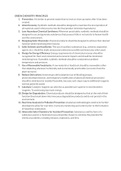
Statistics Collection of methods for planning experiments, obtaining data, organizing, summarizing, presenting, analyzing, interpreting, and drawing conclusions based on data. Descriptive Statistics statistics that summarize the data collected in a study 00:44 01:24 inferential statistics techniques and methods that allow us to use samples to make generalizations about the populations from which the samples were drawn Population a complete collection of all elements under statistical analysis Parameter any numerical measurement related to a population Sample randomly selected elements from the population Statistic any numerical measurement related to a sample Data the values or informations that we have obtained Observational study when we only observe and measure specific characteristics but make no attempt to modify Experimental Study when we apply some treatment and observe its effect Variables the characteristics of the data that we have collected qualitative variable variables that deal with quantity and cannot be measured; arrange individuals into categories according to shared qualities or characteristics 00:02 01:24 quantitative variables variables that deal with numbers and quantity; provide some sort of measurement, like how much or many Discrete variables quantitative variables that will assume only values in a discrete set like the set of integers (counted) Continuous variables variables that usually fall along a continuum and allow for fractional amounts Nominal existing in name only (license plate number, name of school, color of eyes, hair color) Ordinal rank, order (grades, top 10 ranks, movie ratings) Interval addition or subtraction arithmetic operations are meaningful (room temperature, range for grading policy, race time or sporting events) Ratio divide one value by another value and that ratio is meaningful and has a natural starting point ( income salary, years of working experience, heights of athletes) Sampling method a strategy on how to select a sample from within a general population while eliminating bias in the selection process Simple Random Sampling every member of the population being studied has an equal chance of being selected Convenience sampling when a sample is not drawn by a well-defined random method and it is very easy to access (i.e. asking a friend/relative for their opinion) Systematic Sampling choosing a starting point at random, then select every Kth item aftter that (i.e. recording every 10th caller to the customer service) Stratified sampling divide our population of interest into groups that share some characteristics, then randomly select from each group and select individuals from each of these groups. (i.e. Hospital administration divided all patients in two groups, males and females, then randomly selected 10 patients from each group to conduct a survey) Cluster sampling divide our population of interest into groups that share some characteristics, then we randomly select some of these groups, choose all members of these selected groups (Math department used each section of math classes as clusters, selected 10 sections(clusters) randomly, and then distributed a survey to every students on these sections) Lower class limit the smallest value within the class Upper class limit the largest value within the class Class width the difference between consecutive lower class limits (or upper class limits) Range the difference between the highest and lowest scores in a distribution Midpoint of a class the sum of the lower and upper limits of the class divided by 2 (LCL) + (UCL)/ (2) Relative frequency of a class Class frequency (f)/sample size (n) n= ∑f Cummulative frequency the sum of the frequency for that class and all previous classes; cumulative frequency of the last class is equal to the sample size n Frequency histogram The frequency of each class is represented by a vertical bar whose height is equal to the frequency of the class X-axis: quantitative Y-axis: Frequency Histogram A graph of vertical bars representing the frequency distribution of a set of data. Used for large quantitative data set Stem and Leaf plot A method of graphing a collection of numbers by placing the "stem" digits (or initial digits) in one column and the "leaf" digits (or remaining digits) out to the right. Dot plot a graphical device that summarizes data by the number of dots above each data value on the horizontal axis Box-and-whisker plot A graph that displays the highest and lowest quarters of data as whiskers, the middle two quarters of the data as a box, and the median Pie Chart/Graph a type of graph in which a circle is divided into sectors that each represent a proportion of the whole. bar chart/graph A graph that displays the distribution of a categorical variable, showing the counts for each category next to each other for easy comparison Mean the arithmetic average of a distribution, obtained by adding the scores and then dividing by the number of scores Median the middle score in a distribution; half the scores are above it and half are below it Mode the most frequently occurring score(s) in a distribution
Written for
- Institution
- Statiscs
- Course
- Statiscs
Document information
- Uploaded on
- January 22, 2023
- Number of pages
- 5
- Written in
- 2022/2023
- Type
- Exam (elaborations)
- Contains
- Questions & answers
Subjects
-
statiscs sta 2023 final exam

Also available in package deal