BCBA exam questions with correct answers
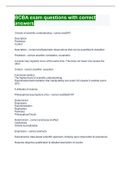
BCBA exam questions with correct answers 3 levels of scientific understanding DPC Description Prediction Control Description Systematic observations that can be quantified & classified Prediction AKA: correlation; covariation 2 events may regularly occur at the same time. This does not mean one causes the other Control AKA: causation Functional relation. The highest level of scientific understanding. Experimental demonstration that manipulating one event (IV) results in another event (DV). 6 attitudes of science Philosophical assumptions of bx DEER PP Determinism Empiricism Experimentation Replication Parimony Philosophical Doubt Determinism Cause & effect Lawfulness Orderly & predictable Empiricism Facts Experimental, data-based scientific approach, drawing upon observation & experience. Requires objective qualification & detailed description of events. Experimentation Basic strategy of most sciences. Requires manipulating variables to see effects on DV. Experiment to determine if one event caused another. Replication Repeating experiments Parisomy The simplest theory. All simple & logical explanations must be ruled out first before complex explanations. Philosophical Doubt Having healthy skepticism & a critical eye 7 dimensions of ABA BATCAGE or GET A CAB Behavioral Applied Technological Conceptually Systematic Analytic Generality Effective Behavioral Observable events. Must be a bx in need of improvement. Applied Socially significant bxs Technological Procedures clearly & precisely so they are replicable. RECIPE Conceptually Systematic Procedures should be based on principles of ABA Analytic AKA: Functional Relation, Experimentation, Control, Causation A functional relation is demonstrated. Generality AKA: Generalization Extends bx change across time, settings, or other bxs Effective Improves bx in a practical manner Mentalism Terminology Hypothetical Constructs Explanatory Fictions Circular Reasoning 4 Branches of Behavior Analysis CASE Conceptual Analysis of Behavior ABA Behavior Service Delivery Experimental Analysis of Bx (EAB) 2 types of bx Respondent Operant Respondent Bx AKA: Reflex, Reflexive Relations, Unconditioned, US-UR Elicited Involuntary Reflex Habituation Habituation Eliciting stimulus is presented repeatedly that respondent bx diminishes Phylogenic Bx that is genetic Respondent conditioning AKA: Classical Conditioning, Pavlovian Conditioning, S-S Pairing, CS-CR When new stimuli acquire the ability to elicit respondents. Operant Behavior AKA: S-R-S, 3 term contingency, ABC Emit/evoke Bx whose probability is determined by its history of consequences. Voluntary action. Operants defined in terms of their relationship to controlling variables. FUNCTION. Encompasses both reinforcement & punishment. Adaptation Adaptation Reductions in responding by repeated or prolonged presentation to antecedent stimulus. Ontogentic Learning that results from interactions with environment Operant Contingency AKA: Behavioral Contingency, Contingency, 3-term Contingency, ABC The occasion for a response (SD), the response, & the outcome. The dependency of a particular consequence on the occurrence of the bx. Reinforcer or punisher is "contingent" on a bx 3-term contingency ABC What is the primary analysis in ABA? Contiguity When 2 stimuli occur close together in time, resulting in an association of those 2 stimuli. 3 Principles of Bx PER Punishment Extinction Reinforcement All strategies are derived from these 3 principles. applied ABA is a(n) _______ science. ABA A scientific approach for discovering environmental variables that reliably influence socially significant bx & for developing a technology of bx change that is practical & applicable Science To achieve a thorough understanding of the phenomena under study (socially significant bxs) Response A single instance of bx. Behavior Larger set/class or responses that share physical dimensions or functions. Response Class A group of bxs that comprise an operant. Operant: Response-consequence relationship. Similar bxs that are strengthened or weakened collectively as a result of operant conditioning. Yes. Can widely vary in form but are limited in topographical variations. Can responses in the same response class look different? Repertoire 1. All bxs that an individual can do. 2. A collection of knowledge & skills an individual has learned that are relevant to a particular task. Environment Complex, dynamic universe of events that differs from instance to instance. All bx occurs within an environmental context. Stimulus Physical events that affect the bx of an individual. Internal or external to the individual. An energy change that affects an organism through its receptor cells. Stimulus Class A group of antecedent stimuli that have a common effect on an operant class. Group members of a stimulus class tend to evoke or abate the same bx or response class, yet may vary across physical dimensions. 3 Types of Stimulus Classes FTF (For The Fun) Formal: Physical features Temporal: time Functional: effect of the stimulus on the bx, can be multiple functions of a single stimulus Feature Stimulus Class Stimuli share: common topographies relative relations INFINITE number of stimuli developed through stimulus generalization Arbitrary Stimulus Class Stimuli that evoke the same response, but they do NOT share a common stimulus feature. They do not physically look alike or share a relative relationship. LIMITED number of stimuli Developed through stimulus equivalence. Consequences Only affect FUTURE bx. Consequences select response classes, NOT individual responses. Immediate consequences have the greatest effect. Automaticity (of R & P) A person does not have to know what a consequence means for it to work. Automatic Reinforcement AKA: Sensory, Self-Stimualtory Bxs, Stereotypy Reinforcement that occurs independent of the social mediation of others. Because it feels good! WARNING!! What looks like automatic reinforcement (i.e. hand flapping) might not be. Automatic Punishment Punishment that occurs independent of the social mediation of others. Reinforcement Does NOT only strengthen rate. Also strengthen: -Duration -Latency -Magnitude -Topography What happens right before reinforcement will be reinforced. Delayed consequence are not technically reinforcement, but they can influence bx. What Reinforcement Does -Makes antecedent stimulus conditions relevant. -Changes what comes after bx & what comes before bx. -Creates stimulus control -depends on motivation Unwanted effects of Reinforcement -Effects of reinforcement can be temporary. -Ethical concerns arise from the severity of the EO that occasions the bx. -Relying on the use of contrived reinforcers as opposed to natural reinforcers. -Using potential reinforcers that may be harmful to long-term health or require undesirably marked deprivation procedures as MOs NOT TRUE -Giving reinforcement will result in loss of intrinsic motivation. -People confusing reinforcement with bribery. Reinforcement TRUMPS Punishment You should recommend reinforcement rather than punishment WHENEVER POSSIBLE Positive Reinforcement AKA: Type 1 Reinforcement; Sr+ A PROCESS that occurs when a bx is followed immediately by the presentation of a stimulus that increases FUTURE frequency of the bx in similar conditions. MOST IMPORTANT & WIDELY USED CONCEPT IN ABA. 5 Types of Positive Reinforcers EATSS Edible Activity Tangible Social Sensory Negative Reinforcement AKA: Type II Reinforcement; Sr- A PROCESS that occurs when a bx is followed immediately by the REDUCTION or REMOVAL of a stimulus that increases the FUTURE frequency of the bx in similar conditions. 2 Types of Negative Reinforcement 1. Escape 2. Avoidance Escape A bx allows escape from an ongoing aversive stimulus. Avoidance A response that prevents or postpones the presentation of a stimulus. 2 Types: -Discriminated Avoidance -Free-Operant Avoidance Discriminated Avoidance A contingency in which responding in the presence of a signal prevents the onset of a stimulus from which escape is a reinforcer. Free-Operant Avoidance NO WARNING. A contingency in which responses at any time during the interval prior to the scheduled onset of an aversive stimulus. The avoidance bx is "FREE" to occur at any time. Ethical Warning about Negative Reinforcement Creating an aversive condition for the individual is unethical & may even bring about more challenging bxs! Unconditioned Reinforcer/Reinforcement AKA: UCR; Primary Reinforcer; Unlearned Reinforcer A stimulus change that can increase the future frequency of bx without prior pairing without any other form of reinforcement. -No learning history required. -Products of phylogeny. All members of a species generally share the same UCRs. Conditioned Reinforcer/Reinforcement AKA: CR; Secondary Reinforcer; Learned Reinforcer When a previously neutral stimulus acquired the ability to function as a reinforcer through S-S pairing with one or more unconditioned or conditioned reinforcers. -Learning history required. -Products of ontogency. Generalized Conditioned Reinforcer AKA: Generalized Reinforcer; GCSR A type of conditioned reinforcer that has been paired with many unconditioned & conditioned reinforcers. -Does not depend on an MO for its effectiveness. -They are likely to be reinforcing at any time. -Same reinforcement is given to people with different preferences. Punishment AKA: SD-; SDP; SP; Punishment-based SD When a response if followed immediately by a stimulus that decreases the FUTURE frequency of similar responses. -Defined by function, not topography. -Defined by future effects on bx. -2-term contingency: Behavior--Consequence -Becomes 3-term contingency when you add the antecedent, "Discriminative Effects of Punishment", when punishment occurs only in some conditions & not in others. Threats are not punishment If a person stops a bx when you threaten them, this is NOT bc of punishment. But bc the threat functions as the MO that evokes alternative bxs that avoid the threatened punishment. Recovery from Punishment When punishment is stopped, the effects on bx are not permanent. Equivalent to extinction for reinforcement. Unwanted effect of Punishment -Society dislikes this -Effect of punishment can be temporary -People who are doing the procedures may be negatively reinforced by their bx. -Does not address the cause of the challenging bx -Emotional & aggressive reactions -Escape & avoidance of ppl and settings -Requires lots of supervision, resources & time -Behavioral Contrast Punisher A stimulus change that decreases the future frequency of the bx that immediately precedes it Positive Punishment AKA: Type I Punishment A PROCESS that occurs when a stimulus is added immediately following a bx that results in a decrease in FUTURE frequency of the bx. 5 Types of Positive Punishment Interventions ROSER Reprimands Overcorrection Shock/Contingent Electrical Stimulation/ECT Exercise/Contingent Exercise Response Blocking Overcorrection 2 Types: 1. Restitutional Overcorrection: repair environment better than original state 2. Positive Practice Overcorrection: individual is required to correctly repeat bx for a certain amount of time or a certain number of times Exercise/Contingent Exercise An individual is required to perform a response not topographically related to the bx. Response Blocking Physically intervening as soon as individual begins to emit bx to "block" the completion of the response Negative Punishment AKA: Type II Punishment; Penalty Principle; Penalty Contingency A PROCESS when a response is immediately followed by removal of a stimulus (or decrease in intensity of stimulus) that decreases the FUTURE frequency of similar responses Negative Punishment Procedures Response Cost Time-Out Response Cost Loss of a specific amount of reinforcement contingent on a bx. -Produces mod-to-rapid decrease in bx 2 Methods 1. Bonus Response Cost 2. Direct Fines **Watch out for ethical issues associated with removing reinforcers Bonus Response Cost When you make additional non-contingent reinforcers available to the individual & then take those away. Example: Students usually get 15 minutes of recess daily, but you give them a "bonus" 15 minutes, so you can take away those extra minutes. Direct Fines Direct loss of positive reinforcers Time-Out AKA: Time-Out from Positive Reinforcement 2 Types: 1. Non-Exclusionary Time-Out 2. Exclusionary Time-Out **Ethical issues about duration & conditions of time-out Non-Exclusionary Time-Out Individual not removed from space. Preferred over exclusionary bc it is less restrictive. 4 Types: (IWOR) 1. Ignoring/Planned ignoring 2. Withdrawal of a Specific Positive Reinforcer 3. Observation/Contingent Observation 4. Ribbon/Time-Out Ribbon Ignoring/Planned Ignoring social reinforcers removed for a specific amount of time Withdrawal of a Specific Positive Reinforcer Taking something preferred away Observation/Contingent Observation Individual is re-positioned in room, so they can observe everything, but not participate. Ribbon/Time-Out Ribbon Colored band placed on individual's wrist. This becomes discriminated for getting reinforcement. Ribbon on = can earn reinforcement Ribbon off = cannot earn reinforcement Exclusionary Time-Out Individual removed from space. 3 Types: (RPH) 1. Room/Time-Out Room 2. Partition Time-Out 3. Hallway Time-Out Room/Time-Out Room Confined space outside of normal environment; devoid of positive reinforcers. -Individual safely placed -Should be located near time-in setting -minimal furnishing Partition Time-Out Individual remains in room, but view is restricted by wall or partition Hallway Time-Out Individual sits in hallway Positive Punishment & Negative Reinforcement Aversive Control Unconditioned Punishers/Punishment AKA: UCP; Primary Punisher; Unlearned Punisher A stimulus change that decreases the frequency of any behavior that immediately precedes it irrespective of the organism's learning history with the stimulus. -No learning history required. -Product of phylogeny. All members of species generally share the same unconditioned punishers. Conditioned Punishers/Punishment AKA: CP; Secondary Punisher; Learned Punisher A previously neutral stimulus change that functions as a punisher bc of prior pairing with 1 or more punishers. -Learning history required. -Products of ontogeny. Generalized Conditioned Punishers AKA: Generalized Punisher A type of conditioned punisher that has been paired with MANY unconditioned & conditioned punishers. -Does NOT depend on an MO for its effectiveness. Verbal Analog Conditioning Verbal pairing procedure without direct pairing Extinction AKA: EXT; Operant Extinction A procedure where maintaining reinforcement is not longer provided, to decrease future bx. -Not punishment -Ext will be more rapid for bx maintained on CRF schedule Unwanted effects of Extinction -Extinction bursts -Extinction induced aggression -Difficult to use on clients that rarely display the target bx -Difficult to know what the reinforcer is for a bx -Difficult or dangerous to ignore -Extinction NOT used in a tx package can cause ethical concerns What Extinction is NOT -Ignoring -Does not refer to a decrease in bx -Response blocking -NCR 3 Types of Extinction PAN Positive Reinforcement Automatic Reinforcement (AKA Sensory Extinction) Negative Reinforcement (AKA Escape Extinction) Extinction Burst The Burst is First Immediate increase in frequency of responding Spontaneous Recovery Bx diminished during extinction reoccurs even though bx does not produce reinforcement Resistance to Extinction 1. Long history of reinforcement 2. Intermittent schedules 3. High quality reinforcer 4. Large amount of reinforcer 5. Response requiring little effort 6. Number of previous extinction trials (relates to intermittent schedules) Operant Extinction withholding reinforcement when bx occurs Respondent Extinction un-pairing of CS & US Antecedent Control Response is altered in the presence of an antecedent stimulus. Factors Affecting Stimulus Control 1. Pre-attending skills 2. Stimulus Salience: prominence of the stimulus in person's environment Discriminative Stimulus AKA: SD Let's you know that reinforcement is available Stimulus Delta AKA: S∆ Stimulus that tells that reinforcement is not available OR has NOT received reinforcement in the past
Written for
- Institution
- BCBA
- Course
- BCBA
Document information
- Uploaded on
- February 4, 2023
- Number of pages
- 63
- Written in
- 2022/2023
- Type
- Exam (elaborations)
- Contains
- Questions & answers
Subjects
- prediction
-
bcba exam questions with correct answers
-
3 levels of scientific understanding dpc description prediction control
-
description systematic observations that can be quantified amp classified

Also available in package deal