NUR 265 Exam 2 Study Guide
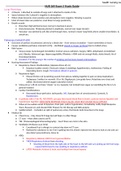
Lungs Physiology 2 Pleural, 1 attached to outside of lungs and 1 attached to inside of ribs. Space between the 2 pleural is negative to atmosphere When inhale becomes more positive and atmosphere more negative. Exhaling is passive Most of lower lobes are posterior, must listen to lungs posteriorly Breath sounds o Bronchial: High pitched & loud, normal in tracheal & larynx o Bronchovesicular: Moderate pitched & amplitude, normal over major bronchi o Vesicular: Low pitched & soft, like wind through trees, normal in lower lung fields where smaller bronchioles & alveoli are. Pulmonary Emboli (P 603) Occlusion of portion of pulmonary artery by a blood clot – from venous circulation – lower extremities or heart. Causes ventilation-perfusion mismatch (V/Q) – Ventilated alveoli no longer perfused due to clotted artery. Risk Factors o Venous stasis (w/prolonged immobility); Central venous catheters; Surgery (NPO, dehydrated, immobilized pts); Obesity; Advanced age; Hypercoagulability (Platelets >400K and not enough fluids; sticky blood); Hx of thromboembolism. o Greatest r/f in the young is the combo of smoking and hormone based contraceptives. Nursing Assessment Findings o Respiratory Classic Manifestations (Hypoxia drives all s/s) Dyspnea (sudden onset); Chest pain (sharp & stabbing); Apprehension, restlessness; Feeling of impending doom; Cough; Hemoptysis (blood in sputum). o Respiratory Signs Pleural friction rub (scratching sounds from pleura rubbing together & pain on deep inspiration); Tachypnea; Crackles (or normal); S3 or S4; Diaphoresis; Low grade fever; Petechiae over chest and axillae; Decreased arterial oxygen saturation (SaO2) o Many pts w/ a PE do not have “classic” sx (i.e. hypoxia), but instead have vague sx resembling the flu (n/v & general malaise) o Cardiac Manifestations Decreased tissue perfusion: tachycardia, JVD, Syncope (loss of consciousness), Cyanosis, & Hypotension. o In patients with r/f for PE, JVD (RSHF), syncope (decreased blood flow to brain), cyanosis (severe hypoxia) and hypotension together, NEED RAPID RESPONSE TEAM CALLED. HAVE HELP ON WAY B4 O2 APPLIED o When pt has sudden onset of dyspnea, chest pain, and/or hypotension, immediately notify Rapid Response Team. Reassure pt. and elevate HOB. Prepare for O2 therapy and ABG analysis o Saddle Emboli – Embolism at split of pulmonary artery that blocks both branches to the lungs Medical Dx o Chest X-ray – May show PE if large but will help r/o other things o CT scan – Most often used to dx PE o TEE (Transesophageal Echocardiography) – See if there are clots in the atria o Ventilation Perfusion scan (V/Q) Considered if pt is allergic to contrast dye done w/CT scan Radioactive substance to see if air is getting into the alveoli; injected into blood to look at clot and can also detect pneumothorax. Done 2x o ABGs Respiratory Alkalosis FIRST from hyperventilation THEN Respiratory Acidosis from shunting Shunting of blood from the right side of the heart to the left side w/o picking up O2 from lungs – causes PaCO2 level to rise resulting in respiratory acidosis. LATER Metabolic Acidosis & lactic acid buildup from tissue hypoxia Even if ABGs & Pulse Ox shows hypoxemia it is not enough to dx PE alone as PE is not the only cause of hypoxemia. Medical Management o GIVE O2, IV FLUIDS, INOTROPES (DOBUTAMINE/MILRINONE) Oxygen therapy to maintain O2 sat at 95% or patient baseline Hypotension - Tx w/ IV fluids (isotonic) & Inotropes (Dobutamine/Milrinone, make heart contract more forcefully); vasopressors (norepi, epi, dopamine) when hypotension persists after fluids. o Anticoagulation w/ Heparin drip – Goal is PTT 1.5-2.5 x normal (60-70 sec) = 90-175 sec Minimize growth of existing clots and prevent new ones Antidote Protamine Sulfate Do not use w/salicylates (Aspirin) o Convert to Warfarin when stable – On 3rd day of Heparin use, overlap – INR target 2-3 (0.9-1.2 normal) Antidote – Vit K – phytonadione (Mephyton) Teach pts to avoid foods high in K (leafy dark green vegis, herbs, spring onions, Brussel sprouts, broccoli, cabbage, asparagus, potatoes, & winter squash). o Enoxaparin or dalteparin o Fibrinolytic (tPA) to tx massive PE or hemodynamic instability Antidotes – clotting factors, FFP, & aminocaproic acid (Amicar) Dissolve the clot itself o Embolectomy – surgical removal of the embolus – When tPA can’t be used or for massive PE w/shock o Inferior Vena Cava Filter – to prevent DVTs from moving to the lungs **Bleeding precautions with all blood thinners o Prevent injury to pt on anticoagulation therapy Use lift sheet; firm pressure on needle stick for 10 minutes; Apply ice to trauma areas; Avoid trauma to rectal tissues; no razor (electric only); soft-bristled toothbrush; NO floss; Not blow nose forcefully; shoes with firm soles; Assess IV sites q4 hrs for bleeding, measure abd girth q8 hrs – internal bleeding Nursing Management o Monitor for hypoxemia & respiratory compromise every 1-2 hrs. VS, lung sounds, cardiac & respiratory status, & urine output (bc hypotensive can cause AKI) o Elevate HOB to high fowlers if BP tolerates. o Obtain venous access and monitor heparin drip/LMWH/Coumadin o Pain and anxiety management w/morphine (vasodilator) – O2 1st then other things b4 morphine. Communication is critical in allaying anxiety. Acknowledge the anxiety & pt perception of a lifethreatening situation. Stay with them, speak calmly, and clearly, providing assurances. o Bleeding precautions, oral care – especially if mouth breather. Prevention Measures o Measures that prevent venous stasis and VTE o Passive and active ROM for postop & immobilized pts o Post-op ambulation ASAP o SCDs or Plexipulse compression – for prevention, not for active DVT o Pt repositioning q2 hrs o Low dose anticoagulant & antiplatelet meds o Smoking cessation (especially females on hormone based contraceptives) bc increases risk for DVTs o Traveling – drink plenty of H2O, change positions, avoid crossing legs, get up and move every 1hr for 5 min. NANDA Diagnoses o Impaired Gas Exchange; Acute Pain, Anxiety; Risk for Bleeding (when on treatment) Pleural Effusion (P 504-505) Collection of fluid (too much) in the pleural space – clear transudative, or exudative (outside the lungs) o Cleat transudative – similar to fluid normally present in pleura space o Exudative – Excess protein, blood, or evidence of inflammation or infection (white, green, cloudy is bad) Can cause pleurisy sx o Pleural friction rub, scratching sounds caused by inflamed pleura rubbing together, pain on deep inspiration. Caused by – HF (mediastinal fluid leaks into pleural space); Liver or renal failure; Infections; chest trauma (inflammation response; smack lungs on ribs in MVA); Lymphatic destruction by lung tumor; PNA Assessment Findings o Dyspnea (lungs can’t expand) o Decreased or absent lung sounds (sounds do not transmit through fluids well) NO CRACKLES BC OCCURS OUTSIDE THE LUNGS o Dull flat sound on percussion (percuss between ribs) o Decreased tactile fremitus (vibration of chest wall produced when pt speaks) – hands around pt ribs o Chest pain w/respirations if pleurisy develops Medical Management o Thoracentesis – Needle aspiration of pleural space to remove fluid for sx relief & dx of causative factor. Want fluid to be clear, if cloudy or another color, send culture for cell counts. o Recurrent effusions may need chest tube w/closed drainage until source tx o Severe cases caused by lung tumors may need pleural stripping or pleurodesis to cause pleura to adhere together to prevent further effusions. Causes the 2 pleura to SCAR together to decrease inflammation, pain, decreases dyspnea & pleuritis Palliative for terminal pts only for pain relief. o Heart monitor needed Acute Respiratory Failure (P 610-612) Sudden deterioration of gas exchange function of the lungs Ventilatory failure, oxygenation (gas exchange) failure, or combo of both, classified by abnormal ABGs (pa) Failure of the pulmonary system to carry out its own major functions o Delivery of adequate amount of O2 to the arterial blood (paO2 <60 hypoxemia) o Removal of corresponding amount of CO2 from blood (paCO2 >45 hypercapnia AND pH <7.35 acidemia) NO MATTER THE PROBLEM, PT IS ALWAYS HYPOXEMIC (low arterial blood O2 levels) Pathophysiology o Ventilatory Failure Blood flow (perfusion) is normal but AIR MOVEMENT (VENTILATION) IS INADEQUATE To little O2 reaches alveoli and CO2 is retained. Physical problems of lungs or chest wall, brain defect, poor respiratory muscle function – diaphragm PaCO2 >45 AND pH <7.35 (acidemia) Pneumothorax – open or tension, ARDS, pulmonary edema (fluid in lungs) o Oxygenation (gas exchange) failure Air movement and oxygen intake is normal but LUNG BLOOD FLOW (PERFUSION) IS DECREASED APPLYING 100% O2 DOESN’T CORRECT THE PROBLEM Massive PE o Combined Ventilatory & Oxygenation Failure Involves hypoventilation – poor respiratory movements BOTH ventilation & perfusion are inadequate – leads to more profound hypoxemia than either alone. Usually underlying chronic disease – COPD, Asthma, Cystic Fibrosis, Lung disease Assessment Findings o Dyspnea (hallmark of respiratory failure) – DOE or when lying down (in slow progression) o Orthopnea – breathe easier in upright position, can’t sleep flat o Change in lung sounds – depends on cause: CHF vs PE o Skin/nail bed color changes (hypoxemia) o Hypoxemia S/S – Pallor, Cyanosis, Increased HR, Restlessness, Confusion O2 therapy is appropriate for any pt w/acute hypoxemia If O2 therapy doesn’t maintain acceptable PaO2 levels (>60) (normal 80-100) then mechanical ventilation may be needed. o Decreased O2 sats. on pulse ox – need ABG for most accurate assessment Pulse ox measures O2 bound to Hgb (increased RBCs = increased O2 sats) ABGs measure O2 floating free in the blood Pulse ox measurement can be inaccurate if Hgb is decreased or in CO2 poisoning (smoke inhalation) Nursing Management o Assist with O2 therapy up to intubation & ventilation o Monitor ABGs & pulse ox o Monitor VS, urine output, & neuro assessments o Ventilator associated pneumonia prevention Hand washing, oral care Q2 hrs, HOB 30 degrees, turning Q 2, ulcer prophylaxis o Peptic ulcer prophylaxis (IHI Guidelines) IV/PO pantaprozole to decrease gastric contents to prevent stress ulcers & aspiration o VTE prophylaxis (IHI guidelines) SCDs & enoxaparin o HOB elevated 30-45 degrees (IHI guidelines) Minimizes aspiration & breathing better Acute Respiratory Distress Syndrome (ARDS) (P 612-614) Acute respiratory failure with o Hypoxemia that persists even when 100% O2 is given (refractory hypoxemia, a cardinal feature) o Decreased pulmonary compliance o Dyspnea o Nonacardiac-associated bilateral pulmonary edema o Dense pulmonary infiltrates on x-ray (ground-glass appearance) Etiology o Direct Injury (lungs or capillaries) – Pulmonary contusion, gastric aspiration (acid in lungs), near drowning, inhalation of toxic gases and vapors, infections, air embolus, fat embolus, amniotic fluid embolus & radiation. o Indirect Injury (damage alveoli wall) – Sepsis, shock or prolonged hypotension, nonthoracic trauma, cardiopulmonary bypass, head injury, pancreatitis, multiple blood transfusions (TRAIL), and diabetic coma. o Trigger is a systemic inflammatory response Pathophysiology o Severe diffuse lung injury, especially to the parenchyma (Alveoli) o Sudden, progressive pulmonary edema w/increasing bilateral pulmonary infiltrates on chest x-ray, hypoxemia refractory 100% oxygen supplementation (O2 doesn’t help) & reduced pulmonary compliance. o Crackles or nothing (no air moving) o Acute phase characterized by damage integrity of the alveolar capillary membrane, w/extensive damage to type 1 alveolar cells w/increasing endothelial permeability (they become leaky) o Interstitial edema w/ protein fluid leaking into alveoli (2 way leak now). Lungs become sticky o Tiny emboli form in the pulmonary microcirculation and add to alveolar edema & hemorrhage. Due to increased clot production & reduction of fibrinolysis (clot breakdown). Small emboli reamin in the lung; DIC plays a role in some pts. o Surfactant decreased from fluid and type 2 alveolar cells secrets less surfactant. Protein deactivates surfactant = collapsed alveoli Signs & Symptoms o Rapid onset of severe dyspnea (as alveoli fill up) o Arterial hypoxemia (refractory to O2 therapy) o Bilateral diffuse infiltrates on CXR – white out or ground glass. o Fibrosing alveolitis – Alveoli inflamed & make scarred tissue Assessment: What we will see o Struggling to breath o Assess the work of breathing Posture if pt seated; Nasal flaring (late sign in adults); Intercostal retractions, use of accessory muscles o Assess rate & depth of respirations – Tachypnea & Hyperpnea (increased depth of breathing) Can’t expand chest o Palpation – Assess lung expansion – decreased due to compliance o Percussion – Dullness over all lung fields if substernal edema present
Written for
- Institution
-
Galen College Of Nursing
- Course
-
NUR 265,
Document information
- Uploaded on
- March 3, 2023
- Number of pages
- 23
- Written in
- 2022/2023
- Type
- Exam (elaborations)
- Contains
- Questions & answers
Subjects
-
nur 265 exam 2 study guide

Also available in package deal