Solid and Hazardous Waste 2022/2023 with 100% complete solutions
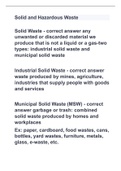
Solid Waste any unwanted or discarded material we produce that is not a liquid or a gas-two types: industrial solid waste and municipal solid waste Industrial Solid Waste waste produced by mines, agriculture, industries that supply people with goods and services Municipal Solid Waste (MSW) garbage or trash: combined solid waste produced by homes and workplaces Ex: paper, cardboard, food wastes, cans, bottles, yard wastes, furniture, metals, glass, e-waste, etc. Hazardous or Toxic Waste Category of waste that threatens human health or the environment due to poisonous, chemically reactive, corrosive, or flammable nature: two largest classes: organic compounds and non-degradable toxic heavy metals; nuclear waste also falls under hazardous waste Examples of Organic Compounds that are considered Hazardous Waste -solvents -pesticides Examples of Toxic Heavy Metals -lead, mercury, arsenic Which country creates the most solid waste? United States Reasons for sharply reducing the amount of solid and hazardous waste 1. 3/4 of materials represent an unnecessary waste of the earth's resources 2. producing the products we use causes air pollution, greenhouse gases, water pollution, land degradation Methods to deal with solid waste issue 1. Waste Management: attempt to reduce environmental impact of solid waste without trying to actually reduce the amount of waste being produced. Typically involves mixing wastes together and transferring them from one part of the environment to another, usually by burying them, burning them, or shipping them to another location. 2. Waste Reduction (preferred): much less waste and pollution are produced, and wastes that are produced are usually seen as resources that can be reused, recycled or composted 3. Integrated Waste Management (most common): variety of strategies for both waste reduction and waste management. Integrated Waste Management Priority 1: Reduce primary pollution and reduce waste by eliminating use of chemicals, reducing packaging, make products last longer Priority 2: Reduce Secondary Pollution and reduce waste by reusing, repairing, recycling, composting Priority 3: Treatment of waste to reduce toxicity, incinerate waste, bury waste (waste management) Reduce, Reuse, Recycle Reducing and Reusing are preferred over Recycling, because they are input or prevention approaches. Recycling is important, but it is an output approach (how we deal with wastes after they have been produced) Major Recyclable Products paper products, glass, aluminum, steel, plastics Primary or Closed-loop recycling Materials are recycled into new products of the same type-turning used aluminum cans into new aluminum cans Secondary Recycling Waste materials are converted into different products MRFs Materials-Recovery Facilities: where mixed waste is separated to recover valuable materials for sale to manufacturers as raw materials and remaining paper, plastic and other wastes are recycled or burned to produce steam or electricity to run the recover plant or sell to nearby industries or homes (very expensive, so environmentalists prefer source separation, where households separate wastes first) Composting Form of recycling that mimic nature's recycling of nutrient, it involves allowing decomposer bacteria to recycle yard trimmings, food scraps, and other biodegradable organic wastes, which can then be added to soil to supply plant nutrients, slow soil erosion, retain water, and improve crop yields. What are some issues encountered with making paper? -Chlorine used to bleach paper -Chlorine and chlorine compounds are corrosive to equipment, hazardous for workers, hard to recover and reuse, and are released into the environment -Many paper mills are now replacing chlorine bleaching chemicals with hydrogen peroxide or oxygen based ones What do plastics consist of? Plastics consist of various types of large polymers or resins-organic molecules made by chemically linking monomer molecules produced mostly from oil and natural gas Pros and cons of recycling Pros: reduces air and water pollution, saves energy, reduces mineral demand, reduces greenhouse gas emissions, reduces solid waste production and disposal, helps protect biodiversity, can save landfill space Cons: can cost more than burying in areas with landfill space, reduces profit for landfill and incinerator owners, source separation can be inconvenient
Written for
- Institution
- Environmental Studies
- Course
- Environmental Studies
Document information
- Uploaded on
- March 6, 2023
- Number of pages
- 15
- Written in
- 2022/2023
- Type
- Exam (elaborations)
- Contains
- Questions & answers
Subjects
-
solid and hazardous waste 20222023 with 100 complete solutions
Also available in package deal