Chapter 21 Solid and Hazardous Waste with 100% complete solutions already graded A
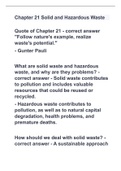
Quote of Chapter 21 "Follow nature's example, realize waste's potential." - Gunter Pauli What are solid waste and hazardous waste, and why are they problems? - Solid waste contributes to pollution and includes valuable resources that could be reused or recycled. - Hazardous waste contributes to pollution, as well as to natural capital degradation, health problems, and premature deaths. 00:00 01:42 How should we deal with solid waste? - A sustainable approach to solid waste is first to reduce it, then to reuse or recycle it, and finally to safely dispose of what is left. Why are refusing, reducing, reusing, and recycling so important? - By refusing and reducing resource use and by reusing and recycling what we use, we decrease our consumption of matter and energy resources, reduce pollution and natural capital degradation, and save money. What are the advantages and disadvantages of burning or burying solid waste? - Technologies for burning and burying solid wastes are well developed, but burning contributes to air and water pollution and greenhouse gas emissions, and buried wastes eventually contribute to the pollution and degradation of land and water resources. How should we deal with hazardous waste? - A more sustainable approach to hazardous waste is first to produce less of it, then to reuse or recycle it, then to convert it to less-hazardous materials, and finally to safely store what is left. How can we make the transition to a more sustainable low-waste society? - Shifting to a low-waste society requires individuals and businesses to reduce resource use and to reuse and recycle wastes and local, national. and global levels. Big Ideas of Chapter 21 - The order of priorities for dealing with solid waste should be to produce less of it, reuse and recycle as much of it as possible, and safely burn or bury what is left. - The order of priorities for dealing with hazardous waste should be to produce less of it, reuse or recycle it, convert it to less-hazardous material. and safely store what is left. - We need to view solid wastes as wasted resources, and hazardous wastes as materials that we should not be producing in the first place. composting Partially decomposed organic plant and animal matter used as a soil conditioner or fertilizer. environmental justice Fair treatment and meaningful involvement of all people, regardless of their race, color, sex, national origin, or income, with respect to the development, implementation, and enforcement of environmental laws, regulations, and policies. industrial solid waste Solid waste produced by mines, factories, refineries, food growers, and businesses that supply people with goods and services. integrated waste management Variety of strategies for both waste reduction and waste management designed to deal with the solid wastes we produce.
Written for
- Institution
- Environmental Studies
- Course
- Environmental Studies
Document information
- Uploaded on
- March 6, 2023
- Number of pages
- 10
- Written in
- 2022/2023
- Type
- Exam (elaborations)
- Contains
- Questions & answers
Subjects
-
chapter 21 solid and hazardous waste with 100 complete solutions already graded a

Also available in package deal