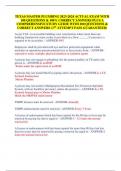
National Pesticide Applicator Certification core manual study notes Correct Solutions.
What is the chemical or chemicals in a pesticide product responsible for the pesticidal activity. It is the material in a pesticide fromulation that actually destroys a pest or performs a desired function. - ANSWER Active Ingredient (a.i.) What are the other ingredients in a pesticide formulation that are not usually named, but the label must show what percentage of the total contents they make up? - ANSWER Inert Ingredients What is the complex name that identifies the chemical components and structure of the pesticide's active ingredient? - ANSWER Chemical name Because chemical names or active ingredients are usually complex, many are given a shorter _______ name. - ANSWER Common The EPA classifies every pesticide product as either ______ or ________ use. - ANSWER Restricted, unclassified/general Many pesticides are designated as _____ if there is reason to believe they could harm humans, livestock, wildlife, or the environment, even when used according to label directions. - ANSWER Restricted use What pesticides typically have a lower toxicity with less potential than restricted-use pesticides to harm humans or the environment. They can be purchased and used by the general public without special permits or restrictions? - ANSWER Unclassified or general-use pesticides The law requres that the manufacturer or formulator of a product put what on the label? - ANSWER name and address of the company What must appear on all pesticide labels? - ANSWER EPA registration number EPA Reg. No. What number identifies the specific product? - ANSWER 280 EPA Reg No. What number identifies the manufacturer? - ANSWER 3120 EPA Reg No. What number identifies the distributor? - ANSWER 1492 What must also appear on the pesticide label to identify the facility that produced the product? - ANSWER EPA establishment number Most pesticide lables must include a ______. This important designation gives the user an indication of the relative acute toxicity of the product to humans and animals? - ANSWER signal word What signal word indicate products that are highly toxic by any route of entry into the body. They can cause death in very low doses. - ANSWER Danger-Poison What signal word indicate products that can cause severe eye damage or skin irritation? - ANSWER Danger What signal word indicate that the product is moderately toxic either orally, dermally, or through inhalation, or causes moderate eye and skin irritation? - ANSWER Warning What signal word signals that the product is slightly toxic either orally, dermally, or through inhalation, or causes slight eye and skin irritation? - ANSWER Caution What appears on all pesticide labels that contain additional statements to help applicators decide what precautions to take to protect themselves, their employees, and other persons (or animals) that could be exposed? - ANSWER Precautionary statements What typical label statements include: Fatal if swallowed. Poisonous if inhaled. Extremely hazardous by skin contact-rapidly absorbed through skin Corrosive-causes eye damage and severe skin burns. - ANSWER Danger What typical label statements include: Harmful if swallowed May be harmful if inhaled May irritate eyes, nose, throat, and skin. - ANSWER Caution What typical lable statements include: Harmful or fatal if swallowed. Harmful or fatal if absorbed throught the skin. Harmful or fatal if inhaled. Causes skin and eye irritation. - ANSWER Warning What part of the label lists first-aid treatments recommended in case of poisoning or accidental exposure and some warning and caution labels contain a note to physicians describing the appropriate medical procedures and antidotes for poisoning emergencies? - ANSWER Statement of Practical Treatment What section of the label describes any special fire, explosion, or chemical hazards the product may pose? - ANSWER Physical or Chemical Hazards What section on the label is found only on product labels that are covered by the EPA Worker Protection Standard (WPS)? - ANSWER Agricultural use requirments What phrase specifies how much time must pass between the application of a pesticide and the reentry of unprotected workers into a treated area. - ANSWER restricted-entry interval (REI) What are very useful documents for learning about specific chemical and physical properties of pesticides or other potentially hazrdous substances. It also provides detailed information about the product's composition, physical and chemical properties and hazards, toxicological and eecological information, and first-aid procedures? - ANSWER Material safety data sheets (MSDS) Chemical product identification, physical and chemical properties, fire and explosion hazards, toxicological information/human health data, cholinesterase inhibiton, regulatory levels and classification, personal protection recommedations, and additinal infrmation are provided on what document? - ANSWER Material safety data sheets (MSDS) What ingredients do not possess pesticidal activity and are added to serve as a carrier for the active ingredient? - ANSWER Inert ingredients What is the mixture of active and inert ingredients called? - ANSWER Pesticide formulation WP is the abbrerviation for what formulation? - ANSWER Wettable Powder RTU is the abbreviation for what formulation? - ANSWER Ready-to-use EC is the abbreviation for what formulation? - ANSWER Emulsifiable concentrate WP is the abbreviation for what formulation? - ANSWER Wettable Powder ULV is the abbreviation for what formulation? - ANSWER Ultra low volume G is the abbreviation for what formulation? - ANSWER Granules What results when a substance is dissolved in a liquid? - ANSWER Solution What is a mixture of finely divided, solid particles in a liquid? - ANSWER Suspension What usually contains a liquid active ingredient, one or more petroleum-based solvents, and an agent that allows the formulation to be mixed with water to form an emulsion? - ANSWER Emulsifiable concentrates (EC or E) Listed below is the advantages & disadvantages of what formulation type? Advantages: Ready to use, portable, easily stored, convenient way to buy a small amount of pesticide. Retain potency over fairly long time. Disadvantages: Practical for only very limited uses. Risk of inhalation injury. Hazardous if punctured, overheated, or used near an open flame. Difficult to confine to target site. - ANSWER Aerosols (A) Listed below is the advantages & disadvantages of what formulation type? Advantages: Most are ready to use with no mixing. Effective where moisture from a spray might cause damage. Required simple equipment. Effective in hard-to-reach indoor areas. Disadvantages: Easily drift off target during application. Residue easily moved off target by air movement or water. May irritate eyes, nose, throat, and skin. Will not stick to surfaces as well as liquids, dampness can cause clogging and lumping, difficult to get an even distribution of particles on surfaces. - ANSWER Dusts (D) Listed below is the advantages & disadvantages of what formulation type? Advantages: Ready to use-no mixing. Drift hazard is low and particles settle quickly. Little hazard to appplicator-no spray little dust, weight carries the formulation through foliage to soil or water target. Simple application equipment needed such as seeder or fertilizer spraders. May break down more slowly than WPs or ECs because of a slow-release coating. Disadvantages: Often difficult to calibrate equipment and apply uniformly. Will not stick to foliage or other uneven surfaces. May need to be incorporated into sail or planting medium. May neeed moisture to activate the pesticide. May be hazardouse to non-targeted species. May not be effective under drought conditions because the AI is not released in sufficeient quantity to control the pest. - ANSWER Granules (G) Listed below is the advantages & disadvantages of what formulation type? Advantages: easy to store, transport, and handle. Less likely than ECs and other petroleum-based pesticides to cause unwanted harm to treated plants, animals, and surfaces. Easily measured and mixed, less skin and eye absorption than ECs and other liquid formulations. Disadvantages: Inhalation hazard to applicatior while measuring and mixing the concentrated powder. Required good and constant agitation in the spray tank and quickly settle out if the agitator is turned off. Abrasive to many pumps and nozzles, causing them to wear out quickly. Difficult to mix in very hard, alkaline water. Often clog nozzles and screens, residues may be visible on treated surfaces. - ANSWER Wettable Powders (WP or W) Listed below is the advantages & disadvantages of what formulation type? Share many of the same advantages and disadvantages of wettable powders except: they are more easily measured and mixed. Because of low dust, they cause less inhalation hazard to the applicator during handling. - ANSWER Water-dispersible granules (WDG) or Dry Flowables (DF) Listed below is the advantages & disadvantages of what formulation type? Advantages: Highly toxic materials are safer for applicators to mix and apply. Delayed or slow release of the AI prolongs its effectiveness, allowing for fewer and less precisely timed applications. The pesticide volatilizes more slowly, less is lost from the application site. These formulations often reduce injury to plants. Disadvantages: Pose a special hazard to bees. Breakdown of the materials release the pesticide sometimes depends on weather conditions. - ANSWER Microencapsulated Materials What are chemicals that do not posses pesticidal activity, and are either premixed in the pesticide formulation or added to the spray tank to improve mixing or applicaiton or to enhance pesticidal performance? - ANSWER Adjuvants What adjuvants physically alter the surface tension of spray droplets? - ANSWER Surfactants or also called wetting agents and spreaders What is an adjuvant that increases the adhesion of solid particles to target surfaces. These adjuvants can decrease the amount of pesticide that washes off during irrigation or rain? - ANSWER Sticker ____ and ____ are adjuvants that acidify and stabilize the water in the spray tank. - ANSWER Buffers and acidifiers What adjuvant increase the viscosity (thickness) of spray mixtures? - ANSWER Thickeners What refers to the ability of a pesticide to cause short-term or long-term injury? - ANSWER Toxicity What is the true concern for the applicator or handler. It is the potential or probability for harm to occur because of product toxicity and human exposure? - ANSWER Hazard Often when is the greatest hazard to the pesticide applicator? - ANSWER during mixing and loading of the pesticide concentrate What is the most common form of pesticide injury or poisoning to applicators? - ANSWER Contact skin Many ____ and ______ can cause severe dermatitis? - ANSWER herbicides, fungicides Symptoms of ______ injury include: Nasea, vomiting, diarrhea, or stomach cramps. Headache, dizziness, weakness, or confusion. Excessive sweating, tearing, chills, or thirst. Chest pains. Breathing difficulties. Body aches and muscle cramps. - ANSWER systemic injury In most exposure situations what is the primary route of pesticide entry onto or into the body? - ANSWER skin ______ is the measure of harm caused by a single, one-time exposure event. Effect occur shortly after exposure, usually within 24 hours. - ANSWER Acute toxicity What is the common method used for comparing acute toxicity. The dose of a toxicant required to kill 50% of the population of test animals under a standard set of condition. - ANSWER LD50 (lethal dose 50 %) What is the commonly used measure of acute toxicity. This is the concentration of a substance in air or water required to kill 50% of the test population - ANSWER LC50 (lethal concentration 50%) The LC50 values most directly applicable to human health are those expressing lethal concentration of chemicals in the ____ - ANSWER Air _____ are those products that have the potential to kill humans at very low exposures. - ANSWER Poisons True or False. The higher the LD50 value of a pesticide, the less it takes to kill 50% of the population of test animals. Therefore, the greater the toxicity of the chemical. - ANSWER False (lower) What signal words are pesticides classified as highly toxic with acute oral LD50 values from a trace to 50mg/kg? - ANSWER Danger-Poison What signal word indicates the potential to cause acute contract injury and indicates the potential for permanent or severe damage to skin, eyes, or lungs. - ANSWER Danger A pesticide product considered moderately toxic will have what signal word? - ANSWER Warning Pesticides products classified as slightly toxic are required to have what signal word? - ANSWER Caution The _____ toxicity of a pesticide is determined by subjecting test animals to long-term exposure to an active ingredient, typically two years. - ANSWER Chronic _____ and other related herbicides (dicamba, MCPA,and MCPP) are irritatiing to the skin and mucous membranes, and they can also cause vomiting, headaches, diarrhea, and confusion. - ANSWER 2,4-D ______ inhibition due to exposure to organophosphate or carbamate insecticides can cause acute or delayed effects. - ANSWER Cholinesterase True or False: In the case of cholinesterase inhibition, it is not always obvious whether a worker is showing symptoms from an acute exposure or experiending delayed effects from repeated exposures. - ANSWER True What meaures the effect of exposure to organophosphate and carbamate insecticides? - ANSWER The Blood cholinesterase test _____ is the initial effort to help a victim while medical help is on the way. - ANSWER First aid When pesticide exposure in eye occurs how long should you continously rinse the eye for? - ANSWER 15 minutes If oral or dermal exposure has occured, the first objective is usually to ____ the pesticide and prevent absorption. - ANSWER Dilute What is the basic first-aid procedure for someone who has inhaled a pesticide? - ANSWER get the exposed person to fresh air What is another first-aid treatment that can be adminsistered when a pesticide has been swallowed? - ANSWER Acivated Charcoal What antidote is given for carbamate insecticide poisoning? - ANSWER Atropine sulfte What antidote is used for treating exposures to anticoagulant rodenticides? - ANSWER Vitamin K1 Fatigue, dizziness and fainting, clammy skin or hot, dry skin, altered behavior-confusion, slurrred speech, quarrelsome irrational, Headaches, nausea, and chills, severe thirst and dry mouth, heavy sweating ro complete lack of sweating area signs of what condition? - ANSWER Heat Stress or Heat Stroke What is the formula pesticide risk can be summarized by? - ANSWER Hazard=toxicity x exposure The term _____ means that no measurable movement of the pesticide through the material occurs during the period of use - ANSWER Chemical resistant Note*- Cotton, leather, canvas, and other absorbent materials are not chemically resistant even to dry formulations. - ANSWER NA Note*- Generally, the best choices of chemical resistant materials are plastics, such as polyvinyl chloride (PVC), rubber, such as butyl, nitrile, neoprene, or vitron rubber, or non-woven fabrics coated with plastic or another barrier material such as Tyvek. - ANSWER NA When using a catagory high chemically resistant material, when should you clean or replace PPE? - ANSWER At the end of day (rinse off pesticides at breaks) When using a catagory moderately chemically resistant clean or replace PPE within how long after contract? - ANSWER an hour or two When using a catagory slightly chemically resistant, clean or replace PPE withing how long after contract? - ANSWER 10 minutes What usually gets the most exposure while handling pesticides? - ANSWER Your skin What should be worn as a minimum when handling pesticides? - ANSWER Long-sleeved shirt, long pants, and socks Note * When wearing coveralls to protect against pesticides make sure coveralls are made of sturdy material such as cotton, polyester, or cotton-synthetic blend, denim, or non-woven fabrics such as Tyvek. - ANSWER NA True or False: When wearing a two-piece outfit to protect against chemicals, do not tuck the shirt or coat in at the waist. - ANSWER True How should your coveralls fit when exposed to chemicals? - ANSWER Loosely How long should a chemical-resistant Apron be when worn? - ANSWER Extends from your neck to at least your knees Pesticide handlers get , by far the most exposure from pesticides on their _____ and _____. - ANSWER hands, forearms Research has shown that workers mixing pesticides received _____% of the total exposure to the hands and _____% to the forearms? - ANSWER 85%, 13% Do not wear what kind of gloves when handling pesticides? - ANSWER Lined gloves _____ and ____ shoes are inappropriate when using pesticides because these materials absorb pesticides easily and cannot be decontaminated. - ANSWER Canvas, leather If a pesticide is likely to get on your lower legs or feet, wear chemical resistant boots that extend past your ______ and at least _____ up to your knee. - ANSWER ankle, halfway True or False: For jobs in which your arms are mostly lowered, place sleeves inside the gloves? - ANSWER False (outside) True or False: For jobs in which your arms are mostly raised, leave your gloves outside your sleeves? - ANSWER True People who wear contact lenses should do what before using pesticides? - ANSWER consult an eye doctor or physician Select goggles made of _____ that have protected ____ to avoid fogging. - ANSWER polycarbonate, air baffles Under the agricultural Worker Protection Standard, if the label requires goggles for eye protection, then the handler must have what at all times? - ANSWER Immediate access to an eyewash dispenser Who has regulations for a respiratory protection program? - ANSWER The Federal Occupational Safety and Health Administration (OSHA) ______ respirators use physical and chemical filters to trap and remove contaminants as they pass through the respirator with the air being breathed by the wearer. - ANSWER Air-purifying _____ respirators provide clean, unconttaminated air from an outside source - ANSWER Air-supplying
Written for
- Institution
- National Pesticide Applicator Certification
- Course
- National Pesticide Applicator Certification
Document information
- Uploaded on
- March 30, 2023
- Number of pages
- 7
- Written in
- 2022/2023
- Type
- Exam (elaborations)
- Contains
- Questions & answers
Subjects
-
national pesticide applicator certification core manual study notes correct solutions
-
national pesticide applicator certification core manual study notes
-
national pesticide applicator certification c