Final Exam NSG 527 / NSG527 (Latest 2023 / 2024): Rated A Questions and Verified Answers
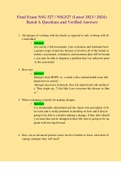
Final Exam NSG 527 / NSG527 (Latest 2023 / 2024): Rated A Questions and Verified Answers 1. Advantages of working with the family as opposed to only working with the individual ~ Answer: you can do a full assessment, your evaluation and treatment have a greater scope of practice because it involves all of the family members; assessment, evaluation, and treatment plan will be broader; you may be able to diagnose a problem that was unknown prior to the assessment 2. Recovery ~ Answer: Emerges from HOPE; ex: a client with a mental health issue like depression or anxiety - through successive treatment, they felt empowered and optimistic. They might say, "I feel like I can overcome this disease or illness." 3. When evaluating a family for making changes ~ Answer: it is situationally determined and the clients own perception of their issue and is really pertinent in deciding on how and if they're going to be able to consider making a change; if they don't identify an issue that can be changed in their life, they're going to be stagnant with moving forward 4. How can an advanced practice nurse involve families to know what kind of coping strategies they will need? ~ Answer: by asking them questions such as "How have you handled or how have you resolved issues in the past?" and "What coping strategies did you have before?" 5. How can the APRN stigmatize the family / individual? ~ Answer: by dictating the treatment plan to them; NOTE: DO NOT DICTATE to them to follow a treatment plan - it puts the client and the family on the defensive. 6. How can the APRN empower the family / individual? ~ Answer: Encourage discussion about possible solutions - it brings the family together. Allow them to have input - make them feel like they are part of the solution. 7. How can the APRN be culturally competent? ~ Answer: By being aware of their own biases and ensure you do not project them on to the client / family. Be less judgmental of other people's behavior. Be sensitive to other people's culture. 8. What is the negative outcome of being culturally incompetent/judgmental? ~ Answer: increased stigmatization; communication will be impaired; assessments will not be accurate 9. Concepts of Recovery ~ Answer: 1) Health dimension recovery - make information based on support for you and your well-being ~ 2) Purpose - you would engage in meaningful activities ~ 3) community dimension of recovery - means that you build relationships and social networks. 10. Home Recovery ~ Answer: a safe and stable place to live, for example - if the patient is d/c'd from a hospital and go to a residential center (such as a SNF or residential drug rehab) 1. Advantages of working with the family as opposed to only working with the individual ~ Answer: you can do a full assessment, your evaluation and treatment have a greater scope of practice because it involves all of the family members; assessment, evaluation, and treatment plan will be broader; you may be able to diagnose a problem that was unknown prior to the assessment 2. Recovery ~ Answer: Emerges from HOPE; ex: a client with a mental health issue like depression or anxiety - through successive treatment, they felt empowered and optimistic. They might say, "I feel like I can overcome this disease or illness." 3. When evaluating a family for making changes ~ Answer: it is situationally determined and the clients own perception of their issue and is really pertinent in deciding on how and if they're going to be able to consider making a change; if they don't identify an issue that can be changed in their life, they're going to be stagnant with moving forward 4. How can an advanced practice nurse involve families to know what kind of coping strategies they will need? ~ Answer: by asking them questions such as "How have you handled or how have you resolved issues in the past?" and "What coping strategies did you have before?" 5. How can the APRN stigmatize the family / individual? ~ Answer: by dictating the treatment plan to them; NOTE: DO NOT DICTATE to them to follow a treatment plan - it puts the client and the family on the defensive. 6. How can the APRN empower the family / individual? ~ Answer: Encourage discussion about possible solutions - it brings the family together. Allow them to have input - make them feel like they are part of the solution. 7. How can the APRN be culturally competent? ~ Answer: By being aware of their own biases and ensure you do not project them on to the client / family. Be less judgmental of other people's behavior. Be sensitive to other people's culture. 8. What is the negative outcome of being culturally incompetent/judgmental? ~ Answer: increased stigmatization; communication will be impaired; assessments will not be accurate 9. Concepts of Recovery ~ Answer: 1) Health dimension recovery - make information based on support for you and your well-being ~ 2) Purpose - you would engage in meaningful activities ~ 3) community dimension of recovery - means that you build relationships and social networks. 10. Home Recovery ~ Answer: a safe and stable place to live, for example - if the patient is d/c'd from a hospital and go to a residential center (such as a SNF or residential drug rehab)
Written for
- Institution
- NSG 527
- Course
- NSG 527
Document information
- Uploaded on
- April 8, 2023
- Number of pages
- 13
- Written in
- 2022/2023
- Type
- Exam (elaborations)
- Contains
- Questions & answers
Subjects
- nsg527
- nsg 527
- nsg 527 midterm exam
- nsg527 midterm exam
- nsg 527 midterm
- nsg527 midterm
- nsg 527 exam
-
nsg527 exam
-
nsg 527 final exam
-
nsg527 final exam
-
nsg 527 final
-
nsg527 final
-
nsg 527 midterm exam
-
nsg

Also available in package deal