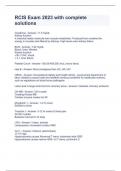
RCIS Exam 2023 with complete solutions
Creatinine - Answer- 1.5 mg/dL Kidney function A chemical waste molecule from muscle metabolism. Produced from creatine the energy in muscles and filtered by kidneys. High levels warn kidney failure BUN - Answer- 7-22 mg/dL Blood, Urea, Nitrates Kidney function 30 = CHF, shock 3 = Liver failure Platelet Count - Answer- 150,00-450,000 /mcL (micro liters) Hep B - Answer- Most contagious than HC, HA, HIV OSHA - Answer- Occupational Safety and Health Admin - government department of labor created to assure safe and healthful working conditions for healthcare workers, such as regulations on blood borne pathogens Lactic acid in large amts found in coronary sinus - Answer- Indicates coronary ischemia CK-MB - Answer- 3-6 hr peak Creating Kinase-MB Cardiac enzyme marker for MI Myoglobin 1 - Answer- 1-4 hr onset Earliest to show Troponin I - Answer- 3-12 hr onset of chest pain 24-48 hr peaks Baseline returned 5-14 days LDH - Answer- 3 days, slowest Leukocytosis -increased number WBC Ca++ - Answer- Calcium (electrolytes) .8-1.0 mg/L Hypercalcemia causes Abnormal T wave, extremely wide QRS Hypocalcemia causes narrow QRS, no T wave, prominent U Mg++ - Answer- Magnesium (electrolytes) 1.5-2.5'mEq/L Heart and nervous system Hypermag causes weakness, low BP, dyspnea, cardiac arrest Hypomag causes loss of appetite, nausea, vomiting, sleepiness, muscle spasms, seizures. Cl- - Answer- Chloride (electrolyte) 95-105 mEq/L Hyperchloremia indicates dehydration, Cushing syndrome, kidney disease, CHF, metabolic alkalosis, respiratory acidosis Metabolic alkalosis - Answer- Happens when tissues are too basic or alkaline Respiratory acidosis - Answer- Happens when lungs can't remove enough CO2 carbon dioxide from body AO valve area - Answer- CO (L/min) / square root (peak - peak gradient mmHg) CO / sq root (LV SYS / AO SYS Peak - Peak gradient = LV sys / AO systole Peak - Peak Gradient - Answer- LV systole - AO systole AO Flow - Answer- CO/(SEP x HR) Na+ - Answer- Sodium 135-145 Helps keep fluids in normal balance, key roll in normal nerves and muscle function Hyponatremia causes confusion, sluggish, could be heart failure, kidney failure, use of diuretics Hypernatremia involves dehydration, thirsty, confused, muscle twitches HGB - Answer- 12-15 g/dL women 14-18 g/dL men Hemoglobin protein in rbc carries oxygen to body Low =anemia High uncommon K+ Potassium - Answer- 3.5-5.5 millimoles per liter mmol/L K+ chemical electrolyte critical for function of nerve and muscle cells, particularly the heart's electrical activity Hypokalemia 3.5 Causes hyperexcitability, SVT, AFib, A flut, A Tach, Trosades T wave flattened or inversed U wave prominent, P wave increased amplitude Causes Trorsades de Pointes Hyperkalemia 5.5 Causes bradycardia, cardiac arrest, asystole, V Fib, PEA Reduces myocardial excitibility Supressed impulse of SA node Reduced conduction of AV node and His-Purkinje Peaked T waves No P wave or flattened and widened Bizzare and prolonged QRS HCT - Answer- 40% (vol%) women 45% (vol%) men Hematocrit = Volume percentage of RBC in blood Used to identify anemia (low) and polycythemia (high) erythrocyes or RBC Erythrocytes - Answer- RBC ACT - Answer- Activated Clotting Time Pre Cath 250-300 sec Norm is 75-100 Platelets and proteins called coagulation factors are activated in steps to cause blood clotting. High doses of heparin prevents clots ACT Sheath removal - Answer- 150-180 seconds ACT performed after heparin administered - Answer- 10 minutes after heparin is administered PT - Prothrombin Time - Answer- 18 sec Measures how long it takes blood to clot Norm 12-15 Nitroglycerin - Answer- Cardiac nitrate blades med vasodilation smooth muscle in arterioles and venous smooth muscle Chief effect is to pool blood in veins which reduces preload, fixation of spastic arteries and arterioles which reduces afterload Inderal, Popranolol - Answer- Beta blocker interfere with beta adrenergic sympathetic system CCB - Answer- Negative inotropic effects and relax vascular smooth muscle Nifedipine, Procardia - Answer- CCB Diltiazem, Cardizem - Answer- CCB Verapamil, Isoptin - Answer- CCB, prevents muscle spasm by relaxing smooth musvle Ibutilide - Answer- Used in Cardio versions of atrial fib easier by blocking potassium channels Digoxin , digitalis - Answer- Slows heart rate and increases contraction Positive Inotropic effect hypes up chemical contractility Cardiotonic and catecholamine dugs - Answer- Induce positive inotropic state slowing HR and increasing force of contraction Furosemide Lasix - Answer- Diuretic drug for severe CHF Promotes urination and venodilation Reduces preload Thiazide - Answer- Diuretic make you diurese or pee Reduces preload Renin-Angiotensin-Aldosterone blockers - Answer- ACE Inhibitor is an Angiotensin Converting Enzyme inhibitor Given post MI to reduce LV dilation and remodeling ACE Inhibs are shown to reduce mortality and morbidity during and post MI Norepinephrine, Dopamine in high dose - Answer- Vasopressors vasoconstrictperipjerslmarterioles Which raise BP "Pressers" Name three stress test drugs - Answer- Vasodilator infusions of: Dobutamine Adenosine (brands Adenoscan, Adenocard) Dipyridamole For pts with pacemaker or orthopedic problems Increase myocardial O2 demand by increasing contractility, HR, and BP. Only use Dobutamine as a last resort due to strength. Fentanyl - Answer- Analgesic drug for pain relief 100x potent than morphine Dosage for Adenosine (Adenoscan, Adenocard) - Answer- (6,12,12 mg) 6 mg rapid IV push If no conversion, give adenosine 12 mg rapid IV push; may repeat 12 mg dose once SVT with aberrancy. Vagal Maneuver - Answer- try this treatment if the patient's QRS is narrow and rhythm is regular. If no change give adenosine 6,12,12 mg Avoid AV nodal blocking agents such as adenosine, digoxin, diltiazem, verapamil. - Answer- If pre-excited atrial fibrillation (Atrial Fibrillation in Wolff-Parkinson-White Syndrome) Patient has significant signs or symptoms of tachycardia AND they are being caused by the arrhythmia. - Answer- The tachycardia is unstable. Immediate cardioversion is indicated. Patient has a pulseless ventricular tachycardia. - Answer- Follow the Pulseless Arrest Algorithm. Deliver unsynchronized high-energy shocks. Patient has polymorphic ventricular tachycardia AND the patient is unstable. - Answer- Treat the rhythm as ventricular fibrillation. Deliver unsynchronized high-energy shocks. What does Coumadin (warfarin) inhibit - Answer- vitamin K Used for long term anticoagulation, like pts w/artificial valves or thromboembolic disease. discovered as rat poison by bleeding rats to death What is Fibrinolytic therapy used for - Answer- Ischemic stroke or brain attack within 3 hrs of symptoms What is Streptokinase (Streptase) - Answer- Clot dissolving IV med tPA (Alteplase) - Answer- thrombolytic Reteplase (Retavase Recombinant) - Answer
Written for
- Institution
- Rcis
- Course
- Rcis
Document information
- Uploaded on
- May 24, 2023
- Number of pages
- 17
- Written in
- 2022/2023
- Type
- Exam (elaborations)
- Contains
- Questions & answers
Subjects
- rcis e
- creatinine
- bun
- platelet count
- hep b
- osha
-
rcis exam 2023 with complete solutions
-
lactic acid in large amts found in coronary sinus

Also available in package deal