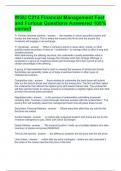
WGU C214 Financial Management Fast and Furious Questions Answered 100% correct
WGU C214 Financial Management Fast and Furious Questions Answered 100% correct T1 Primary financial markets the markets in which securities (stocks and bonds) are first issued. This is where the issuers (the firms) and the buyers (the investors) will engage in an exchange. T1 Syndicate When a company wants to issue stock, bonds, or other publicly traded securities, it hires an underwriter to manage what is often a long and complex process. After determining the offering structure, the underwriter usually assembles what is called a syndicate to get help manage the minutiae (and risk) of large offerings. A syndicate is a group of investment banks and brokerage firms that commit to sell a certain percentage of the offering. A group of intermediaries that is used to oversee the issuance of stocks and bonds. Syndicates are generally made up of large investment banks or other types of institutional investors. Competitive sale those wishing to underwrite the bond issue will submit bids (on the bond's prices and interest rate) to the issuing firm. The firm will then select the underwriter that offered the highest price and lowest interest rate. The underwriter will then sell the bonds to various investors at (hopefully) a slightly higher price than that at which the bonds were purchased Negotiated sale is the process of underwriters submitting proposals including bids. involves a more thorough interview process with the underwriters. The issuing firm will carefully select the management team that will place these bonds. Secondary Financial Markets Where securities after they are sold for the first time are traded. Auction Market A market with a physical location and prices are set by the investors willingness to pay. (New york Stock Exchange) Dealer Market No physical location made up of multiple dealers who take inventory of stocks and prices (NASDAQ) The bid Ask spread the difference between the bid price and the ask price Limit orders orders that are price contingent - orders are only executed if the value of the market reaches the price of the limit. Market Orders Orders that are time contingent - First come first serve Friedmans three roles of prices. 1. Prices convey information to consumers. 2. prices affect incentives 3. prices affect the distribution of income Price Efficiency whether prices fully reflect all of the available information about a particular security Dollar Returns calculated by taking the difference between the price of the security during the previous time period and the price of the security at the current time period, plus any additional cash flow that came from the security Percentage Returns Percentage returns are calculated by simply dividing the dollar returns by the price of the security at time t-1, or the previous time period. Agency Cost costs that are incurred when management does not act in the best interests of shareholders 2 issues that effect profit maximization 1. Agency Costs 2. Potential effect of focusing solely on profits (Ethics) Cash Flow Statement Cash flows from operations, investing and financing activities Cash accounting counts cash out as expense and cash in as revenue Accrual accounting Revenue is recognized when the earnings process is complete. Revenue Recognition Timing of recognition of sales or income based on certain rules. Gross Profit Revenue - Cost of goods sold (COGS) EBIT Earnings before Interest and Taxes (AKA Operating Income) COGS Cost of goods sold = direct labor and materials. Gross Fixed Assets the original cost of the firm's fixed assets before accumulated depreciation Net PP&E original purchase price (historical cost) minus accumulated depreciation Historical Cost What the asset was originally purchased for not the current value. Used in accrual accounting. (most assets are stated at the original cost less depreciation) Retained Earnings money put back into the company from prior net income. Net Income = Dividends + Change in retained Earnings there are only two things a company can do with net income 1) pay it out as dividends to shareholders, or 2) retain it within the firm. New Retained Earnings = Old Retained Earnings + Net Income - Dividends Free cash flow (FCF) the cash that can be distributed after funding required reinvestment in PP&E as well as increased working capital. Gross Cash Flows the sum of CFO, CFI, and CFF Things that cause managers to move cash from one category to another Core activities Cash flow management Market pressure Difference between CFO and Net income ... indirect method start with net income and adjust for differences between net income and CFO. CFO= Net Income + depreciation expenses + Change in Operating accounts CFI = Changes in PPE End Gross PPE - Begining Gross PPE Net PPE Gross PPE- Accumulated Depreciation. Gross PPE Net PPE+ Accumulated Depreciation FCFF the cash distributable to all the providers of capital (i.e., to both debt and equity holders) and is most commonly used in financial analysis FCFE the cash distributable to the equity holders after satisfying all obligations to debt holders Dividends the cash actually distributed to stockholders; CAPEX Capital Expenditures How much the firm spends on fixed assets. Ratio one number from a financial statement and divide it by another so that you can analyze the health of a firm or compare two firms. 4 categories of ratios liquidity asset use efficiency financing profitability Benefits of Ratios Standardization flexibility focus Current Ratio A liquidity tool Current assets/ current liabilities Higher number is better number of assets the firm has for every liability Current liability Debt requiring payment within the next 12 months Current assets Assets that will earn revenue within the next year. Quick Ratio A liquidity tool (Current assets - inventory)/current liabilities High number is better number of assets the firm has minus the inventory for every liability. Inventory is the least liquid of assets. Accounts receivable turnover A liquidity tool Credit sales / Accounts receivable AR turnover and ACP provide the same information Average collection period (ACP) Liquidity tool 365/Accounts receivable turnover AR turnover and ACP provide the same information number of times a year that AR turns over. inventory turnover liquidity tool COGS/INVENTORY Days on hand (DOH) Liquidity tool 365/inventory turnover conclusion will tell how much inventory the firm has on hand in number of days.
Written for
- Institution
- WGU C214
- Course
- WGU C214
Document information
- Uploaded on
- June 11, 2023
- Number of pages
- 16
- Written in
- 2022/2023
- Type
- Exam (elaborations)
- Contains
- Questions & answers
Subjects
-
wgu c214 financial management fast and furious que
-
t1 primary financial markets the markets in which
-
t1 syndicate when a company wants to issue stock
-
competitive sale those wishing to underwrite the b

Also available in package deal