Kettering Study Guide RPSGT Review Section A Questions and Answers
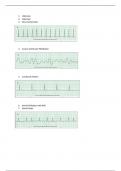
Informed Consent - Answer- May be written, oral, or implied HIPPA - Answer- Health Insurance Portability and Accountability Act Electrode - Answer- an object placed on the skin to conduct electric current from the body to a monitoring or measuring device. Lead - Answer- consists of a positive and negative electrode that allows electrical current to flow. Lead II placement - Answer- One lead placed under the right collarbone, the other placed on the left lowers rib cage 12 lead ECG - Answer- electrodes are placed on the arms and legs and on the chest around the heart. Normal BPM in adults - Answer- 60-90/min while asleep Bradycardia - Answer- less than 60/min Tachycardia - Answer- greater than 90/min Flutter - Answer- greater than 200/min Fibrillation - Answer- too fast to count Normal ECG PR interval - Answer- 0.12-0.20 seconds Normal ECG QRS complex - Answer- 0.04-0.12 seconds Normal ECG QT interval - Answer- 0.36-0.44 seconds Calculating HR - Answer- HR= 300 /# of large block between R waves OR HR= 1500 / # of small blocks between R waves Unifocal PVCs - Answer- originating from the same locations Multifocal PVC's - Answer- coming from different locations Bigeminy - Answer- PVC is every other beat Trigeminy - Answer- PVC every third beat Couplet - Answer- Two PVC's in a row ventricular tachycardia - Answer- Ventricular rhythm with rate greater than 100/min Ventricualr Fibrillation - Answer- completely irregular ventricular rhythm Asystole - Answer- absence of contractions of the heart Ischemia - Answer- indicated by a depressed or inverted T wave Cardiac injury - Answer- indicated by an elevated S-T segment cardio infarction - Answer- diagnosed by significant Q waves Hyperkalemia - Answer- will cause elevated or spiked T waves Atrial flutter - Answer- the rate is faster than 250/min but less than 350/min Atrial fibrillation - Answer- rate is greater than 350/min and may even be too fast to measure. Produces an irregular baseline with no visible P waves. QRS complexes are also irregular. Premature atrial contraction (PAC) - Answer- an atrial ectopic focus fires before the SA nodes fires. The P wave will appear different than all the other P waves. QRS complex will not change in appearance. 1st degree AV block - Answer- PR interval is greater than 0.20 May be caused by ischemia or digitalis Treated with atropine 2nd degree AV block - Answer- Irregular rhythm, normal P waves, QRS complex is missing. Treated with atropine or a pacemaker 3rd degree AV block - Answer- Atrial rate greater than 60/min, ventricular rate less than 40/min PR interval cannot be determined, QRS complex will be widened. Treated with pacemaker Petite Mal seizure - Answer- may not be apparent to the sleep tech Grand Mal seizure - Answer- includes loss of consciousness and violent muscle contractions Postictal state - Answer- altered state of consciousness after an epileptic seizure. Lasts between 5-30 mins. Drowsiness, confusion, nausea, hypertension, headache, migraine. Bronchodilation - Answer- relaxation of the airways bronchoconstriction - Answer- tightening of the airways suprachiasmatic nucleus (SCN) - Answer- located in the hypothalamus and is affected by light. Pacemakers for the circadian rhythm Dopamine - Answer- decreased amounts in the brain will decrease the amount of sleep Acetylcholine - Answer- Mainly activates muscles Noradrenaline - Answer- Increases HR and blood flow to the skeletal muscle congestive heart failure - Answer- Left heart failure cor pulmonale - Answer- right heart failure Thalamus - Answer- communicates with the cerebral cortex. plays a role in awareness and activity Brain consists of - Answer- Brain stem, diencephalons, cerebrum, cerebellum Brain stem consists of - Answer- midbrain, pons, medulla oblongata Diencephalon - Answer- thalamus, hypothalamus, epithalamus, pineal gland Forensic patients - Answer- considered the safest of all patients to work with Asthma medications - Answer- (steroids and beta agonists) have a stimulant effect than can lead to reduced sleep
Written for
- Institution
- RPSGT
- Course
- RPSGT
Document information
- Uploaded on
- June 25, 2023
- Number of pages
- 3
- Written in
- 2022/2023
- Type
- Exam (elaborations)
- Contains
- Questions & answers
Subjects
-
kettering study guide rpsgt review section a quest

Also available in package deal