IBOLC Final exam 2023 with complete solutions
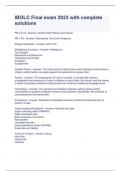
FM 3-21.8 - Answer- Infantry Rifle Platoon and Squad FM 1-02 - Answer- Operational Terms and Graphics Ranger Handbook - Answer- SH 21-76 Warfighting Functions - Answer- Intelligence Fire Support Movement and Maneuver Command and Control Protection Sustainment Combat Power - Answer- The total means of destructive and/or disruptive force which a military unit/formation can apply against the opponent at a given time Tactics - Answer- The employment of units in combat. It includes the ordered arrangement and maneuver of units in relation to each other, the terrain, and the enemy in order to translate potential combat power into victorious battles and engagements. Techniques - Answer- The general and detailed methods used by troops and/or commanders to perform assigned missions and functions, specifically, the methods of using equipment and personnel. Procedures - Answer- Standard and detailed courses of action that describe how to perform a task. Troop Leading Procedures - Answer- Receive the order Issue a warning order (WARNO) Make a tentative plan Start necessary movement Reconnoiter Complete the plan Issue Operations Order (OPORD) Supervise and Refine Forms of Contact - Answer- visual direct fire indirect fire obstacle air CBRN Signal/EW Civil/Nonlethal Four critical functions - Answer- Find Fix Finish Follow Through Purpose of offensive operations - Answer- Seize, retain, and exploit the initiative to defeat the enemy decisively Throw the enemy off balance Overwhelm enemy capabilities Gain information Deceive and divert the enemy Fix the enemy Disrupt enemy attack/coherence Set conditions for future successful operations types of offensive operations - Answer- Movement to contact- Undertaken to gain or regain contact with the enemy Search and attack Approach march Attack- Undertaken to achieve a decisive outcome Exploitation- Undertaken to take advantage of a successful attack Pursuit- Undertaken to destroy an escaping enemy types of defensive operations - Answer- area mobile retrograde types of retrograde defense - Answer- delay - trade space for time withdrawal - trades time for space retirement - movement away when not in contact principles of direct fire control - Answer- Command and Control Mass the effects of fire Destroy the greatest threat first Avoid target overkill Employ the best weapon for the target Minimize friendly exposure Prevent fratricide Plan for limited visibility conditions Develop contingencies for diminished capabilities Surface Danger Zone - Answer- The SDZ is the ground and airspace for vertical and lateral containment of projectiles, fragments, debris, and components resulting from the firing, launching, or detonation of weapons systems (including explosives and demolitions) Minimum Safe Distance - Answer- The minimum distance in meters from desired ground zero at which a specific degree of personnel risk and vulnerability will not be exceeded with a 99% assurance. The minimum safe distance is the sum of the radius of safety and the buffer distance. Also called MSD. In other words, MSD ensures that friendly soldiers are far enough away from the effects of munitions so the risk is negligible. Risk Estimated Distance - Answer- REDs are divided into two categories based on the percent of incapacitation (PI) to friendly soldiers, expressed as .1 PI and 10 PI. The former being one in one-thousand soldiers being unable to fight because of potential weapons effects. The latter (10 PI) means that one in ten soldiers will not be able to fight because of weapons effects. When MSD and REDs are put together, the leader is able to manage his risk from negligible- to 10 PI- based on his distance from impact of friendly supporting indirect fire. Direct Fire - Answer- Gunfire delivered on a target, using the target itself as a point of aim for either the gun or the director. Target Reference Point - Answer- An easily recognizable point on the ground (natural or manmade) used to initiate, distribute, and control fires. Target Reference Points (TRPs) can also designate the center of an area where the commander plans to distribute or converge the fires of all his weapons rapidly. They are used by Task Force and below, and can further delineate sectors of fire within an engagement area. TRPs are designated using the standard target symbol and numbers issued by the fire support officer. Once designated, TRPs also constitute indirect fire targets. Weapons Hold - Answer- Engage only if engaged or ordered to engage Weapons Tight - Answer- Engage only targets positively identified as hostile IAW current ROE Weapons Free - Answer- Engage any targets that are not positively identified as friendly IAW ROE Terrain base fire control measures - Answer- TRPs Sectors of fire PDF Engagement Area fire with respect to tgt - Answer- frontal flanking enfilade oblique Fire patterns - Answer- Crossfire Depth fire Frontal Fire Platoon Movement Formations - Answer- Platoon column Platoon file Platoon line, Squad line Platoon line, Squad column Platoon Vee Platoon wedge Movement techniques - Answer- traveling traveling overwatch bounding ten classes of supply - Answer- Class I- Food, Rations, Water Class II- Clothing Class III- Patroleum, oils, lubricants Class IV- Fortification and barrier materials Class V- Ammunition Class VI- Personal items Class VII- Major end items Class VIII- Medical supplies Class IX- Repair parts Class X- Misc. supplies Commanders intent - Answer- clear concise statement of conditions the force must meet to succeed Course of Action development - Answer- Analyze Relative combat power generate options array initial forces develop schemes of mane
Written for
- Institution
- IBOLC
- Course
- IBOLC
Document information
- Uploaded on
- June 25, 2023
- Number of pages
- 6
- Written in
- 2022/2023
- Type
- Exam (elaborations)
- Contains
- Questions & answers
Subjects
-
ibolc final exam 2023 with complete solutions

Also available in package deal