EPPP Clinical Psychology Study Guide with Complete Solutions
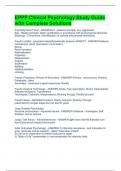
Psychodynamic Freud - ANSWER-Id - pleasure principle, sex, aggression Ego - Reality principle; defers gratification in accordance with environmental demands Superego - Conscience; internalization of societal and parental restrictions Freud's conflict - pressures internally/externally produce ANXIETY - ANSWER-Defense mechanisms result: Repression (most basic) Denial Re'xn formation Rationalization Projection Displacement Fixation Sublimation Splitting Intellectualization Undoing Freud's Processes: Primary & Secondary - ANSWER-Primary - unconscious: Dreams; Parapraxis; Jokes Secondary - conscious:Logical sequences; Reality Freud's Goals & Techniques - ANSWER-Goals: Free association; Dream interpretation; Address resistance; Transference Techniques: Catharsis; Interpretations; Working through; Parallel process Freud's Steps - ANSWER-Confront; Clarify; Interpret; Working Through (assimilation)longest stage and can last for years Jung (Analytic Psychology) Personal unconscious - repressed issues - ANSWER-Collective - Archetypes: Self; Shadow; Anima; Animus Jung's Trait theory - Intro/Extraversion - ANSWER-@40 have mid-life transition turn from Extraversion toward Introversion Adler (Individual Psychology) - ANSWER-1) Inferiority complexes - and motivation to grow, dominate and be superior - called "masculine protest" 2) Can be in conjunction to inferior body part or organ 3) "Style of Life" compensate or overcompensate for inferiority traits Adler explains maladaptive nature - ANSWER-self-destructive and an unproductive life-style ensues: Neurotic; Psychotic; Delinquent Adler's Treatment modality - ANSWER-Family atmosphere; Address distorted beliefs & attitudes; Consider birth order; Dream interpretation; Resistances; Transferences; Role-plays Adler's contribution to education - ANSWER-STEP / STET : Systematic Training for Effective Parenting / Systematic Training for Effective Teaching Neo-Freudians - ANSWER-Horney, Sullivan, & Fromm Horney - emphasis upon early relationships - ANSWER-Anxiety due to parental behaviors; Indifference; Overprotection; Rejection Horney's theory about movement - Toward - Against - Away - ANSWER-Movement to, from, against others, normal, but if only move 1 of the 3, become neurotic Sullivan:Lifespan relationships / cognitive experience theory - ANSWER-1) Prototaxic mode - symbols of no connections - 1st month of life 2) Parataxic mode - symbols of casual connections - neurotic if distorted 3) Syntaxic mode - symbols of shared meaning - end of 1st year, underlies language acquistion Fromm: social dynamics on personality - ANSWER-5 characteristic styles as a response to demands of society Receptive; Exploitive; Hoarding; Marketing; Productive (best) Ego Analysts: Anna Freud; Rappaport; Hartmann - ANSWER-Ego Emphasis Goal - help client build more adaptive defenses Ego defensive functions in resolution of conflict Ego Analysts: Ego autonomous functions - ANSWER-1) Adaptive 2) Non-conflict laden: Learning; Memory; Speech; Perception Object Relations: Klein, Fairbairn, Mahler; Kernberg' Kohut and Winnicott - ANSWER-Object introject - mental representation of a person 1) Self-representation (self) 2) Object-representation (other) By age 3, can do both
Written for
- Institution
- EPPP
- Course
- EPPP
Document information
- Uploaded on
- June 27, 2023
- Number of pages
- 9
- Written in
- 2022/2023
- Type
- Exam (elaborations)
- Contains
- Questions & answers
Subjects
- eppp
- psychodynamic freud
-
eppp clinical psychology study guide
-
freuds conflict pressures internallyexternally
-
freuds processes primary amp secondary

Also available in package deal