NHA CBCS LATEST UPDATED PRACTICE TESTS- STUDY GRADED A+
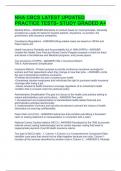
Medical Ethics - ANSWER-Standards of conduct based on moral principles. Generally accepted as a guide for behavior towards patients, physicians, co-workers, the government, and insurance compaines. Compliance Regulations - ANSWER-billing-related cases are based on HIPAA and False Claims Act. Health Insurance Portability and Accountability Act of 1996 (HIPPA) - ANSWER-Created the Health Care Frad and Abuse Control Prpgram enacted nt check for fraud and abuse in the Medicare and Medicaid programs, and private payers. Two provisions of HIPPA - ANSWER-Titile I: Insurance Reform Title II: Administrative Simplification Insurance Reform. -Primary purpose to provide continuous insurance coverage for workers and their dependents when they change or lose their jobs. - ANSWER--Limits the use of preexisting conditions exclusions -Prohibits discrimination for part or present poor health -Guarantees cetraom employees and individuals the right to purchase health insurance coverage after losing a job - Allows renewal of health insurance coverage regardless of an individual's health condition that is covered under the particular policy Administrative Simplification-The goal is to focus on the health care practice setting to reduce administrative cost and burdens. - ANSWER-Two parts: 1. Development and implementation of standardized health-related financial and administrative activities electronically. 2. Implementation of privacy and security procedures to prevent the misuse of health information by ensuring confidentiality. False Claim Act (FCA) - ANSWER-Federal law that prohibits submittimg a fraudulent claim or making statement or representation in connection with a claim. National Correct Coding Initiative (NCCI) - ANSWER-Developed by the CMS to promote national correct coding methodologies and to control improper coding that leads to inappropriate payment of part B health insurance claims. Two type of NCCA edits - 1. Column 1 /Column 2 or Comprehensive Component Edits: identifies code pairs that should not be billed together because one code. Column 1 includes all the services described by another code in Column 2. - ANSWER-2. Mutually Exclusive Edits: identifies code pairs that, for clinical reason, are unlikely to be performed on the same patient on the same day. Office of Inspector General (OIG) - ANSWER-Investigates and prosecute health care fraud and abuse. Fraud - ANSWER-Knowingly and intentionally deceiving or misrepresenting information that may result in unauthorized benefits. Abuse - ANSWER-Defined as incidents or practices, not usually considered fradulaent that are inconsistant with the accepted medical business or fiscal practices in the industry. Patient Confidentiality- All patients have the right to privacy, and all information should remain privileged. - ANSWER-Discuss patient information with only the patient's physician or office personnel that need cetain information to do their job. Obtained a signed consent form to release medical infomation to the insurance company or other individual. Under HIPPA Privacy Rule, providers may use patient's Protected Health Information (PHI) without specific authorization for - ANSWER-Treatment: primarily for the purpose of discussion fo the patient's case with other providers. Payment: providers submit claims on behalf of patients. Operations: for purposes such as stafff training and quality improvment. Employern Liability - ANSWER-Physicians are legally responsible for their own conduct and any action of their employees (their designee) perform within the context of their employment. Refered to as "vacarious liability"also known as "respondent superior" which means "let the master answer". Employee Liabiltiy - ANSWER-"Errors and omissions insurance" is protection against loss of monies by failure through error or unintentional omission on the part of the individual or service submitting the insurance claim. Medical Records - ANSWER-Documentaiton of the patient's social and medical history, family history, physical examination findings, progress notes, radiology, and lab results, consultation reports, and correspondence to patient. Information needed when billing the insurance company - ANSWER-Date of service (DOS), place of service (POS), type of service (TOS), diagnosis (dx or DX), and procedures. Retention of Medical Records - ANSWER-Governed by state and local laws and may bary from state-to-state. Most physicians are required to retain records indefinitley; deceased patient records should be kept for at least (5) years.
Written for
- Institution
- NHA CBCS
- Course
- NHA CBCS
Document information
- Uploaded on
- July 20, 2023
- Number of pages
- 31
- Written in
- 2022/2023
- Type
- Exam (elaborations)
- Contains
- Questions & answers
Subjects
- nha cbcs
-
nha cbcs latest updated practice tests study

Also available in package deal