NCC EFM with correct answers
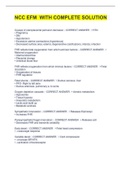
NCC EFM Maternal Hypovolemia - correct answer Tracing change: Tachycardia, minimal variability, late decelerations Maternal vital signs change after more than 30% of blood volume lost (700-800cc) Placental abruption - correct answer EFM most sensitive to detect Tracing: loss of variability, late or prolonged decelerations ultrasound can diagnose abruption 90% of abruption will have uterine activity w/in 1st 4hrs oligohydramnios - correct answer oligo: AFI < 5cm, max vertical pocket < 2cm low normal = 5-10cm leads to fetal malformation, umbilical cord compression, neonatal death Category III - correct answer - absent variability + recurrent late decels - absent variability + recurrent variable decels - absent variability + bradycardia - sinusoidal pattern cord prolapse - correct answer umbilical cord slips into vagina before fetus and becomes compressed and cuts off fetal blood supply. risk: unengaged presenting part, non vertex presentation, premies, multiple birth, breech delivery, long umbilical cord tracing: recurrent decelers followed by prolong deceleration Tx: relieve pressure of cord, trendelenburg, immediate c/s amnioinfusion - correct answer indicated for recurrent variable decelerations - not indicated to dilute meconimum - not indicated if pre-infusion AFI normal - bolus 250-500cc followed by 125-150cc/hr increase risk of cord prolapse if iatrogenic polyhydramnios periodic - correct answer with contractions episodic - correct answer without contractions recurrent variable decelerations - correct answer with equal or more than 50% of contractions - If tx not alleviated by intrauterine resuscitative measures over 30min, immediate c/s - if moderate variability between variables, good oxygenation of baby late decelerations - correct answer visually apparent, usually symmetrical, gradual (>30sec from onset to nadir) after onset and peak of contractions. - uteroplacental insufficiency - immediate delivery if recurrent lates + acceleration absent + variability decreased/absent - Lates + moderate variability can be alleviated by removing inciting factor (fix blood pressure) Tx: stop oxytocin, change position, IV fluids, O2, expectant management vs. delivery choriamnionitis - correct answer infection of intraamniotic fluid from normal vaginal flora - 100.4 fever, maternal tachycardia, uterine tenderness, purulent/foul amniotic fluid - fetal tachycardia >160bpm = increase metabolic rate and consume more oxygen results in hypoxia - Tx: Antibiotics FSE - correct answer Capabilities: - provides continuous monitoring - detects baseline FHR, variability, acceleration - detects fetal dysrhythmia (each point on tracing is an R wave = ventricle depolarize) Indications: - unsatisfactory external tracing - Category II/III Contraindications: - fetal presentation of face, fontanelles, genitalia - maternal infection that are transferrable to fetus (HIV/hepB) - placenta previa - undiagnosed vaginal bleeding Bishop Score - correct answer probability of vaginal birth after induction >8 is favorable, < or equal to 6 unfavorable Value 0-3 for each category 1) cervical dilation (closed = 0, 1-2cm = 1, 3-4cm = 2, 5-6cm = 3) 2) cervical effacement (0-33% = 0, 40-50% = 1, 60-70% = 2, 80% = 3) 3) fetal station (-3 = 0, -2 = 1, -1,0 = 2, +1, +2, +3 = 3) 4) consistency of cervix (firm = 0, Medium = 1, soft = 2) 5) position of cervix (posterior = 0, mild = 1, anterior = 2) Preterm Labor - correct answer regular contractions and cervical dilation of at least 2cm that occur before 37 weeks Biophysical Variable - correct answer Ultrasound of Baby to check status 8-10 = good 6 or less = suspicious 1) fetal breathing 2) fetal movements 3) Fetal tone 4) AFI 5) NST
Written for
- Institution
- Ncc efm
- Course
- Ncc efm
Document information
- Uploaded on
- August 4, 2023
- Number of pages
- 4
- Written in
- 2023/2024
- Type
- Exam (elaborations)
- Contains
- Questions & answers
Subjects
-
ncc efm with correct answers 2023 2024