BIOD 151 A&P 1 Module 5 notes: of the Muscular System: Introduction & Muscles of the Head,
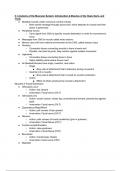
5.1 Anatomy of the Muscular System: Introduction & Muscles of the Head, Neck, and Trunk ● Skeletal muscles under conscious control of body ○ Brain sends message through spinal cord, which attaches to muscle and then action is performed ● Peripheral nerves ○ Carry signal from CNS to specific muscle destination in order for movement to occur ● Messages from CNS to muscle called motor actions ● Nerves carry info from external environment to the CNS, called sensory input ● Tendons ○ Connective tissue connecting muscle to bone at each end ○ Flexible, can bend at joints, help cushion against sudden movement ● Ligaments ○ Connective tissue connecting bone to bone ○ Helps stabilize joints where bones meet ● All Skeletal Muscles have origin, insertion, and action ○ Origin ■ Bony site of attachment that’s stationary during movement ○ Insertion (of a muscle) ■ Bony site of attachment that’s moved by muscle contraction ○ Action ■ Effect of what’s produced by muscle’s attachment Muscles of Facial Expression ● Orbicularis oculi ○ Action: eye closure ○ Innervation: Facial nerve (CN 7) ● Orbicularis oris ○ Action: mouth closure: closes lips, protrudes lips forward, presses lips against teeth ○ Innervation: Facial nerve (CN 7) ● Zygomaticus Major/Minor ○ Action: pull corners of lips upward ○ Innervation: Facial nerve (CN 7) ● Risorius ○ Action: pulls corners of mouth posteriorly (grin or grimace) ○ Innervation: Facial Nerve (CN 7) ● Frontal (occipitofrontalis) ○ Action: raise eyebrows ○ Innervation: Facial Nerve (CN7) ● Buccinator ○ Action: Compresses cheeks ○ Innervation: facial nerve (CN7) ● Masseter ○ Action: jaw closure ○ Innervation: Trigeminal nerve (CN 5. Mandibular branch) ● Temporalis ○ Action: Elevates Mandible, closes Jaw ○ Innervation: trigeminal nerve (CN 5. Mandibular Branch) Muscles of the Head and Neck ● Muscles in Head and neck facilitate actions that move the head and control the neck ● Side bending of neck called lateral flexion ● Neck Flexion refers to action of moving chin towards sternum ● Several muscles have differing actions if acting together on both sides (bilaterally) or acting on one side only (unilaterally) ● Semispinalis Capitis ○ Origin: Articular processes of inferior cervical and transverse process of superior thoracic vertebrae ○ Insertion: Occipital bone ○ Action: ■ Bilateral: Extend head ■ Unilateral: laterally flexes neck to same side ○ Innervation: spinal nerves ● Sternocleidomastoid ○ Origin: sternal end of clavicle and manubrium ○ Insertion: mastoid region of skull ○ Action ■ Bilateral: Neck flexion ■ Unilateral: turns face to opposite side ○ Innervation: Accessory nerve (CN 11) ● Splenius Capitis ○ Origin: spinous process/ligaments of inferior cervical vertebrae ○ Insertion: mastoid process: occipital bone of skull ○ Action ■ Bilateral: extend head ■ Unilateral: laterally flex neck to same side ○ Innervation: cervical spinal nerves ● Longissimus cervicis ○ Origin: transverse processes of superior thoracic vertebrae ○ Insertion: transverse process of middle and superior cervical vertebrae Action: Bilateral extend head Unilateral laterally flexes neck to same side ○ Innervation: cervical and thoracic spinal nerves ● Longissimus thoracis
Written for
- Institution
- BIOD 151
- Course
- BIOD 151
Document information
- Uploaded on
- September 4, 2023
- Number of pages
- 15
- Written in
- 2023/2024
- Type
- OTHER
- Person
- Unknown
Subjects
-
biod 151 ap 1 module 5 notes of the muscular sys

Also available in package deal