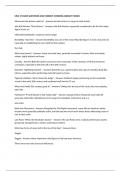
Manual VISE Prep - NR667
1. Hypertension Presentation: Most are not symptomatic, Occipital Headaches, headache on awakening in am, blurry vision, Assessment: • Asymptomatic • Occipital headache • Blurry vision • Headache upon wakening • Look for AV nicking • LVH Exam: • Carotid bruits • Abdominal bruits • Kidney bruits Diagnostic studies: to look for secondary causes of HTN like target organ damage and establish ASCVD risk: EKG, fasting lipid profile, fasting blood glucose, CBC, CMP (electrolyte, creatinine, & calcium levels), and urinalysis (checking for proteinuria). Diagnosis: Measure BP 5 minutes apart. Average of 2 or more BP readings on two different visits at 140/90 mm Hg start then can be diagnosed with HTN. If Stage 1 (ASCVD 10%) then non-pharmacologic management only: • First: Lifestyle modifications: diet and exercise 30 minutes aerobic exercise 5 days per week. • Limit alcohol • stop smoking • stress management. • DASH • Medication compliance • Reduce sodium intake • Measure BP daily If Stage 2 (ASCVD 10% and known CAD) initiate lifestyle + Pharmacologic Management: • Alone: hydrochlorothiazide (HCTZ) 25 mg/day (chlorthalidone is preferred over HCTZ) • Alone: lisinopril 10mg/day complicated HTN first line • Combo: thiazide + ACE or ARB • Alternative CB (especially in isolated HTN seen mainly in older adults) • Black population: thiazide + CCB is recommended first line Follow up: • 2-4weeks Referral: • Cardiology if EKG is abnormal Differential: • Secondary hypertension • Pregnant • Pregnancy induced hypertension Hollier: page 62 2. Hyperlipidemia Etiology: may be familial, dietary, obesity, hypothyroid, renal disorders, thiazide or beta blocker use, alcohol and/or caffeine intake Presentation: few physical findings • Xanthomata (lipid deposits around the eyes) • Corneal Arcus prior to age 50 years (white iris), normal • Angina • Bruits • MI • Stroke Diagnostics: • Fasting/nonfasting lipid profile (total cholesterol, LDL, and HDL minimally affected by eating) • Glucose, • UA and creatinine (for detection of nephrotic syndrome which can induce dyslipidemia), • TSH (for detection of hypothyroidism) Diagnosis: Pt with LDL = 190mg/dL Non-pharmacologic Management: • Lifestyle Modification; diet and exercise. Pharmacologic Management Those who benefit most from statin therapy include: • hx of CVD or stroke, • LDL 190 or greater, • DM with LDL 70-189, • no evidence of ASCVD or DM but have LDL 70-189 PLUS an estimated ASCVD risk of 7% or greater • High risk: o Atorvastatin 40 or 80 mg daily o Rosuvastatin 20 or 40 mg daily • Moderate risk: o Atorvastatin 10 or 20 mg daily o (other statin medications also listed in Hollier) • If statins not tolerated, temporarily stop, decrease dose, and re-challenge with 2-3 statins of differing metabolic pathways and intensities. Follow up: • after initiating therapy, follow-up every 6-8 weeks until goal attained then every 6-12 months to evaluate compliance • evaluate lipids every 5 years starting at age 20 if normal values obtained Refer: Nutritionist Differentials: consider secondary causes • Hypothyroidism • Pregnancy • Diabetes • Non-fasting state Hollier: page 55 3. Diabetes type 2 - Etiology: genetics, high BMI with central obesity, inactivity, drug or chemical induced like glucocorticoids or antiretroviral therapy Risk factors: • BMI /= 25 • Hx of gestational diabetes • First or second degree relative with DM • PCOS, acanthosis nigricans • HDL-C 35 / TG 250 • HTN or HTN treatment meds • CVD Presentation (assessment): insulin resistance in target tissues • Polydipsia, Polyuria, Polyphagia, (showing symptoms) • agitation, • nervousness, • obesity, • fatigue • blurry vision • Exam feet, pulses, nail thickness, odor, swelling, mobility Diagnostics: EKG, CBC and urinalysis (glucosuria, proteinuria, hyperglycemia), CMP, LIPIDS Microalbuminuria, TSH, A1C Diagnosis: • Diabetes Hgb A1C or equal to 6.5% Fasting glucose126mg/dl and confirmed on a different day Fasting between 100-126 = impaired glucose Nonfasting less than 126 = normal values Recurrent yeast infections Non-pharmacologic Management/prevention: • Weight loss (5-10 pound goal) • Monitor Blood glucose at home and diary (daily) • Exercise 150 minutes or more per week (no more than 2 consecutive days without activity); resistance training 2-3 days per week on nonconsecutive days • avoid alcohol • avoid smoking Pharmacologic Management: • First: Initiate metformin 500mg BID if not contraindicated, then, when needed add- • Actos 15 mg daily, then, when needed add- • Levemir 10 units once a day • *Initiate insulin early in course of oral therapy: 0.1-0.2 units/kg/day or 10 units daily of peakless insulin • With older adults, start low and go slow Follow up: • recheck A1C in 90 days • Screening in adults 45 years be done every 3 years and ore often if fasting glucose close to 126 • Screen patients with hx of gestational diabetes at 6-12 weeks gestation with OGTT and Q3years after that for life Referral: • Ophthalmologist at time of diagnosis • Fundoscopic exam • Diabetic educator/ specialist • Podiatry Education: • Carbs 50% • Protein 30% • Fat 20% • Good glycemic control – no low sugars • 10-15 years develop complications Complications (usually present within 10-15 years after onset of DM but may earlier): • Neuropathy • Nephropathy • Glaucoma = blindness • Cataracts • Charcot foot Differentials: • Gestational diabetes • Cushing’s syndrome • Corticosteroid use Hollier: page 216 4. Back pain – Etiology: often unable to pinpoint; may be due to stretching or tearing of nerves (radiculopathy), muscles, tendons, ligaments, or fascia of the back secondary to trauma or just chronic mechanical stress; compression or irritation of the nerve roots are common Presentation: • back pain complaint, buttock or one or more thighs that is aggravated by movement, rising from seated positions, standing, and flexion (may be relieved by rest) • muscle spasm may be present over lumbosacral area • Maybe localized, referred, or radiating (down leg and below knee) • Assess rectal tone in those describing cauda equina • Motor, sensory, and reflex exams should be done o DTRs: patellar tests nerve roots at L2-L4 & Achilles tests nerve roots at S1-S2 o Diminished or absent imply myopathies, decreased muscle mass, and nerve root impairment • New onset of radicular pain on older adults is often sign of spinal stenosis • Straight leg raise test: elevation of affected leg in supine will elicit pain at 20-30 degrees for severe disease, 30-60 degrees for moderate. • Determine OLDCARTS, any pre-existing conditions, past surgeries or trauma which may be contributing. Diagnostics: (see imaging below) • routine imaging is not recommended for patients with acute or non-specific back pain, lack of clinical improvement may warrant imaging with x-ray after 4 weeks (consider systemic illness when there is no relief after a period of time and nothing relives the pain) • X-ray to r/o fracture/disc degeneration (with injury only). • MRI and CT (the study of choice for evaluation of disc disease). • Labs: CBC, CMP, Urinalysis, CRP • Rule out cauda equina – loss of bladder control, saddle anesthesia, incontinence – refer to ED Non-pharmacologic Management: • Restrict activities that aggravate symptoms and avoid heavy lifting. • Gradually resume activities as tolerated, • Core strengthening workouts – abs/rectus muscles • Apply heat for 20-30 min several times a day. • Manage weight. Pharmacologic Management: • NSAIDS are most effective first line pharm management: Naproxen 250-twice a day. • Muscle relaxants have NOT been proven more effective than NSAIDS either alone or concomitantly but helpful for spasm Follow up:
Written for
- Institution
- Manual VISE Prep - NR667
- Course
- Manual VISE Prep - NR667
Document information
- Uploaded on
- September 15, 2023
- Number of pages
- 31
- Written in
- 2023/2024
- Type
- Exam (elaborations)
- Contains
- Questions & answers