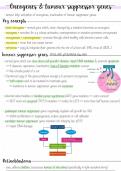
Oncogenes & tumour suppressor genes
- tumour dvlp: activation of oncogenes, inactivation of tumour suppressor genes
Key concepts
- proto-oncogene = normal gene which, when changed by a mutation becomes an oncogene
- oncogene = encodes for a p whose activation, overexpression or mutation promotes oncogenesis
- oncogenesis = carcinogenesis = process through which healthy cells become cancer cells
- oncovirus = virus that can cause cancer
- retrovirus = copy & integrate their genome into the chr of a host cell (HIV, virus of AIDS...)
Tumour suppressor genes TP53, APC, pTEN, BRCA1, Bax, RB-1
- normal gene which can slow down cell growth/ division, repair DNA mistakes & promote apoptosis
=> if absence, repression, inactivation, loss-of-function mutation: cancer
=> like a brake pedal of a car
- 1 functional copy of the gene produces enough p to prevent oncogenesis
=> both copies need to be mutated to inactivate gene
=> mutations in tumour suppressor genes are recessive
- inherited abnormalities in familial cancer syndromes (APC gene mutation => colon cancer)
=> BUT most are acquired (TP53 mutation => codes for p53 => more than half human cancers)
- gatekeeper tumour suppressor gene: negatively regulate cell growth (ex: Rb)
=> inhibit proliferation or angiogenesis, induce apoptosis or cell adhesion
- caretaker tumour suppressor gene: maintain chr integrity (ex: p53)
=> repair DNA damage
Retinoblastoma
- rare, affects children: cancerous tumour of the retina (specifically in light-sensitive lining)
, (or deletion long arm chr 13: 13q deletion)
- during dvlp: retinal cells grow rapidly but stop => when continue: retinoblastoma
- 40%: mutation in RB1 gene (inherited/ acquired in early dvlp) => bilateral (affects both eyes)
60%: no mutation (not understood) => unilateral (affects 1 eye)
- if detected early: 95% treatment success (can be fatal)
- G1 checkpoint before replication (S)
=> transcription factor E2F allow cells to enter S-phase
=> start the building of proteins/ enzymes for replication
=> E2F inactivated by Rb protein (1 is sufficient)
=> replication IF Rb inactivated by phosphorylation
=> if mutation => continuous replication => cancer
(can’t bind E2F) Cyclini
(Dk4/6
- “two-hit” Knudson hypothesis of tumour suppressor genes:
=> both copies need to be mutated to inactivate gene
=> inherited: inherited mutation = 1st hit ; mutation of normal copy = 2nd hit
=> spontaneous: 2 mutations (lower chances and require more time: older & only 1 tumour)
- at cellular level: recessive BUT if inherited mutation => predisposition passed as a dominant trait
(only need 1 mutation in the normal allele)
- RB1 mutated in most cancers:
- Loss of Heterozygosity (LOH)
involved in cancer dvlp: loss of a
wild type allele, loss/ inactivation
of a gene, duplication allele...
P53 tumour suppressor - guardian of the genome
- transcription factor p53: encoded by TP53 on chr 17
=> prevents mutations + stabilises genome
- tumour dvlp: activation of oncogenes, inactivation of tumour suppressor genes
Key concepts
- proto-oncogene = normal gene which, when changed by a mutation becomes an oncogene
- oncogene = encodes for a p whose activation, overexpression or mutation promotes oncogenesis
- oncogenesis = carcinogenesis = process through which healthy cells become cancer cells
- oncovirus = virus that can cause cancer
- retrovirus = copy & integrate their genome into the chr of a host cell (HIV, virus of AIDS...)
Tumour suppressor genes TP53, APC, pTEN, BRCA1, Bax, RB-1
- normal gene which can slow down cell growth/ division, repair DNA mistakes & promote apoptosis
=> if absence, repression, inactivation, loss-of-function mutation: cancer
=> like a brake pedal of a car
- 1 functional copy of the gene produces enough p to prevent oncogenesis
=> both copies need to be mutated to inactivate gene
=> mutations in tumour suppressor genes are recessive
- inherited abnormalities in familial cancer syndromes (APC gene mutation => colon cancer)
=> BUT most are acquired (TP53 mutation => codes for p53 => more than half human cancers)
- gatekeeper tumour suppressor gene: negatively regulate cell growth (ex: Rb)
=> inhibit proliferation or angiogenesis, induce apoptosis or cell adhesion
- caretaker tumour suppressor gene: maintain chr integrity (ex: p53)
=> repair DNA damage
Retinoblastoma
- rare, affects children: cancerous tumour of the retina (specifically in light-sensitive lining)
, (or deletion long arm chr 13: 13q deletion)
- during dvlp: retinal cells grow rapidly but stop => when continue: retinoblastoma
- 40%: mutation in RB1 gene (inherited/ acquired in early dvlp) => bilateral (affects both eyes)
60%: no mutation (not understood) => unilateral (affects 1 eye)
- if detected early: 95% treatment success (can be fatal)
- G1 checkpoint before replication (S)
=> transcription factor E2F allow cells to enter S-phase
=> start the building of proteins/ enzymes for replication
=> E2F inactivated by Rb protein (1 is sufficient)
=> replication IF Rb inactivated by phosphorylation
=> if mutation => continuous replication => cancer
(can’t bind E2F) Cyclini
(Dk4/6
- “two-hit” Knudson hypothesis of tumour suppressor genes:
=> both copies need to be mutated to inactivate gene
=> inherited: inherited mutation = 1st hit ; mutation of normal copy = 2nd hit
=> spontaneous: 2 mutations (lower chances and require more time: older & only 1 tumour)
- at cellular level: recessive BUT if inherited mutation => predisposition passed as a dominant trait
(only need 1 mutation in the normal allele)
- RB1 mutated in most cancers:
- Loss of Heterozygosity (LOH)
involved in cancer dvlp: loss of a
wild type allele, loss/ inactivation
of a gene, duplication allele...
P53 tumour suppressor - guardian of the genome
- transcription factor p53: encoded by TP53 on chr 17
=> prevents mutations + stabilises genome