TCFP Hazmat Operations Practice Test/Answered/Verified 100%
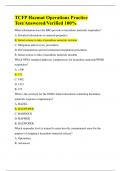
TCFP Hazmat Operations Practice Test/Answered/Verified 100% TCFP Hazmat Operations Practice Test/Answered/Verified 100% What information does the ERG provide to hazardous materials responders? A. Detailed information on material properties B. Initial actions to take a hazardous materials incident C. Mitigation and recovery procedures D. Decontamination and environmental remediation procedures B. Initial actions to take a hazardous materials incident Which NFPA standard addresses competencies for hazardous materials/WMD responders? A. 1500 B. 472 C. 1902 D. 1421 B. 472 What is the acronym for the OSHA federal document containing hazardous materials response competencies? A. HAZEL B. HAZWOPER C. HADDOCK D. HAPPIER B. HAZWOPER Which responder level is trained to enter heavily contaminated areas for the purpose of stopping a hazardous materials release? A. Operations B. Advanced C. Awareness D. Technician D. Technician Which is a detailed profile of a chemical or chemical mixture provided by the manufacturer? A. Local emergency response plan (LERP) B. Emergency Response Guide (ERG) C. The safety data sheet (SDS) D. NFPA 49 (Hazardous Chemicals Data) C. The safety data sheet (SDS) Core competencies of operations level hazardous materials/WMD responders are: A. Offensive B. Indirect C. Passive D. Defensive D. Defensive What federal agency enforces and publicizes laws and regulations governing transportation of goods? A. OSA B. OPA C. DOT D. DOHA C. DOT The measurable characteristic of a chemical are called ___________ properties. A. Molecular B. Empirical C. Reactivity D. Physical D. Physical A(n) __________ change occurs when a chemical undergoes a change at the molecular level, usually with a release of some form of energy. A. Physical B. Electrical C. Morphological D. Chemical D. Chemical What does it mean if a substance's vapor density is 2.3? A. It will float in air B. It has a relatively high boiling point C. It has an extraordinarily high boiling point D. It will sink in air D. It will sink in air Which term refers to the residue of a chemical that has been released and has come into contact with people, the environment, and animals?
Written for
- Institution
- TCFP Hazmat Operations
- Course
- TCFP Hazmat Operations
Document information
- Uploaded on
- September 22, 2023
- Number of pages
- 13
- Written in
- 2023/2024
- Type
- Exam (elaborations)
- Contains
- Questions & answers
Subjects
- what is the
-
tcfp hazmat operations practice testansweredveri
-
tcfp hazmat operations practice test
-
what information does the erg provide to hazardous
-
which nfpa standard addresses competencies for haz

Also available in package deal