EMT Final Exam| 3675 Questions| 1173 Pages| With complete Solutions
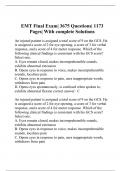
An injured patient is assigned a total score of 9 on the GCS. He is assigned a score of 2 for eye opening, a score of 3 for verbal response, and a score of 4 for motor response. Which of the following clinical findings is consistent with his GCS score? Select one: A. Eyes remain closed, makes incomprehensible sounds, exhibits abnormal extension B. Opens eyes in response to voice, makes incomprehensible sounds, localizes pain C. Opens eyes in response to pain, uses inappropriate words, withdraws from pain D. Opens eyes spontaneously, is confused when spoken to, exhibits abnormal flexion correct answer: C An injured patient is assigned a total score of 9 on the GCS. He is assigned a score of 2 for eye opening, a score of 3 for verbal response, and a score of 4 for motor response. Which of the following clinical findings is consistent with his GCS score? Select one: A. Eyes remain closed, makes incomprehensible sounds, exhibits abnormal extension B. Opens eyes in response to voice, makes incomprehensible sounds, localizes pain C. Opens eyes in response to pain, uses inappropriate words, withdraws from pain D. Opens eyes spontaneously, is confused when spoken to, exhibits abnormal flexion correct answer: C A ventilation/perfusion (V/Q ratio) mismatch occurs when: Select one: A. ventilation is compromised, resulting in the accumulation of carbon dioxide in the bloodstream, alveoli, and the tissues and cells of the body. B. a traumatic injury or medical condition impairs the body's ability to effectively bring oxygen into the lungs and remove carbon dioxide from the body. C. a disruption in blood flow inhibits the exchange of oxygen and carbon dioxide in the lungs, even though the alveoli are filled with fresh oxygen. D. ventilation is inadequate due to a traumatic injury or medical condition, which results in an impairment in pulmonary gas exchange. correct answer: C A ventilation/perfusion (V/Q ratio) mismatch occurs when: Select one: A. ventilation is compromised, resulting in the accumulation of carbon dioxide in the bloodstream, alveoli, and the tissues and cells of the body. B. a traumatic injury or medical condition impairs the body's ability to effectively bring oxygen into the lungs and remove carbon dioxide from the body. C. a disruption in blood flow inhibits the exchange of oxygen and carbon dioxide in the lungs, even though the alveoli are filled with fresh oxygen. D. ventilation is inadequate due to a traumatic injury or medical condition, which results in an impairment in pulmonary gas exchange. correct answer: C What is the correct ratio of compressions to ventilations when performing two-rescuer child CPR? Select one: A. 30:2 B. 5:1 C. 15:2 D. 3:1 correct answer: C What is the correct ratio of compressions to ventilations when performing two-rescuer child CPR? Select one: A. 30:2 B. 5:1 C. 15:2 D. 3:1 correct answer: C You are performing bag-mask ventilations with oxygen connected and set at a flow rate of 15 L/min. What percentage of oxygen are you delivering? Select one: A. 45% B. 55% C. 65% D. Nearly 100% correct answer: D You are performing bag-mask ventilations with oxygen connected and set at a flow rate of 15 L/min. What percentage of oxygen are you delivering? Select one: A. 45% B. 55% C. 65% D. Nearly 100% correct answer: D One of the primary waste products of normal cellular metabolism that must be removed from the body by the lungs is: Select one: A. carbon dioxide. B. pyruvic acid. C. carbon monoxide. D. lactic acid. correct answer: A One of the primary waste products of normal cellular metabolism that must be removed from the body by the lungs is: Select one: A. carbon dioxide. B. pyruvic acid. C. carbon monoxide. D. lactic acid. correct answer: A At rest, the normal adult heart rate should not exceed: Select one: A. 100 beats/min. B. 80 beats/min. C. 90 beats/min. D. 70 beats/min. correct answer: A At rest, the normal adult heart rate should not exceed: Select one: A. 100 beats/min. B. 80 beats/min. C. 90 beats/min. D. 70 beats/min. correct answer: A Upon arriving at the scene of a motor vehicle crash, you find a single patient still seated in his car. There are no scene hazards. As you approach the vehicle, you note that the patient is semiconscious and has a large laceration to his forehead. You should: Select one: A. direct your partner to apply manual in-line support of the patient's head. B. slide a long backboard under his buttocks and lay him sideways on the board. C. apply a vest-style extrication device before attempting to move the patient. D. apply a cervical collar and quickly remove the patient with a clothes drag. correct answer: A Upon arriving at the scene of a motor vehicle crash, you find a single patient still seated in his car. There are no scene hazards. As you approach the vehicle, you note that the patient is semiconscious and has a large laceration to his forehead. You should: Select one: A. direct your partner to apply manual in-line support of the patient's head. B. slide a long backboard under his buttocks and lay him sideways on the board. C. apply a vest-style extrication device before attempting to move the patient. D. apply a cervical collar and quickly remove the patient with a clothes drag. correct answer: A After performing a primary assessment, a rapid exam of the body should be performed to: Select one: A. determine the need for spinal motion restriction precautions. B. find and treat injuries or conditions that do not pose a threat to life. C. look specifically for signs and symptoms of inadequate perfusion. D. identify less-obvious injuries that require immediate treatment. correct answer: D After performing a primary assessment, a rapid exam of the body should be performed to: Select one: A. determine the need for spinal motion restriction precautions. B. find and treat injuries or conditions that do not pose a threat to life. C. look specifically for signs and symptoms of inadequate perfusion. D. identify less-obvious injuries that require immediate treatment. correct answer: D Which is the most appropriate method to use when moving a patient from his or her bed to a wheeled stretcher? Select one: A. Extremity carry B. Log roll C. Direct carry D. Draw sheet method correct answer: D Which is the most appropriate method to use when moving a patient from his or her bed to a wheeled stretcher? Select one: A. Extremity carry B. Log roll C. Direct carry D. Draw sheet method correct answer: D A 75-year-old male with a terminal illness has died at home. As you and your partner enter the residence, a family member becomes verbally abusive, pushes you, and states that you took too long to get there. You should: Select one: A. ignore the family member and assess the patient. B. retreat and notify law enforcement personnel. C. tell the family member that it is not your fault. D. subdue the family member until the police arrive. correct answer: B A 75-year-old male with a terminal illness has died at home. As you and your partner enter the residence, a family member becomes verbally abusive, pushes you, and states that you took too long to get there. You should: Select one: A. ignore the family member and assess the patient. B. retreat and notify law enforcement personnel. C. tell the family member that it is not your fault. D. subdue the family member until the police arrive. correct answer: B An effective team leader should: Select one: A. command his or her team. B. help the team accomplish goals. C. perform all difficult interventions. D. refrain from any direct patient care. correct answer: B
Written for
- Institution
-
Ivy Tech Community College
- Course
-
EMT
Document information
- Uploaded on
- September 28, 2023
- Number of pages
- 1173
- Written in
- 2023/2024
- Type
- Exam (elaborations)
- Contains
- Questions & answers
Subjects
-
emt final exam 3675 questions 1173 pages with c

Also available in package deal