MATERNAL NEWBORN NURSING TEST 1 2023
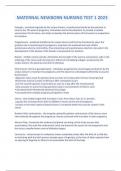
MATERNAL NEWBORN NURSING TEST 1 2023 Estrogen - secreted originally by the corpus luteum, is produced primarily by the placenta as early as the 7th week of pregnancy. Stimulates uterine development to provide a suitable environment for the fetus, also helps to develop the ductal system of the breasts in preparation for lactation Progesterone - produced initially by the corpus luteum and then by the placenta, plays the greatest role in maintaining the pregnancy; maintains the endometrium and inhibits spontaneous uterine contractility, thus preventing early spontaneous abortion; also aids in the development of the lobules of the breasts in preparation for lactation Relaxin - inhibits uterine activity, diminishes the strength of the uterine contractions, aids in the softening of the cervix and has long-term effects of remodeling collagen; produced by the corpus luteum, the placenta and uterine deciduas HCG (human choronic gonadotropin) - stimulates progesterone and estrogen production by the corpus luteum to maintain the pregnancy until the placenta is developed sufficiently to assume that function diagnostic value: basis for pg test (most accurate 10-14 days after the last missed period) blood tests may be as early as 48 hours after conception occurs over the counter pg tests may be done as soon as 1 day after the missed period most accurate on early morning specimens due to concentration of HCG in urine • decreased level=threatened abortion/miscarriage • increased level=multiple pregnancy/hydatiform mole Uterus - pear shaped organ that increases in size: from about 2ozs to 2.5 pounds_ capacity has increased from 10ml to 5000ml or more; by the end of pregnancy increase in the total maternal blood volume is contained within the vascular system of the uterus Braxton-Hicks contractions - the irregular, generally painless contractions of the uterus; occur intermittently throughout the pregnancy; may be confused with true labor in later pregnancy Mucous Plug - formed by the endocervical glands secreting a thick sticky mucous that accumulates; this seals the endocervical canal and prevents the ascent of microorganisms into the uterus; expelled when cervical dilatation begins Cervical os - closed except in multiparas (never completely closes after the birth of a child due to stretching with the birth process (maybe open a fingertip); at the time of labor expands from an opening of fingertip to 10cms to accommodate the birth of the baby Goodell's Sign - softening of cervix at 4-6 weeks Hegar's Sign - Softening of isthmus of uterus at 4-6 weeks Chadwick's sign - Bluish tint to cervix and vagina due to increased vascularization at 4-12 weeks gestation Vagina - estrogen causes a thickening of the vaginal mucosa and an increase in vaginal secretions; o secretions are thick, white, and acidic; the acidic conditions help to prevent bacterial infections but favors the growth of yeast infections TEACH: s/s of infection (odorous discharge, thin watery yellowish-gray discharge, perineal itching; teach to wear cotton underwear and to wipe front to back; also teach Kegal exercises Ovaries - stop producing ova during pregnancy; the corpus luteum continues to produce to hormones until about 6-8 weeks; also continues to secrete progesterone until week 7 when the placenta takes over producing progesterone Recommended Weight Gain - recommended weight gain during pregnancy: 25-35 pounds (for women of normal weight before pregnancy) women who are overweight before pregnancy: the recommended weight gain is:15-25 pounds. women who are underweight: the recommendation is: to gain weight to reach their ideal weight plus 25-35 pounds average weight pattern is: 3.5-5 pounds in the 1st trimester and 12-15 pounds during the each of the last 2 trimesters Weight Gain during pregnancy - Weight gain in pregnancy: 1st trimester---3.5-5 pounds (many women lose weight during the 1st trimester) 2nd trimester—1 pound/week 3rd trimester---1 pound/week for twins the weight gain per week is _1.5 pounds/week in the 2nd and 3rd trimester Inadequate weight gain associated with preterm labor/delivery o The average maternal weight gain distribution: 11 pounds for the fetus, placenta, amniotic fluid 2 pounds for the uterus 4 pounds for the increased blood volume 3 pounds for the breast tissue 5-10 pounds for the maternal stores TOTAL: 25-30 pounds Carbohydrates and Pregnancy - body's primary source of energy as well as fiber; if too low the body resorts to protein for energy consumption which means less available for growth; carbohydrates need to increase during the 2nd and 3rd trimester; the fetus doubles its weight in the last 6-8 weeks of pregnancy
Written for
- Institution
- National Certification Corporation
- Course
- National Certification Corporation
Document information
- Uploaded on
- October 1, 2023
- Number of pages
- 8
- Written in
- 2023/2024
- Type
- Exam (elaborations)
- Contains
- Questions & answers
Subjects
-
maternal newborn nursing test 1 2023

Also available in package deal