Sample Questions from ANCC with 100% correct answers.
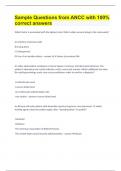
Which factor is associated with the highest risk of falls in older persons living in the community? A) A history of previous falls B) Living alone C) Osteoporosis D) Use of an assistive device A) A history of previous falls An older adult patient complains of recent lapses in memory and decreased alertness. The patient's laboratory test results indicate a mild, macrocytic anemia. Which additional test does the adult-gerontology acute care nurse practitioner order to confirm a diagnosis? A reticulocyte count A serum folate level An erythrocyte sedimentation rate Iron studies A serum folate level An 80-year-old male patient with dementia requires long-term care placement. To which funding agency does the patient apply, after "spending down" to qualify? Medicaid Medicare The American Association of Retired Persons The United States Social Security Administration Medicaid A 70-year-old patient with acute systolic heart failure denies any functional limitations, is able to walk five blocks before tiring, and is euvolemic. Which medication is the first-line therapy for this patient? Amlodipine (Norvasc) Digoxin (Lanoxin) Furosemide (Lasix) Lisinopril (Zestril) Lisinopril (Zestril) A patient has hyperactive reflexes of the lower extremities. The adult-gerontology acute care nurse practitioner assesses for ankle clonus by: C) applying a low-pitched tuning fork firmly to the lateral malleolus. B) sharply dorsiflexing and maintaining the foot in this position, while supporting the knee. striking the Achilles tendon with the percussion hammer C) after flexing the leg at the knee and rotating it externally. D) stroking the lateral aspect of the sole with the sharp end of the percussion hammer from the heel to the ball of the foot. B) sharply dorsiflexing and maintaining the foot in this position, while supporting the knee. A 15-year-old patient with type 1 diabetes mellitus reports elevated blood glucose levels in the morning. An adult-gerontology acute care nurse practitioner determines that the patient's hyperglycemia is due to the dawn phenomenon and: A) increases the insulin dosage at bed time. B) reduces the insulin dosage at bed time. C) tests the blood glucose level at 3:00 AM every morning. D) tests the blood glucose level in the evening. A) increases the insulin dosage at bed time. A patient with profound hypotension is transferred from the medical-surgical unit to the intensive care unit. The patient is started on fluids and norepinephrine (Levophed) IV. The blood cultures that were drawn 48 hours ago from the tunneled catheter, show preliminary results of gram-negative bacilli. The patient's most recent echocardiogram report reveals an ejection fraction of 40%. The adult-gerontology acute care nurse practitioner determines that: A) a pulmonary artery catheter insertion is indicated, to manage septic shock. B) fluid resuscitation will be limited to no more than 4 L C) indwelling vancomycin (Vancocin) should be placed in the ports of the tunneled catheter. D) piperacillin-tazobactam (Zosyn) is indicated for the line-related infection. D) piperacillin-tazobactam (Zosyn) is indicated for the line-related infection. Which research design has the greatest strength in determining if an intervention is effective? Case control Clinical trial Cohort Cross-sectional Clinical trial A 55-year-old man who has no history of diabetes mellitus, heart disease, hypertension, or thrombotic events is diagnosed with paroxysmal atrial fibrillation. Based on national stroke prevention guidelines, the recommended antithrombotic management for this patient is: aspirin (Bayer). aspirin with dipyridamole (Aggrenox). clopidogrel (Plavix). warfarin (Coumadin). aspirin (Bayer) An adult-gerontology acute care nurse practitioner who specializes in cardiology is asked to give a presentation on lipid-lowering drugs. A major drug company that markets a lipid-lowering medication plans to pay the presenter an honorarium, but asks the nurse practitioner to limit his or her remarks to its drug. This situation presents a: breach of contract. conflict of interest. personal choice. reasonable request. conflict of interest 32-year-old patient who underwent an open splenectomy for a ruptured spleen, is preparing for discharge. An adult-gerontology acute care nurse practitioner reviews the potential complications with the patient. The nurse practitioner emphasizes which instruction to the patient? Continue antibiotics for 14 days Follow up with primary care provider for vaccinations No international travel for five years No weight lifting restrictions Follow up with primary care provider for vaccinations A 65-year-old female patient has a confirmed diagnosis of terminal liver disease. The patient's advance directive designates comfort measures, only. An adult-gerontology acute care nurse practitioner's action is to: A) discuss the patient's decision with the patient's family members. B) persuade the patient to participate in a hepatitis clinical trial. C) reconfirm the patient's end-of-life decision. D) refer the patient for a psychological evaluation. C) reconfirm the patient's end-of-life decision. A 68-year-old patient had surgery three days ago, for repair of an abdominal aortic aneurysm. The patient remains intubated, is neurologically intact, and has active bowel sounds. The patient's liver function is within normal limits and the patient has no signs or symptoms of heart failure. The patient's laboratory values are: blood urea nitrogen of 12 mg/dL, creatinine of 0.8 mg/dL, PaCO2 of 37 mm Hg. The preferred form of nutritional support for this patient is: A) enteral feeding to the duodenum via a nasogastric small-bore tube. B) enteral feeding to the stomach via a gastrostomy tube. C) peripheral parenteral nutrition via an 18-gauge IV catheter. D) total parenteral nutrition via a central venous line. A) enteral feeding to the duodenum via a nasogastric small-bore tube. A hospital requires adult-gerontology acute care nurse practitioners to submit credentialing applications for the purpose of: A) authorizing clinical roles and responsibilities. B) delineating therapeutic and diagnostic services. C) monitoring the nurse practitioner's clinical activities. D) verifying education, licensure, and experience. D) verifying education, licensure, and experience. Assessment of which endocrine system response to sepsis-induced hypotension is essential in guiding subsequent therapy? Adrenal Pancreatic Pituitary Thyroid Adrenal A patient with a history of atrial fibrillation, who has maintained normal sinus rhythm with sotalol (Betapace) is hospitalized for acute pyelonephritis. The appropriate antibiotic regimen for this patient is parenteral:A patient with a history of atrial fibrillation, who has maintained normal sinus rhythm with sotalol (Betapace) is hospitalized for acute pyelonephritis. The appropriate antibiotic regimen for this patient is parenteral: cefoxitin (Mefoxin). ceftriaxone (Rocephin). ciprofloxacin (Proquin). levofloxacin (Levaquin). ceftriaxone (Rocephin). Generally healthy patients, who are diagnosed with acute bronchitis, inappropriately ask for which category of drugs? Antibiotics Beta-agonists Corticosteroids Xanthines Antibiotics What legislation allowed nurse practitioners to be recognized Medicare providers in all geographical areas with their own provider number? The Affordable Care Act The Balanced Budget Act The Civilian Health and Medical Program of the Uniformed Services The Omnibus Budget and Reconciliation Act The Balanced Budget Act A 19-year-old male patient arrives at the emergency department exhibiting symptoms of lower abdominal pain that radiates to the groin, and that the patient rates as an 8 on a scale of 1 to 10. That patient states that the pain came on suddenly, while he was playing football with friends. The patient's physical examination reveals positive bowel sounds in all quadrants; a soft, non-tender abdomen; no rebounding and no guarding; and no palpable mass in the abdomen or groin. Examination of the patient's genitalia reveals a unilateral cremasteric reflex. What is the adult-gerontology acute care nurse practitioner's leading differential diagnosis, based on the patient's presentation? Appendicitis Epididymitis Inguinal hernia Testicular torsion Testicular torsion An exception to the practice of maintaining patient confidentiality is when: A) a family member of the patient gives consent. B) a family member of the patient is paying for the tx. C) the patient is unresponsive. D) the patient plans to hurt someone. D) the patient plans to hurt someone.
Written for
- Institution
- University Of The People
- Course
- ANCC
Document information
- Uploaded on
- October 2, 2023
- Number of pages
- 9
- Written in
- 2023/2024
- Type
- Exam (elaborations)
- Contains
- Questions & answers
Subjects
-
sample questions from ancc

Also available in package deal