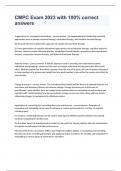
CMPC Exam 2023 with 100% correct answers
3 approaches to conceptual orientations - correct answer -(a) experiential and relationship-oriented approaches such as person-centered therapy, existential therapy, and emotion-focused therapy (b) the goal-directed collaborative approach of solution-focused brief therapy (c) three generations of cognitive behavioral approaches such as behavior therapy, cognitive behavior therapy, rational emotive behavior therapy, mindfulness-based therapy, acceptance and commitment therapy, compassion-focused therapy, and dialectical behavior therapy Systems theory - correct answer -A holistic approach used to examine and understand systems. Individuals and groups are viewed as their own ecosystem with many moving parts that affect each other. With the notion that the whole is greater than the sum of its parts, the aim of systems therapy is to help members of a system gain insight into how each member's role within the system may affect its functionality. Change processes - correct answer -The transtheoretical model and the theory of planned behavior are two classic and dominant theories of behavior change. Change processes are at the heart of practitioners' work, whether they are related to the enhancement or restoration of performance and mental health. Understanding how human behavior change occurs over time, along with key factors influencing change, is fundamental to effective practice. Application of counseling and consulting theory to performance - correct answer -Principles of counseling and consulting can be used to enhance or restore performance in a variety of contexts, including sport. For instance, existential therapy can be used to help injured athletes examine whether they should continue competing for another year. On the other hand, the transtheoretical model can be useful for helping athletes who are unmotivated to improve certain aspects of their performance. Mental performance consultants (MPCs) can integrate multiple aspects of counseling and consulting theories into their consulting philosophy and applied practice in order to be versatile and competent in responding to various types of performance situations. Case Question: Stephanie is a freshman student-athlete playing on her collegiate volleyball team. She recently moved away from home for the first time and has been finding it difficult to adapt to her new city, program of study, and sport team. Additionally, she is experiencing an increased level of anxiety due to her feelings of inadequacy in training and in the classroom, and she is missing her family's immediate support. Stephanie tends to compare herself to others and to be overly critical of herself, particularly in evaluative situations. Her coach notices that she has been more tired, withdrawn, and unfocused than usual and asks to speak with her after practice. Listen to the conversation that Coach Brownwell and Stephanie have in the coach's office. Which approach should Cassandra use in her first session with Stephanie? A. Use behavior therapy to work on Stephanie's elevated anxiety and sleep issue. Teaching Stephanie a relaxation technique will help her achieve her desired behaviors of sleeping throughout the night and effectively managing stress in her school and sport contexts. B. Use person-centered therapy (PCT) to listen to and empathize with Stephanie's story and establish trust and rapport. The main concern in this first session is to understand Stephanie's experience and get a sense of the factors that are contributing to it. C. Use acceptance and commitment therapy (ACT) to get Stephanie to actively and nonjudgmentally embrace her experiences in the here and now. The aim is to get Stephanie to connect with her values and to accept her current situation just as it is, including the unpleasant thoughts and feelings she is having. - correct answer -B. Use person-centered therapy (PCT) to listen to and empathize with Stephanie's story and establish trust and rapport. The main concern in this first session is to understand Stephanie's experience and get a sense of the factors that are contributing to it. Counseling is defined as - correct answer -The skilled and principled use of a professional relationship to empower individuals to achieve mental health, wellness, education, and career goals. It aims to facilitate self-knowledge, emotional acceptance and growth, and the optimal development of personal resources Consulting re
Written for
- Institution
- CMPC
- Course
- CMPC
Document information
- Uploaded on
- October 13, 2023
- Number of pages
- 23
- Written in
- 2023/2024
- Type
- Exam (elaborations)
- Contains
- Questions & answers
Subjects
-
cmpc exam 2023 with 100 correct answers

Also available in package deal