Metabolism (practice questions) With Complete Solutions
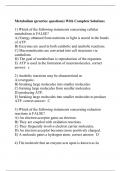
1) Which of the following statements concerning cellular metabolism is FALSE? A) Energy obtained from nutrients or light is stored in the bonds of ATP. B) Enzymes are used in both catabolic and anabolic reactions. C) Macromolecules are converted into cell structures via catabolism. D) The goal of metabolism is reproduction of the organism. E) ATP is used in the formation of macromolecules. correct answer: c 2) Anabolic reactions may be characterized as A) exergonic. B) breaking large molecules into smaller molecules. C) forming large molecules from smaller molecules. D) producing ATP. E) breaking large molecules into smaller molecules to produce ATP. correct answer: C 3) Which of the following statements concerning reduction reactions is FALSE? A) An electron acceptor gains an electron. B) They are coupled with oxidation reactions. C) They frequently involve electron carrier molecules. D) An electron acceptor becomes more positively charged. E) A molecule gains a hydrogen atom. correct answer: D 4) The molecule that an enzyme acts upon is known as its A) substrate. B) coenzyme. C) apoenzyme. D) holoenzyme. E) catalyst. correct answer: a 5) Which of the following statements concerning enzymes is FALSE? A) They are usually, but not always, proteins. B) They function best at 37°C. C) They can be denatured if the pH of their environment is too high or too low. D) They form a temporary intermediate compound with a substrate. E) They can be used to catalyze a chemical reaction over and over again. correct answer: B 6) Sulfanilamide is an antimicrobial drug that mimics the shape of an important substrate for a particular bacterial enzyme, thereby inhibiting the enzyme. This type of inhibition is known as A) allosteric inhibition. B) competitive inhibition. C) excitatory allosteric control. D) noncompetitive inhibition. E) feedback inhibition. correct answer: B 7) Which of the following produces NADPH? A) the pentose phosphate pathway B) the Entner-Doudoroff pathway C) the Embden-Meyerhof pathway D) both the Embden-Meyerhof and Entner-Doudoroff pathways E) both the pentose phosphate and Entner-Doudoroff pathways correct answer: E 8) Which of the following statements concerning glycolysis is TRUE? A) It produces ATP by oxidative phosphorylation. B) It occurs in the cell membranes of bacteria. C) It both requires the input of ATP and produces ATP. D) It is an alternative to fermentation. E) It involves ribulose 5-phosphate as an intermediate correct answer: C 9) Carbon dioxide is a by-product of which of the following? A) the Krebs cycle B) glycolysis C) chemiosmosis D) the pentose phosphate pathway E) electron transport correct answer: A 10) Pyruvic acid is a product of A) the Krebs cycle. B) fermentation. C) glycolysis. D) the Entner-Doudoroff pathway. E) both glycolysis and the Entner-Doudoroff pathway. correct answer: E
Written for
- Institution
- Metabolism
- Course
- Metabolism
Document information
- Uploaded on
- October 17, 2023
- Number of pages
- 15
- Written in
- 2023/2024
- Type
- Exam (elaborations)
- Contains
- Questions & answers
Subjects
-
metabolism practice questions with complete solu

Also available in package deal