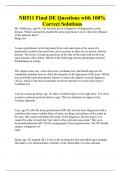
NR511 Final DE Questions with 100% Correct Solutions
Mr. McKinsey, age 69, was recently given a diagnosis of degenerative joint disease. Which assessment should the nurse practitioner use to check for effusion of the patient's knee? Bulge test A nurse practitioner is driving home from work and stops at the scene of a motorcycle accident that must have just occurred, as there are no rescue vehicles present. The driver is lying unconscious at the side of the road with an obvious open fracture of his femur. Which of the following actions should take priority? Establishing an airway. The valgus stress test, varus stress test, Lachman test, and thumb sign are all considered standard tests to check the integrity of the ligaments of the knee. Which test would the nurse practitioner choose to assess the anterior cruciate ligament (ACL), which is the most commonly involved structure in severe knee injury? Lachman test. You are assessing Jamal, age 16, after a football injury to his right knee. You elicit a positive anterior/posterior drawer sign. This test indicates an injury to the: Cruciate ligament. Cass, age 67, tells the nurse practitioner (NP) that she has been diagnosed with a condition that causes sudden flares of pain, swelling, and redness of the joints in her toes. She cannot remember the name of the diagnosis, but she knows it is caused by urate crystals that "get stuck in the joint and cause pain." She is on hydrochlorothiazide (HCTZ) for management of her hypertension. The NP should suspect a diagnosis of: Gout Ethan, age 10, jumped off a 2-foot wall, twisting his foot and ankle upon landing. His ankle x-ray demonstrates a fracture of the distal tibia, over the articular surface, through the epiphysis and physis. Based on the Salter-Harris classification of growth plate injuries, you know this is a: Salter-Harris III fracture. Mrs. Kelly, age 80, has a curvature of the spine. This is likely to indicate which age-related change? Dorsal kyphosis. Upon assessment, the nurse practitioner notes unilateral back pain of acute onset that increases when standing and bending. A straight leg raise test is negative. The most likely diagnosis is: Muscle strain. Joyce, age 87, broke her wrist after falling off a curb. She just had a plaster cast applied to her wrist. In instructing Joyce and her family on allowing the cast to dry properly, tell them to: Change the position of Joyce's arm every hour. Anne, age 67, sustained a fall on an outstretched hand. She presents holding her arm against her chest with her elbow flexed. Based on the specific location of her pain, you suspect a radial head fracture. The best initial strategy to assess for a radial head fracture would be: To palpate for tenderness, swelling, and crepitus just distal to the lateral epicondyle. Lillian, age 70, was told that she has osteoporosis. When she asks you what this is, you respond that osteoporosis: Develops when loss of bone occurs more rapidly than new bone growth. Jeffrey, age 16, was involved in a motor vehicle accident. He walks in to the office with an obvious facial fracture and then collapses. What should the first action of the nurse practitioner be? Assessing for an adequate airway. Marsha, age 34, presents with symptoms resembling both fibromyalgia and chronic fatigue syndrome, which have many similarities. Which of the following is more characteristic of fibromyalgia than of chronic fatigue syndrome? Musculoskeletal pain. The nurse practitioner (NP) is assessing Maya, a 69-year-old Asian woman, for the first time. When trying to differentiate between scoliosis and kyphosis, the NP recalls that kyphosis involves: A posterior rounding at the thoracic level.
Written for
- Institution
- NR511
- Course
- NR511
Document information
- Uploaded on
- October 31, 2023
- Number of pages
- 36
- Written in
- 2023/2024
- Type
- Exam (elaborations)
- Contains
- Questions & answers
Subjects

Also available in package deal