100% satisfaction guarantee Immediately available after payment Both online and in PDF No strings attached 4.6 TrustPilot
logo-home
Exam (elaborations)

TestB ank For HESI DOSAGE CALCULATIONS PRACTICE EXAM

Rating
-
Sold
-
Pages
106
Grade
A+
Uploaded on
02-11-2023
Written in
2023/2024

TestB ank For HESI DOSAGE CALCULATIONS PRACTICE EXAM.A client with cardiogenic shock weighs 220 lb and is receiving dopamine at the rate of 3 mcg/kg/minute. The solution strength available is dopamine 400 mg in 250 ml of D5W. The nurse should set the infusion pump to deliver how many ml/hours? (Enter numeric value only. If rounding is required, round to the nearest tenth.) - √Answer11.3 First, convert pounds to kg, 220 lb : X = 2.2 lb : 1 kg = 100 kg. Next, calculate the dosage per minute, 3 mcg/kg/min x 100 kg = 300 mcg/min. Convert mcg/min to mcg/hour, 300 mcg/min x 60 min=18,000 mcg/hour. Convert mcg/hr to mg/hour, 18,000 mcg/hr = 18.0 mg/hour. Calculate the rate, 400 mg : 250 ml = 18 mg : X ml 400X = 4500 X = 11.25 = 11.3 ml. So, 18 mg/11.3 ml should be infused at 11.3 ml/hour. HESI DOSAGE CALCULATIONS PRACTICE EXAM Quiz: A client with hypertension who weighs 72.4 kg is receiving an infusion of nitroprusside (Nitride) 50 mg in D5W 250 ml at 75 ml/hour. How many mcg/kg/minutes is the client receiving? (Enter numeric value only. If rounding is required, round to the nearest tenth.) - √Answer3.5 Calculate the mg/hour infusing, 50 mg : 250 ml = X : 75 ml 250X = 3750 and X = 15 mg/hour. Next, convert mg/hr to mcg/hour, 15 mg/hour = 1 mg / 1000 mcg = 15,000 mcg/hour, then divide by 60 min = 250 mcg/minute. Lastly, 250 mcg/72.4 kg/min = 3.45 = 3.5 mcg/kg/minute. Quiz: A client who weighs 70 kg is receiving a dopamine solution of 800 mg/500 ml normal saline at 5 ml/hour. How many mcg/kg/minutes is the client receiving? (Enter numeric value only. If rounding is required, round to the nearest tenth.) - √Answer1.9 To change ml/hour to mcg/kg/minute, use the formula: desired rate (5 ml/hour) / volume available (500 ml) x dose available (800 mg) = 8 mg/hour. Next, convert milligrams/hour to mcg/kg/minute: mg (8) x 1000 / kg (70) / 60 minutes = 1.904 = 1.9 mcg/kg/minute. Quiz: A client is receiving an IV solution of sodium chloride 0.9% (Normal Saline) 250 ml with amiodarone (Cardamone) 1 gram at 17 ml/hour. How many mg/minutes of amiodarone is infusing? (Enter numeric value only. If rounding is required, round to the nearest tenth.) - √AnswerConvert grams to mg, 1 gram equals 1,000 mg. Using ratio and proportion - 1,000 mg : 250 ml :: X mg : 1ml 250X= 1,000 so X = 4 mg/ml is the solution concentration of amiodarone. The infusion rate (ml/hour) x concentration (mg/ml) divided by 60 minutes/hour 17 ml/hour x 4 mg/ml = 68/60 = 1.13 = 1.1 mg/minute. Quiz: A client who weighs 176 pounds is receiving an IV infusion with esmolol hydrochloride (Brevibloc) at 48 ml/hour. The IV solution is labelled with the concentration of Brevibloc 10 mg/ml. How many mcg/kg/minutes is the client receiving? (Enter numeric value only.) - √Answer100 Convert pounds to kg by dividing 176 pounds by 2.2 pounds = 80 kg. Convert the IV concentration from mg to mcg. 1 mg : 1000 mcg :: 10 mg : 10,000 mcg. Infusion rate (48 ml/hour) x concentration (10,000 mcg/ml) divided by 60 minutes/hour x 80 kg = 48 x 10,000 divided by 60 x 80 = 480,000 / 4800 = 100 mcg/kg/minute. Quiz: The nurse is preparing the change-of-shift report for a client who has a 265 ml secondary infusion that was started 2 hours ago at a rate of 85 ml/hour via an infusion pump. The nurse should report that how many ml remain to be infused by the on-coming nurse? (Enter numeric value only.) - √Answer95 85 ml x 2 hours = 170 ml has infused. 265 ml (total amount to be infused) - 170 ml (amount infused) = 95 ml remain to be infused. Quiz: A male client receives a prescription for ondansetron hydrochloride (Zofran) 4 mg IV to prevent postoperative nausea after an inguinal hernia repair. The medication is available in 2 mg/ml. How many ml should the nurse administer? (Enter numeric value only.) - √Answer2 Use ratio and proportion, 4 mg : X ml = 2 mg : 1 ml 2X = 4 X = 2 Quiz: The nurse is preparing to administer Hepatitis B Vaccine, Recombinant (Energex-B) 5 mcg IM to a school-aged child. The vaccine is labelled, 10 mcg/ml. How many ml should the nurse administer? (Enter numeric value only. If rounding is required, round to the nearest tenth). - √Answer1 or 0.5 Use ratio and proportion, 5 mcg : X ml :: 10 mcg : 1ml 10X = 5 X = 0.5 ml Quiz: A client's daily PO prescription for aripiprazole (Abilify) is increased from 15 mg to 30 mg. The medication is available in 15 mg tablets, and the client already received one tablet today. How many additional tablets should the nurse administer so the client receives the total newly prescribed dose for the day? (Enter numeric value only.) - √Answer1 30 mg (total dose) - 15 mg (dose already administered) = 15 mg that still needs to be administered. Using the Desired/Have formula: 15 mg/15 mg = 1 tablet Quiz: At the end of the shift, the nurse is recording the fluid balance for a client receiving a continuous gastrostomy tube (GT) feeding. Based on the client's records, how many ml should the nurse record for the total fluid balance (intake - output) for the shift that started at 0700 and ended at 1900? (Enter numeric value only.) (Click on each image asset for additional information.) - √Answer695 The tube feeding is administered at 75 ml/hour for 11 hours () and then turned off for one hour because the residual is greater than 200 ml. 11 hours x 75 ml/hr = 825 ml. Three doses of 20 ml of medication are administered, with 10 ml of water used to flush the GT before and after each dose. 20 ml x 3 doses = 60 ml; 10 ml (flush) x 2 x 3 doses = 60 ml; so, 825 ml + 60 ml + 60 ml = 945 ml. 250 ml of residual is removed and not replaced. 945 ml - 250 ml = 695 ml total fluid balance (Intake - output). Quiz: The nurse is administering a 250 millilitre (ml) intravenous solution to be infused over 2 hours. How many ml/hours should the nurse program the infusion pump? (Enter numeric value only.) - √Answer125 250 ml : 2 hours = X ml : 1 hour 250 = 2X X = 250 divided by 2 = 125 ml/hr Quiz: The nurse is preparing to administer 0.25 mg of bumetanide (Bumex) IV. The medication is available in a vial labelled 1 mg/4 ml. How many ml of medication should the nurse administer? (Enter numeric value only.) - √Answer1 Using the Desired/Have x Volume formula: Desired = 0.25 mg Have = 1 mg Volume = 4 ml 0.25 mg/1 mg x 4 ml = 1 ml Quiz: A client with hypertension receives a prescription for carteolol (Cartel) 7.5 mg PO daily. The drug is available in 2.5 mg tablets. How many tablets should the nurse administer? (Enter numeric value only.) - √Answer3 Using D/H: 7.5 mg / 2.5 mg = 3 tablets Quiz: The healthcare provider prescribes trimethoprim-sulfamethoxazole (Bactrim-DS Oral Suspension) 120 mg BID for a child with bronchitis. The Bactrim bottle is labelled 200 mg/5ml. How many ml should the nurse administer at each dose? (Enter numeric value only.) - √Answer3 Using the formula D/H x Q, 120/200 x 5 = 3 ml Quiz: A 180-pound adult male is admitted to the Emergency Center after receiving thermal burns to 60 percent of his body. Using the Parkland formula of 4 ml/kg/24 hours, the client should receive how many ml of fluid during the first 24 hours? (Enter numeric value only. If rounding is required, round to the nearest whole number.) - √Answer19632 Using the Parkland formula, the client's fluid requirements for the first 24 hours after injury: 4 ml lactated Ringer's solution x Body weight (in kilograms) x Percent burn. Convert 180 pounds to kg = 180 / 2.2 = 81.8 kg 4 ml x 81.8 kg x 60 = 19632 ml over the first 24 hours. Quiz:The healthcare provider prescribes acetazolamide (Diamox) 600 mg/m2/day divided into 3 doses. The nurse calculates the child's body surface area (BSA) as 0.7 m2. How many mg should the child receive per dose? (Enter numeric value only.) - √Answer140 Using the child's BSA, 0.7 m2, calculate the mg/dose, 600 mg x 0.7 m2 = 420 mg/day/3 doses = 140 mg/dose Quiz:A loading dose of acetylcysteine (Mucomyst) 8 grams, which is available as a 20% solution (200 mg acetylcysteine per ml) is prescribed by nasogastric tube for a client with acetaminophen toxicity. How many ml of diluent should be added to the medication to obtain a 1:4 concentration? (Enter numeric value only. If rounding is required, round to the nearest whole number.) - √Answer120 8 grams = 8,000 mg prescribed dose. Using the formula, D/H x Q, 8,000 mg / 200 mg x 1 ml = 40 ml of the 20% solution. Dilute the 40 ml to a 1:4 concentration for administration using ratio and proportion, 1 : 4 solution :: 40 ml : X X= 160 ml total volume to administer. Subtract total volume of 160 ml - 40 ml of 20% concentration = 120 ml diluent is added to obtain a 1:4 concentration. Quiz:A child who weighs 55 pounds receives a prescription for atovaquone with proguanil (Malarone Pediatric) 125 mg/50 mg PO daily. A drug reference states that children 11 to 20 kg should receive 1 pediatric tablet daily; 21 to 30 kg should receive 2 pediatric tablets daily; 31 to 40 kg should receive 3 pediatric tablets daily; and greater than 40 kg should receive 1 adult tablet daily with food. The drug is available as atovaquone 62.5 mg/proguanil 25 mg pediatric tablets. How many tablets should the nurse administer? - √Answer2 Calculate each drug component dose, using the formula, D/H 125 mg / 62.5 mg (atovaquone) = 2 combined with 50 mg / 25 mg (proguanil) = 2. The child should receive 2 tablets. Quiz:A client receives a prescription for azithromycin (Zithromax) 500 mg PO x 3 days. Azithromycin is available as 250 mg scored tablets. How many tablets should the nurse administer per dose? (Enter numeric value only. - √Answer2 Using the formula, D/H 500 mg/250 mg = 2 tablets Quiz:A child who is scheduled for a kidney transplant receives a prescription for basiliximab (Simulect) 20 mg IV 2 hours prior to surgery. The medication is available in a 20 mg vial that is reconstituted by adding 5 ml sterile water for injection, and administered in a 50 ml bag of normal saline over 30 minutes. The nurse should program the infusion pump to deliver how many ml/hour? (Enter numeric value only. - √Answer110 After reconstituting the medication vial, the nurse adds the 5 ml of medication to the 50 ml of sterile water to result in a 55 ml volume to infuse in 30 minutes. Using the formula, Volume/Time = 55 ml / 0.5 hours = 110 ml/hour Quiz:A client with a gastrostomy tube (GT) receives a prescription for Osmolite® 1/2 strength enteral formula at 80 ml/hour. To prepare a 4 hour solution, the nurse should dilute the full-strength formula with how many ml of water? (Enter numeric value only.) - √Answer160 Determine the total volume needed at 80 ml/hour x 4 hours = 320 ml. Use the formula, Desired strength/strength on Hand x Volume = 50/100 x 320 = 160 ml of Osmolite® enteral formula, which must be diluted to half strength. Or use ratio and proportion, Desired strength (1/2 = 1 part : 2 parts) :: Volume of full strength : Total Desire volume 1 : 2 :: X : 320 ml 2X = 320, and X = 160 ml of Osmolite® enteral formula, full strength 320 ml total volume - 160 ml of full-strength formula = 160 ml of water to create 1/2 strength or 50% concentration. Quiz:The nurse notes that a client is receiving an oxytocin (Pitocin) infusion via a pump that is programmed to deliver 30 ml/hour. The available solution is Ringer's Lactated 1,000 ml with Pitocin 20 units. How many milliunits/minute is the client receiving? (Enter numeric value only.) - √Answer10 Convert units to milliunits, 20 x 1,000 = 20,000 units. Using D/H x Q = 30 ml/hour X/20,000 units x 1,000 ml = 30 ml/hour (60 minutes) X/20 =30/60, reduce X/2 = 1/2, and 2X = 20, so X = 10 milliunits/minute OR 20/1,000 = 0.02 1000 : 0.02 :: 30 : X = 0.6 :: 1,000X X = 600 and 600/60 = 10 milliunits/minute. Quiz:A client is receiving Heparin Sodium 25,000 Units in 5% Dextrose Injection 500 ml IV at 1,000 unit/hour per protocol for acute coronary syndrome (ACS). The client's partial thromboplastin time (PTT) is 76 seconds. Based on the ACS protocol, the infusion should be decreased by 100 units/hour for a PTT between 71 to 80 seconds. The nurse should program the pump to deliver how many ml/hour? (Enter numeric value only.) - √Answer18 Adjust the infusion to 900 units/hour (1,000 units/hour minus 100 units/hour per protocol). Using the formula, D/H x Q, 900 units/1 hour divided by 25,000 units x 500 ml = 90/5= 18 ml/hour. Quiz:The healthcare provider prescribes oxytocin (Pitocin) 0.5 milliunits/minute for a client in labor. One liter Ringer's Lactate with 10 units of oxytocin (Pitocin) is infusing. The nurse should program the infusion pump at how many ml/hour? (Enter numeric value only.) - √Answer3 Using the formula, D/H x Q, 0.5 milliunits / 10,000 milliunits x 1000 ml = 0.05 ml/minute. Multiply by 60 minutes = 3 ml/hour. Quiz:Docusate sodium (Colace) 0.3 grams is prescribed for a client who has frequent constipation. Each capsule contains 100 mg. How many capsules should the nurse administer? - √Answer3 Using the known equivalent, 1 gram = 1000 mg, the nurse should first convert the dose to the same unit of measurement, which is 0.3 gram = 300 milligram. Using the formula, Desired / Available x 1 capsule = 300/100 x 1 = 3 capsules. Quiz:A client who has a sinus infection is receiving a prescription for amoxicillin/clavulanate potassium (Augmentin) 500 mg PO q8 hours. The available form is 250 mg amoxicillin/125mg clavulanate tablets. How many tablets should the nurse administer for each dose? (Enter numeric value only.) - √Answer2 Using Desired/Available formula: 500 mg/250 mg x 1 tablet = 2 Quiz:The healthcare provider prescribes acetaminophen elixir (Tylenol elixir) 600 mg PO q6 hours for an adult client experiencing pain associated with maxillofacial surgery. The bottle is labeled 500 mg/15 ml. How many ml should the nurse administer? (Enter numeric value only. If rounding is required, round to the nearest tenth.) - √Answer18 Using the formula D/H x Q: 600 mg/500mg x 15 ml = 18 ml Quiz:A client who has AIDS is receiving octreotide (Sandostatin) 1,200 mcg by subcutaneous injection every day for symptoms of diarrhea. Octreotide is available for injection in 1 mg/ml vials. How many ml should the nurse administer? (Enter numeric value only. If rounding is required, round to the nearest tenth.) - √Answer1 or 1.2 First, to convert micrograms to milligrams, divide the number of micrograms by 1000: 1,200/1000 = 1.2 mg. Using the Desired/Have available formula: 1.2 mg/1 mg x 1 ml = 1.2 ml. Quiz:A client is receiving dantrolene sodium (Dantrium) PO for malignant hyperthermia. The maximum safe dose is 8 mg/kg/day in 4 divided doses. The client currently weighs 48.5 kg. What is the maximum safe dose the nurse should administer? (Enter numeric value only. If rounding is required, round to the nearest whole number.) - √Answer97 Determine the maximum number of mg this client should receive in a day: 48.5 kg x 8 mg/kg/day = 388 mg/day. Next determine how many mg the nurse should deliver each dose: 388 mg/4 doses = 97 mg. Quiz:A child with a urinary tract infection is receiving Cephalexin (Keflex) 100 mg suspension PO QID. Keflex oral suspension is labeled 125 mg in 5 ml. How many ml should the nurse administer? (Enter numeric value only

Show more Read less
Institution
HESI DOSAGE CALCULATIONS
Course
HESI DOSAGE CALCULATIONS

Content preview

HESI DOSAGE
CALCULATIONS
PRACTICE
EXAM


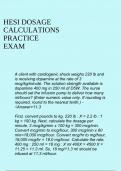
A client with cardiogenic shock weighs 220 lb and
is receiving dopamine at the rate of 3
mcg/kg/minute. The solution strength available is
dopamine 400 mg in 250 ml of D5W. The nurse
should set the infusion pump to deliver how many
ml/hours? (Enter numeric value only. If rounding is
required, round to the nearest tenth.) -
√Answer>11.3

First, convert pounds to kg, 220 lb : X = 2.2 lb : 1
kg = 100 kg. Next, calculate the dosage per
minute, 3 mcg/kg/min x 100 kg = 300 mcg/min.
Convert mcg/min to mcg/hour, 300 mcg/min x 60
min=18,000 mcg/hour. Convert mcg/hr to mg/hour,
18,000 mcg/hr = 18.0 mg/hour. Calculate the rate,
400 mg : 250 ml = 18 mg : X ml 400X = 4500 X =
11.25 = 11.3 ml. So, 18 mg/11.3 ml should be
infused at 11.3 ml/hour.

,>Quiz: A client with hypertension who weighs 72.4
kg is receiving an infusion of nitroprusside (Nitride)
50 mg in D5W 250 ml at 75 ml/hour. How many
mcg/kg/minutes is the client receiving? (Enter
numeric value only. If rounding is required, round
to the nearest tenth.) - √Answer>3.5

Calculate the mg/hour infusing, 50 mg : 250 ml =
X : 75 ml 250X = 3750 and X = 15 mg/hour. Next,
convert mg/hr to mcg/hour, 15 mg/hour = 1 mg /
1000 mcg = 15,000 mcg/hour, then divide by 60
min = 250 mcg/minute. Lastly, 250 mcg/72.4
kg/min = 3.45 = 3.5 mcg/kg/minute.

>Quiz: A client who weighs 70 kg is receiving a
dopamine solution of 800 mg/500 ml normal saline
at 5 ml/hour. How many mcg/kg/minutes is the
client receiving? (Enter numeric value only. If
rounding is required, round to the nearest tenth.) -
√Answer>1.9

To change ml/hour to mcg/kg/minute, use the
formula: desired rate (5 ml/hour) / volume
available (500 ml) x dose available (800 mg) = 8
mg/hour. Next, convert milligrams/hour to
mcg/kg/minute: mg (8) x 1000 / kg (70) / 60
minutes = 1.904 = 1.9 mcg/kg/minute.

,>Quiz: A client is receiving an IV solution of
sodium chloride 0.9% (Normal Saline) 250 ml with
amiodarone (Cardamone) 1 gram at 17 ml/hour.
How many mg/minutes of amiodarone is infusing?
(Enter numeric value only. If rounding is required,
round to the nearest tenth.) - √Answer>Convert
grams to mg, 1 gram equals 1,000 mg. Using ratio
and proportion - 1,000 mg : 250 ml :: X mg : 1ml
250X= 1,000 so X = 4 mg/ml is the solution
concentration of amiodarone. The infusion rate
(ml/hour) x concentration (mg/ml) divided by 60
minutes/hour 17 ml/hour x 4 mg/ml = 68/60 = 1.13
= 1.1 mg/minute.

>Quiz: A client who weighs 176 pounds is
receiving an IV infusion with esmolol hydrochloride
(Brevibloc) at 48 ml/hour. The IV solution is
labelled with the concentration of Brevibloc 10
mg/ml. How many mcg/kg/minutes is the client
receiving? (Enter numeric value only.) -
√Answer>100

Convert pounds to kg by dividing 176 pounds by
2.2 pounds = 80 kg. Convert the IV concentration
from mg to mcg. 1 mg : 1000 mcg :: 10 mg :
10,000 mcg. Infusion rate (48 ml/hour) x
concentration (10,000 mcg/ml) divided by 60
minutes/hour x 80 kg = 48 x 10,000 divided by 60
x 80 = 480, = 100 mcg/kg/minute.

, >Quiz: The nurse is preparing the change-of-shift
report for a client who has a 265 ml secondary
infusion that was started 2 hours ago at a rate of
85 ml/hour via an infusion pump. The nurse should
report that how many ml remain to be infused by
the on-coming nurse? (Enter numeric value only.)
- √Answer>95

85 ml x 2 hours = 170 ml has infused. 265 ml (total
amount to be infused) - 170 ml (amount infused) =
95 ml remain to be infused.

>Quiz: A male client receives a prescription for
ondansetron hydrochloride (Zofran) 4 mg IV to
prevent postoperative nausea after an inguinal
hernia repair. The medication is available in 2
mg/ml. How many ml should the nurse administer?
(Enter numeric value only.) - √Answer>2

Use ratio and proportion, 4 mg : X ml = 2 mg : 1 ml
2X = 4 X = 2

>Quiz: The nurse is preparing to administer
Hepatitis B Vaccine, Recombinant (Energex-B) 5
mcg IM to a school-aged child. The vaccine is
labelled, 10 mcg/ml. How many ml should the
nurse administer? (Enter numeric value only. If
rounding is required, round to the nearest tenth). -
√Answer>1 or 0.5

Written for

Institution
HESI DOSAGE CALCULATIONS
Course
HESI DOSAGE CALCULATIONS

Document information

Uploaded on
November 2, 2023
Number of pages
106
Written in
2023/2024
Type
Exam (elaborations)
Contains
Questions & answers

Get to know the seller

Seller avatar
Reputation scores are based on the amount of documents a seller has sold for a fee and the reviews they have received for those documents. There are three levels: Bronze, Silver and Gold. The better the reputation, the more your can rely on the quality of the sellers work.
NURSE0050 Manchester Metropolitan University
View profile
Follow You need to be logged in order to follow users or courses
Sold
86
Member since
3 year
Number of followers
51
Documents
876
Last sold
2 weeks ago
I offer the best study resources(EXAMS,STUDY GUIDES and TEST BANKS)

Get quality Test banks and Exam accurate and verified solutions here.Leave feedback after purchase.Please give a REVIEW after purchase.

3.9

15 reviews

5
7
4
4
3
1
2
2
1
1

Trending documents

Recently viewed by you

Why students choose Stuvia

Created by fellow students, verified by reviews

Quality you can trust: written by students who passed their tests and reviewed by others who've used these notes.

Didn't get what you expected? Choose another document

No worries! You can instantly pick a different document that better fits what you're looking for.

Pay as you like, start learning right away

No subscription, no commitments. Pay the way you're used to via credit card and download your PDF document instantly.

Student with book image

“Bought, downloaded, and aced it. It really can be that simple.”

Alisha Student

Frequently asked questions