NR 546 Week 7 ADHD Medication Table Latest.
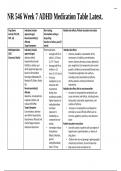
NR 546 Week 7 ADHD Medication Table Latest. Drug Name (include if IR, XR, ODT, LA) Indication (include approved ages) Neurotransmitter(s) Affected Target Symptoms Short-acting, intermediate-acting or long-acting. Duration of action, peak (if noted) Notable side effects /Patient education instructions Methylphenidate (D/L) (Concerta, Ritalin) Indication (include approved ages) Attention deficit hyperactivity disorder (ADHD) in children and adults (approved ages vary based on formulation) Narcolepsy (Metadate ER, Methylin ER, Ritalin, Ritalin SR) Neurotransmitter(s) Affected dopamine, norepinephrine reuptake inhibitor and releaser (DN-RIRe) Target Symptoms Concentration, attention span Motor hyperactivity Impulsiveness Physical and mental fatigue Daytime sleepiness Depression Pharmacokinetics • Average half-life in adults is 3.5 hours (1.3–7.7 hours) • Average half-life in children is 2.5 hours (1.5–5 hours) • First-pass metabolism is not extensive with transdermal dosing, thus resulting in notably higher exposure to methylphenidate and lower exposure to metabolites as compared to oral dosing • Immediate-release formulations (Ritalin, Methylin, generic methylphenidate) have 2–4 hour Notable side effects • Insomnia, headache, exacerbation of tics, nervousness, irritability, overstimulation, tremor, dizziness Anorexia, nausea, abdominal pain, weight loss Can temporarily slow normal growth in children (controversial) Blurred vision Transdermal: application site reactions, including contact sensitization (erythema, edema, papules, vesicles) and chemical leukoderma Nobable side effects link to neurotransmitter • Increases in norepinephrine peripherally can cause autonomic side effects, including tremor, tachycardia, tachycardia, hypertension, and cardiac arrhythmias • Increases in norepinephrine and dopamine centrally can cause CNS side effects such as insomnia, agitation, psychosis, and substance abuse Patient education instructions • Use with caution in patients with any degree of hypertension, hyperthyroidism, or history of drug abuse • Children who are not growing or gaining weight should stop treatment, at least temporarily • May worsen motor and phonic tics NR 546 Week 7 ADHD Medication Table Latest. ADHD Table durations of clinical action • Sustained-release formulations such as Methylin ER, Ritalin SR, Metadate ER, and generic methylphenidate sustained-release all have approximately 4–6 hour durations of clinical action • Sustained-release Metadate CD has an early peak and an 8-hour duration of action • Sustained-release Ritalin LA also has an early peak and an 8-hour duration of action, with 2 pulses (immediate and after 4 hours) • Sustained-release Concerta trilayer tablet, orally disintegrating tablet Cotempla XRODT, Quillivant XR, and Aptensio XR have 12-hour • May worsen symptoms of thought disorder and behavioral disturbance in psychotic patients • Stimulants have a high potential for abuse and must be used with caution in anyone with a current or past history of substance abuse or alcoholism or in emotionally unstable patients ADHD Table durations of action Orally disintegrating tablet CotemplaXR-ODT has a 12- hour duration of action Dexmethylphenidate (Focalin) (D) Indication (include approved ages) Attention deficit hyperactivity disorder (ADHD) in children ages 6– 17 (Focalin, Focalin XR) and in adults (Focalin XR) Neurotransmitter(s) Affected dopamine, norepinephrine reuptake inhibitor and releaser (DN-RIRe) Target Symptoms Concentration, attention span Motor hyperactivity Impulsiveness Physical and mental fatigue Daytime sleepiness Depressio Pharmacokinetics • d-threoenantiomer of racemic d,lmethylphenidat • Mean plasma elimination half-life approximately 2.2 hours (same as d,lmethylphenidate • Does not inhibit CYP450 enzymes • Immediate-release d-methylphenidate has the same onset of action and duration of action as immediaterelease racemic d,lmethylphenidate (i.e., 2–4 hours) but at half the dose Notable side effects • Insomnia, headache, exacerbation of tics, nervousness, irritability, overstimulation, tremor, dizziness Anorexia, nausea, abdominal pain, weight loss Can temporarily slow normal growth in children (controversial) Blurred vision Nobable side effects link to neurotransmitter • Increases in norepinephrine peripherally can cause autonomic side effects, including tremor, tachycardia, tachycardia, hypertension, and cardiac arrhythmias • Increases in norepinephrine and dopamine centrally can cause CNS side effects such as insomnia, agitation, psychosis, and substance abuse Patient education instructions • Use with caution in patients with any degree of hypertension, hyperthyroidism, or history of drug abuse • Children who are not growing or gaining weight should stop treatment, at least temporarily • May worsen motor and phonic tics • May worsen symptoms of thought disorder and behavioral disturbance in psychotic patients • Stimulants have a high potential for abuse and must be used with caution in anyone with a current or past history of substance abuse or alcoholism or in emotionally unstable patients.
Written for
- Institution
- NR 546 ADHD Medication Table
- Course
- NR 546 ADHD Medication Table
Document information
- Uploaded on
- November 4, 2023
- Number of pages
- 12
- Written in
- 2023/2024
- Type
- OTHER
- Person
- Unknown
Subjects
- nr 546 week 7 latest
-
nr 546 week 7 adhd medication table latest
-
nr 546 week 7 adhd medication table
-
nr 546 adhd medication table latest
-
nr 546 adhd medication table

Also available in package deal