Principles of Microeconomics Lecture 15 – Cost Minimization
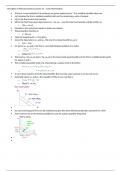
A firm is a cost-minimizer if it produces any given output level y ³ 0 at smallest possible total cost.
c(y) denotes the firm’s smallest possible total cost for producing y units of output.
c(y) is the firm’s total cost function.
When the firm faces given input prices w = (w 1,w2,…,wn) the total cost function will be written as
o c(w1,…,wn,y).
Consider a firm using two inputs to make one output.
The production function is
o y = f(x1,x2).
Take the output level y ≥ 0 as given.
Given the input prices w1 and w2, the cost of an input bundle (x1,x2) is
o w1x1 + w2x2.
For given w1, w2 and y, the firm’s cost-minimization problem is to solve
o
o Subject to
The levels x1*(w1,w2,y) and x2*(w1,w2,y) in the least-costly input bundle are the firm’s conditional demands
for inputs 1 and 2.
The (smallest possible) total cost of producing y output units is therefore
o
A curve that contains all of the input bundles that cost the same amount is an iso-cost curve.
Generally, given w1 and w2, the equation of the $c iso-cost line is
o
o Slope is - w1/w2.
Iso-cost and isoquant lines can be combined to give the most efficient production outcome for a firm
Firms want to be on the lowest possible iso-cost for a given quantity (isoquant)
A firm is a cost-minimizer if it produces any given output level y ³ 0 at smallest possible total cost.
c(y) denotes the firm’s smallest possible total cost for producing y units of output.
c(y) is the firm’s total cost function.
When the firm faces given input prices w = (w 1,w2,…,wn) the total cost function will be written as
o c(w1,…,wn,y).
Consider a firm using two inputs to make one output.
The production function is
o y = f(x1,x2).
Take the output level y ≥ 0 as given.
Given the input prices w1 and w2, the cost of an input bundle (x1,x2) is
o w1x1 + w2x2.
For given w1, w2 and y, the firm’s cost-minimization problem is to solve
o
o Subject to
The levels x1*(w1,w2,y) and x2*(w1,w2,y) in the least-costly input bundle are the firm’s conditional demands
for inputs 1 and 2.
The (smallest possible) total cost of producing y output units is therefore
o
A curve that contains all of the input bundles that cost the same amount is an iso-cost curve.
Generally, given w1 and w2, the equation of the $c iso-cost line is
o
o Slope is - w1/w2.
Iso-cost and isoquant lines can be combined to give the most efficient production outcome for a firm
Firms want to be on the lowest possible iso-cost for a given quantity (isoquant)