Hardware Foundations (ISDS) Questions and Answers Fully solved
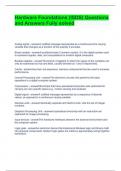
Hardware Foundations (ISDS) Questions and Answers Fully solved Analog signal A codified message represented as a continuous time varying variable that changes as a function of the quantity it encodes. Binary system A positional base 2 numeric system. It is the digital system used to represent signals, data, and computations in modern digital computers. Brainpower Read More Previous Play Next Rewind 10 seconds Move forward 10 seconds Unmute 0:06 / 0:15 Full screen Boolean algebra The branch of algebra in which the values of the variables can only be expressed as true and false, usually denoted as 1 and 0 respectively. Cache Very fast, but expensive, memory components that are used to increase performance. Central Processing Unit The electronic circuitry that performs the basic operations in a digital computer system. Coprocessor Microchips that have specialized instruction sets optimized for carrying out very specific tasks (e.g., motion sensing and analysis) Digital signal A codified message represented as a sequence of discrete values, as opposed to a continuous varying variable. Discrete units Individually separate and distinct units. Like the set of integer numbers. Graphics Processing Unit A specialized microchip with an instruction set optimized for image processing. Input devices The hardware interfaces between the external environment and the computer system. Logic gate An electronic device that implements Boolean logic and binary math into physical components. Modern logic gates are made by appropirately wiring together transistors. Magnetic memory Long term memory devices that record data by using a read/write head to magnetize the surface of the device (e.g., hard disks and storage tapes). Microprocessor An integrated circuit that contains all the functions of the central processing unit of a computer. Moore's Law The number of transistors etched on an integrated circuit (i.e., a microchip) doubles every one to two years Optical memory Long term memory devices that record data by burning the surface of reflective material and using laser to read it (e.g., CD ROMs and DVDs). Output devices The hardware interfaces between the compouter system and the external environment. Primary storage Also known as "main memory" or "internal memory". It is the short-term data storage element of a digital computer that is directly accessible by the CPU. Random Access Memory (RAM The most important primary storage component of a computer system. It is used to store all the data that has yet to be saved to long-term memory. Registers Very fast primary storage locations. Secondary storage The long-term memory element of a computer system, also known as "long term memory." Solid state Storage devices that differ from other technologies because they have no mechanical moving parts (e.g., USB thumb drives). Transistors Electrical current regulators made of three layers of semiconductor material. They can switch electronic signals and electrical power, thereby being able to take both an "on" and "off" position.
Written for
- Institution
- ISDS
- Course
- ISDS
Document information
- Uploaded on
- January 18, 2024
- Number of pages
- 2
- Written in
- 2023/2024
- Type
- Exam (elaborations)
- Contains
- Questions & answers
Subjects
-
hardware foundations isds questions and answers
-
analog signal a codified message represented as a
-
digital signal a codified message represented as a
-
magnetic memory long term memory devices that reco

Also available in package deal