WEB WOC Continence Care Exam 2024
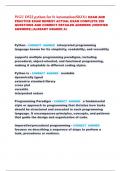
WEB WOC Continence Care Exam 2024 encopresis - Answer ️️ -a disorder characterized by repeated stool evacuation in inappropriate places in children over the age of four primary: children who never reached continence secondary: children who reached continence for at least a year and are now relapsed sympathetic nervous system role - Answer ️️ -*involuntary* When the rectum is empty, the SNS inhibits the contraction of the rectal wall, and contracts the internal anal sphincter (IAS) to prevent leakage parasympathetic nervous system role - Answer ️️ -when the rectum is filled post mass transit, it stretches and the PNS sends information to the CNS to coordinate bowel elimination. The rectum then contracts in conjunction with the ENS and the IAS relaxes. Feces then moves down the anal canal to the external anal sphincter (EAS) enteric nervous system - Answer ️️ -The intrinsic nervous system within the bowel wall. This system responds to a variety of stimuli and generates peristalsis rectoanal inhibitory reflex - Answer ️️ -the involuntary relaxation of the IAS when the rectum is stretched that allows feces to move down anal canal sampling reflex - Answer ️️ -when rectal contents contact Anoderm (receptors at distal anal canal) for differentiation allows squamous epithelium below the Denate Line with sensory receptors that differentiate between solid, liquid, gaseous rectal contents anal wink - Answer ️️ -with cotton swab, swipe at 5 and 7 o'clock on the buttocks with the patient in the modified lithotomy position a focused physical exam that assesses prostate and pelvic muscle control and verifies function of pudendal nerve bulbocavernosus reflex - Answer ️️ -in modified lithotomy position, squeeze penis glans to verify external anal sphincter wink or flick the clitoris in females a focused physical exam that assesses prostate and pelvic muscle control and verifies function of pudendal nerve 5 factors that promote continence - Answer ️️ -1: colonic transit, stool volume, and consistency 2: sensory awareness 3: sphincter competence 4: rectal compliance and c
Written for
- Institution
- ATI Ostomy Care
- Course
- ATI Ostomy Care
Document information
- Uploaded on
- January 24, 2024
- Number of pages
- 22
- Written in
- 2023/2024
- Type
- Exam (elaborations)
- Contains
- Questions & answers
Subjects
-
web woc continence care exam 2024