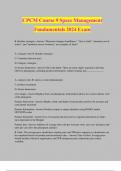
CPCM Course 9 Space Management Fundamentals 2024 Exam
CPCM Course 9 Space Management Fundamentals 2024 Exam B. Retailer strategies -Answer-"Maximize shopper friendliness", "first to shelf', "minimize out of stocks", and "minimize excess inventory" are examples of what? A. Category roles B. Retailer strategies C. Consumer decision trees D. Category strategies D. fixture dimensions -Answer-Fill in the blank. There are many inputs required to develop effective planograms, including product information, retailer strategy and _____________. A. category roles B. tactics or sales fundamentals C. product assortment D. fixture dimensions Live images -Answer-Replace boxes in planograms with product photos for a more realistic view of the planogram Product dimensions -Answer-Height, width, and depth of each product needs to be accurate and consistently measured Product Information -Answer-Products require a unique identifier using ID/SKU and/or UPC/GTIN codes Product hierarchies -Answer-Use of consumer decision trees to segment data based on what's most important to the Shopper Product data -Answer-Addition of average units sold per week per store. case cost. unit price and units per case drive the planogram analytics B. False. The average price should have regular price and TPR price separate so calculations can be completed based on baseline and incremental sales. -Answer-True or false? Average price should include a blend of regular price and TPR (temporary price reduction) price where available. A. True. This will allow for a proper blended margin across items for proper promotional analysis. B. False. The average price should have regular price and TPR price separate so calculations can be completed based on baseline and incremental sales. B. False. "All-in" cost is not always available for retailers. The important thing is to ensure that the cost included is consistent across all items in the category. -Answer-True or False? Unit cost always needs to be an "all in" cost including promotional trade spend. A. True. An "all-in" cost is required in order for the planogram analytics to be correct. B. False. "All-in" cost is not always available for retailers. The important thing is to ensure that the cost included is consistent across all items in the category. 34.7 (WORK= (1) annual movement: 8*(365/7)=417.1429 (2) Turnover: 417.14/12=34.7617) - Answer-What is the inventory turns for an item with the following results: -Weekly movement = 8 units -Shelf capacity = 12 units -Profit= $1.23 per unit Enter your answer to one decimal place. A. If you placed 12 units on the shelf each time you filled the shelf, you would need to do it about 35 times each year. -Answer-What's the interpretation if a product has: -Weekly movement = 8 units -Shelf capacity = 12 units -Inventory turns = 35 A. If you placed 12 units on the shelf each time you filled the shelf, you would need to do it about 35 times each year. B. If you placed 35 units on the shelf each time you filled the shelf, you would need to do it about 8 times each year. C. If you placed 8 units on the shelf each time you filled the shelf, you would need to do it about 12 times each year. D. If you placed 8 units on the shelf each time you filled the shelf, you would need to do it about 35 times each year. Shelf Capacity (Formula) -Answer-= Capacity per Facing * # of Facings Lost Sales (Formula) -Answer-= Potential Sales (Unit Movement * Average Price) - Sales Allocated (Shelf capacity * Average Price) Inventory Turnover (Formula) -Answer-= Annual Movement/ Shelf Capacity Share of Shelf (Formula) -Answer-= Product Grouping Linear Feet / Total Category # of Linear Feet * 100 32 (WORK= 8*4=32) -Answer-What is the shelf capacity of an item with 4 facings and a capacity per facing of 8 that sells 10 units per day? Type in the nearest whole number (no decimals). D. The product has 6 facings and a cap on top. -Answer-Refer to the diagram and the product with an orange box around it. Which of the following statements is MOST CORRECT about this product? A. The product has 6 facings and 12 fronts. B. The product has 12 facings. C. The product has a shelf capacity of 12. D. The product has 6 facings and a cap on top. 14.4 (WORK = 520 units per year / (6 facings x 6 units per facing) = 14.4.) -Answer-Product A has 6 facings and holds 6 units per facing. Its weekly movement is 10 units per week (520 units per year). What are the inventory turns for Product A? Type in your answer as a number with one decimal place (example "10.2"). B. Shelf capacity -Answer
Written for
- Institution
- CPCM
- Course
- CPCM
Document information
- Uploaded on
- February 2, 2024
- Number of pages
- 6
- Written in
- 2023/2024
- Type
- Exam (elaborations)
- Contains
- Questions & answers
Subjects
-
cpcm course 9 space management fundamentals 2024 e

Also available in package deal